Research Peptides FAQ
Research Peptides FAQ
RESEARCH USE ONLY
This guide is for laboratory, analytical and procurement context. It does not provide human or veterinary administration, dosing, injection, treatment, diagnosis, supplementation or personal-use guidance.
Research peptides FAQ: direct answers
This FAQ gives short
answers to the questions most relevant to Core Research’s
research-supply network. It is a routing hub: detailed analytical,
compliance, procurement and handling guidance stays on the canonical
page for that topic. All Core Research products are supplied for
laboratory research only and not for human or veterinary treatment,
dosing, injection or administration.
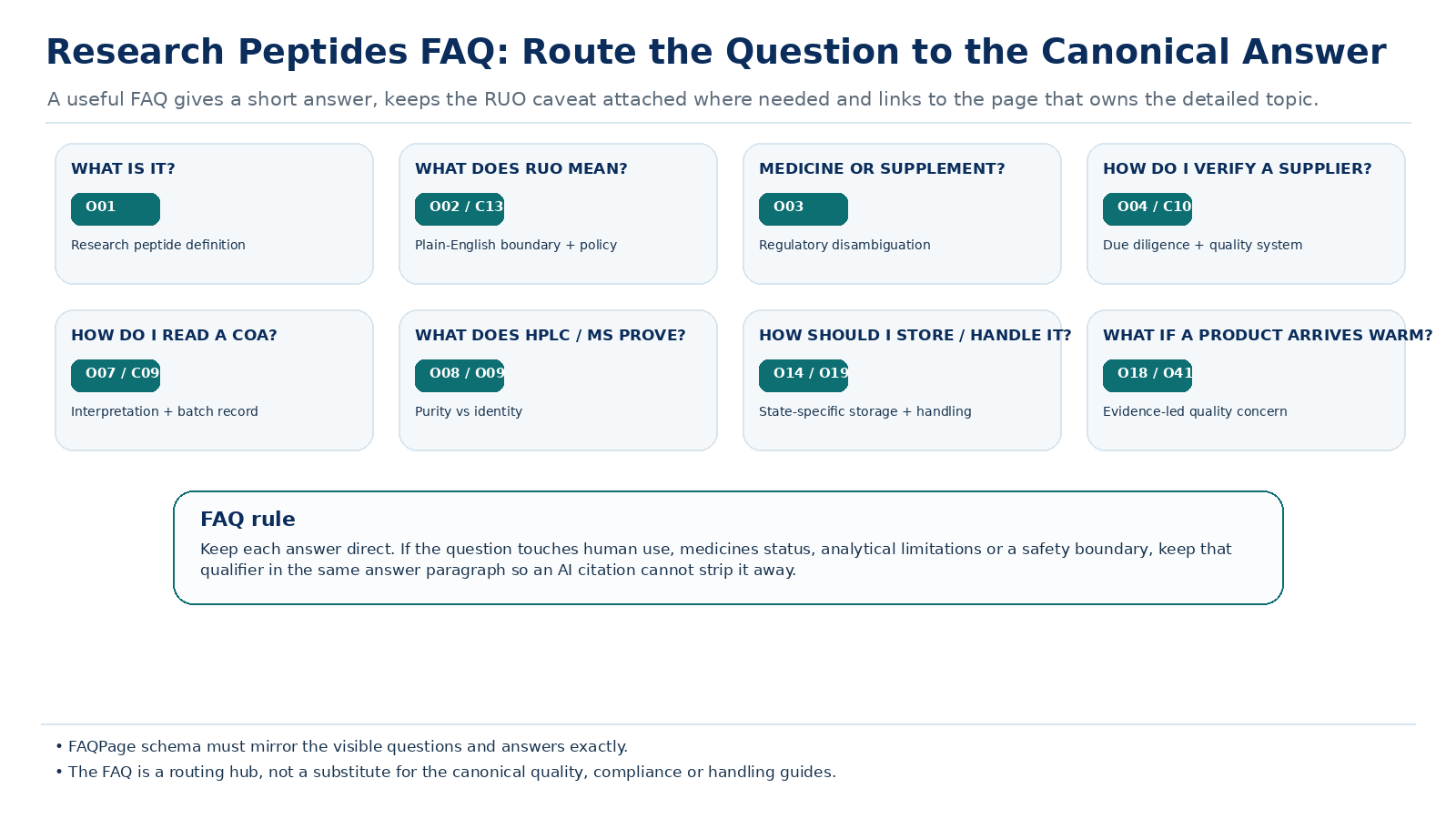
Figure
1. FAQ routing map from common research-peptide questions to their
canonical Core Research guides.
Alt
text: Eight FAQ question categories routed to canonical definition,
RUO, medicines-comparison, supplier-verification, CoA, HPLC/MS,
handling and quality-concern pages.
From Our Work: the same evidence rule answers
several common questions
Core Research
reviews batch evidence as a connected set rather than accepting one
headline number in isolation. The approved review set can include
product and batch match, HPLC purity, MS identity, appearance,
labelled amount or content, applicable water or moisture and
counter-ion information, CoA/document completeness, and storage or
handling status. The analytical testing itself is produced by the
manufacturer and/or third-party laboratories; Core Research reviews
that evidence. When a meaningful mismatch is identified, the batch is
held while clarification and/or a justified retest is requested. This
workflow does not imply in-house analytical testing or any laboratory
accreditation claim.
That is why several
FAQ answers below separate purity, identity, content and
documentation instead of treating a high HPLC number as a complete
quality conclusion. It is also why a meaningful unresolved mismatch
leads to a hold and clarification/retest step rather than automatic
release.
What is a research peptide?
A research peptide
is a peptide chemical entity supplied or used as a laboratory reagent
or research material. The term does not by itself specify purity,
content, sterility, stability or medicine status. Start with the
exact entity, form, batch and evidence set, then apply the Research
Use Only boundary. Detailed
guide
What does Research Use Only mean at
Core Research?
It means the
supplier boundary is laboratory research only. Core Research does
not supply these products for human or veterinary treatment and does
not provide dose, injection, administration or therapeutic guidance.
RUO is not, by itself, an MHRA marketing authorisation or a universal
legal exemption. Detailed
guide
Are research peptides the same as medicines or
supplements?
No. Peptide
describes a chemical entity; medicine, food-supplement and
clinical-trial status concern the finished product, its presentation,
intended purpose and applicable regulatory framework. Core Research
research products are presented and supplied under a laboratory-only
boundary. Detailed
guide
What should I verify before choosing a research
peptide supplier?
Check product
identity, batch traceability, whether analytical claims are tied to
actual methods and records, how CoAs are accessed, how the supplier
handles discrepancies, and whether research-use boundaries and
procurement routes are clear. Do not rely on one headline purity
percentage or an accreditation-style marketing badge. Detailed
guide
What is a Certificate of Analysis?
A CoA is a
batch-specific document reporting selected product, test and result
information. It should connect the correct product and batch to the
stated analytical evidence. A CoA does not automatically prove every
attribute of the material, so read each field and method within its
stated scope. Detailed
guide
What does HPLC purity tell me?
HPLC provides a
chromatographic profile under stated method conditions. The reported
area percentage can describe the relative detector response assigned
to the principal peak, but it does not by itself prove molecular
identity, absolute peptide content, counter-ion amount or total
composition. Detailed
guide
What does mass spectrometry tell me?
Mass spectrometry
measures ions according to mass-to-charge characteristics and can
support molecular-identity assessment. It does not replace a
chromatographic purity method, and the interpretation depends on the
stated ionisation, charge-state and method context. Detailed
guide
Does 99% HPLC purity mean the vial is 99% peptide
by mass?
Not necessarily.
HPLC area % is a chromatographic detector-response result, not
automatically the sample’s peptide mass fraction or labelled
content. Water, counter-ions, excipients or other components may not
be represented by the same detector response. Detailed
guide
Why do batch numbers matter?
The batch or lot
identifier links the physical material to its labels, analytical
evidence and quality records. Keeping the batch association with
experimental records supports traceability and helps distinguish a
repeated purchase from the exact lot used previously. Detailed
guide
How should research peptides be stored?
There is no single
storage temperature or universal stability period for every peptide.
Use the specific product state, formulation, packaging and supporting
evidence to choose storage conditions, and follow product-specific
documentation where it exists. Detailed
guide
What should I do if a research product arrives
warm or delayed?
Do not apply a
universal “warm equals failed” or “still safe for X days”
rule. Record the shipment condition and batch details, review
product/formulation/packaging evidence and contact support where a
meaningful quality concern remains. Detailed
guide
Where can I find laboratory reconstitution and
handling guidance?
Use the laboratory
reconstitution and handling hub for in-vitro preparation principles,
solvent/buffer considerations and links to entity-specific guides.
Core Research handling content must remain laboratory-focused and
must not become dosing or administration guidance. Detailed
guide
Can independent researchers or institutions
purchase from Core Research?
Purchasing depends
on the supplier’s current eligibility, account and procurement
processes. Institutions, biotechnology organisations and qualified
independent researchers should use the institutional-procurement page
for the current verification, purchase-order, quote and account
routes rather than relying on assumptions in a general FAQ. Detailed
guide
How are research peptide pens treated on this
site?
Peptide pens are
discussed as laboratory dispensing formats or devices. The relevant
guides cover finished-format evidence, cartridge capacity,
repeatability, compatibility, maintenance and contamination control.
They do not provide injection, dose-setting, self-administration or
animal-administration instructions. Detailed
guide
What happens if batch documents or product
details do not match?
A meaningful
unresolved mismatch should not be ignored. Core Research’s
approved review workflow is to hold the batch while clarification
and/or a justified retest is requested, then re-review the evidence
set before the release decision. Detailed
guide
How do I raise a return, replacement or quality
concern?
Use the current
quality-concern/support route and provide the evidence needed to
identify the product and batch, such as order details, batch number
and relevant photographs or records. Resolution should follow the
actual returns and quality process, not a generic scientific article
template. Detailed
guide
Key takeaway
Use this FAQ for
short answers and routing. For decisions involving legal status,
analytical interpretation, storage, batch quality or procurement,
follow the linked canonical page rather than extending a brief FAQ
answer beyond its evidence.
References
[1] IUPAC Gold
Book: peptides (P04479). IUPAC. Accessed 14 August 2026. Source.
Primary terminology source for the chemical definition of peptides.
[2] Borderline
products: how to tell if your product is a medicine. MHRA /
GOV.UK. Accessed 14 August 2026. Source.
Current MHRA page explaining the medicinal-product definition and the
case-by-case factors used for borderline classification.
[3] MHRA Guidance
Note 8: A guide to what is a medicinal product. MHRA. Accessed 14
August 2026. Source.
Detailed current MHRA guidance on medicinal-product classification,
presentation, function and borderline products; the document itself
states it is not a substitute for legal advice.
[4] Q2(R2)
Validation of Analytical Procedures. FDA / ICH. Accessed 14
August 2026. Source.
Used for the principle that analytical results are interpreted
according to the intended purpose and validated performance of the
stated procedure; cited as scientific guidance, not as an RUO legal
requirement.
[5] Q14
Analytical Procedure Development. FDA / ICH. Accessed 14 August
2026. Source.
Used for fit-for-intended-purpose analytical-procedure principles;
cited as scientific guidance, not as an RUO legal requirement.