How to Read a Peptide Certificate of Analysis
How to Read a Peptide Certificate of Analysis
RESEARCH USE ONLY
This guide explains how to interpret analytical documentation supplied with laboratory research materials. It does not provide dosing, administration, reconstitution, treatment or veterinary-use guidance.
What is the fastest way to read a peptide CoA?
Start with the document-to-material match, not the purity percentage. Confirm that the product or chemical entity and the batch/lot number on the Certificate of Analysis (CoA) match the material you actually received. Then read each analytical result according to what that method can establish: chromatography can describe a purity/profile result under a stated method, while mass spectrometry can support molecular identity or mass confirmation. Finally, compare the reported result with any stated specification or acceptance criterion and escalate mismatches, unexplained omissions or contradictory evidence.
A CoA is useful because it is batch-specific evidence. It is not a universal guarantee that the material is suitable for every experiment, and it does not automatically prove sterility, biological activity, long-term stability, exact peptide content by mass or the absence of every possible impurity.
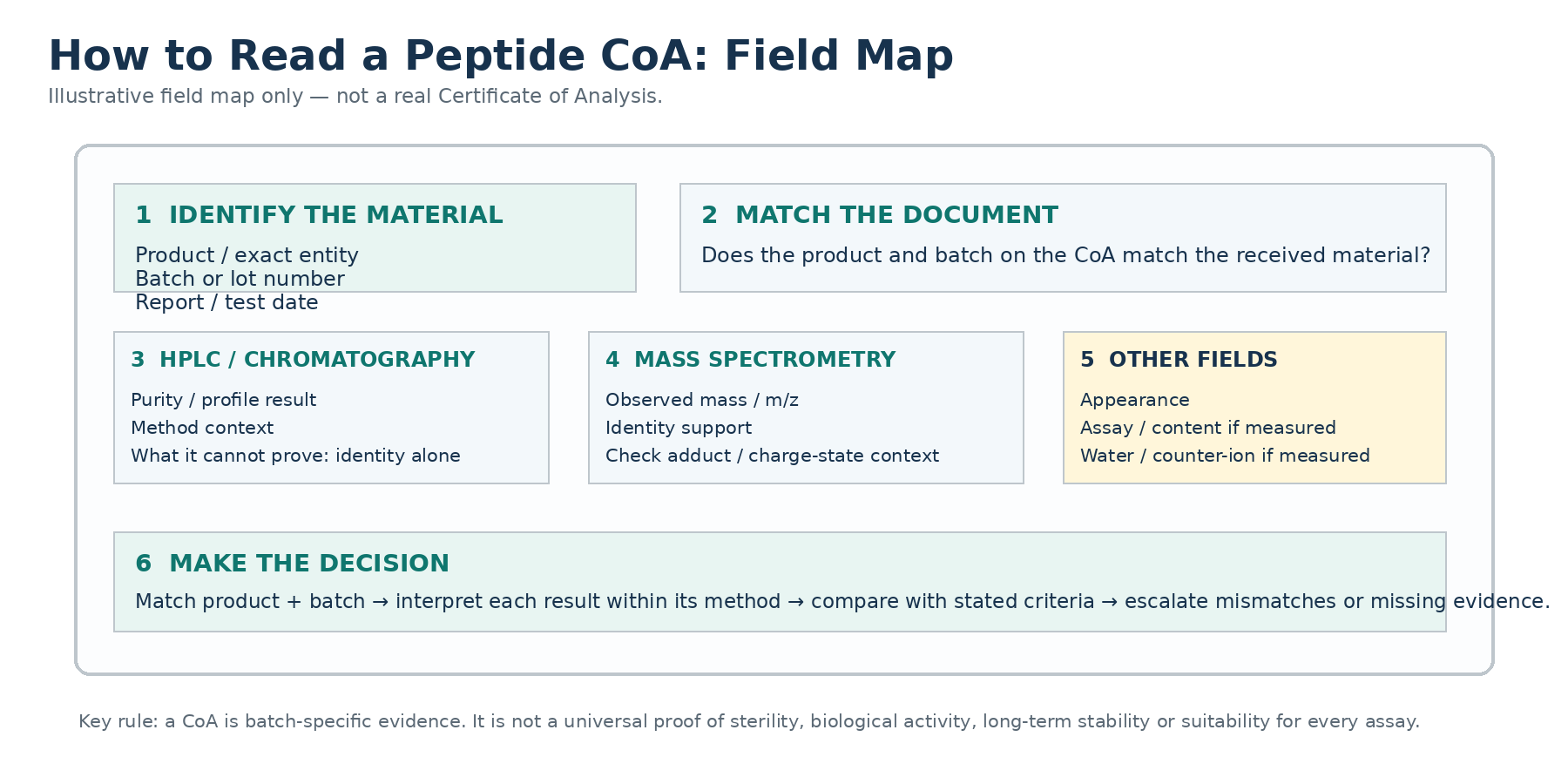
1. Match the CoA to the exact material
The first question is whether the document belongs to the material in front of you. A technically impressive chromatogram is irrelevant if the report is for a different product or batch.
- Product or chemical identity: does the name on the CoA match the label and the exact material ordered?
- Batch or lot number: does the identifier on the CoA match the identifier on the received vial, container or finished format?
- Report or test date: when was the analytical work performed, and does the document clearly identify the tested batch?
- Document/report identifier: if present, can the CoA be distinguished from another revision or batch report?
Core Research batch-document rule
Treat the batch/lot number as the link between the received material and the analytical document. If the product or batch on the CoA does not match the material received, do not use that CoA as evidence for the batch. Use the batch-specific CoA pathway or contact Core Research for the correct document.
Batch documentation: Core Research CoA page
Related guide: Why Batch Numbers and Lot Traceability Matter
2. Separate the result from the specification
A reported result and an acceptance criterion are different things. In regulated analytical frameworks, a specification is a defined set of tests, analytical procedures and acceptance criteria; the result is what was observed when the sample was tested.[1] That regulatory definition should not be treated as a legal requirement for an RUO supplier, but it is a useful analytical distinction when reading any CoA.
Do not assume that every peptide CoA must contain the same tests or the same acceptance limits. The appropriate analytical package depends on the exact material, its form and the quality questions being addressed.
| CoA element | What it answers | Interpretation |
|---|---|---|
| Test / attribute | What characteristic was examined? | Examples include chromatographic purity/profile, molecular mass or appearance. |
| Method / procedure | How was the characteristic measured? | The method determines what the result can and cannot establish. |
| Result | What did the test observe? | Read the value in the context of the stated method and units. |
| Specification / acceptance criterion | What criterion was the result compared with, if one is stated? | Do not invent a threshold when the document does not provide one. |
| Status | How was the result classified by the issuer? | A PASS/FAIL status is only as informative as the underlying test, method and criterion. |
3. Read HPLC purity as chromatographic evidence, not identity proof
High-performance liquid chromatography (HPLC) is commonly used to separate a peptide from related components and report a chromatographic purity or profile. The percentage shown on a CoA is method-dependent: column chemistry, mobile phase, gradient, detector, wavelength, integration approach and sample conditions can all affect the observed chromatogram. Analytical procedures should be suitable and validated for their intended purpose; identity, purity/impurity and quantitative measurements are distinct analytical purposes.[2]
A high HPLC area percentage does not, by itself, prove that the main peak is the intended peptide. ICH Q6A explicitly notes that identification solely by a single chromatographic retention time is not sufficiently specific in its regulated context; orthogonal evidence or a more specific combined procedure may be needed.[1]
| When you see an HPLC result | Reasonable conclusion | Do not conclude |
|---|---|---|
| Main-peak / area-percent result | The sample gave the reported chromatographic profile under the stated method. | That the main peak has the correct molecular identity. |
| Chromatogram supplied | You can inspect peak pattern, baseline, integration and run context if enough method information is shown. | That an attractive trace proves the batch is free of all impurities. |
| Purity result only, no trace/method context | The issuer is reporting a value, but independent interpretation is limited. | That the number is directly comparable with a result produced by a different method. |
Detailed HPLC interpretation: What Is HPLC Purity in Peptide Testing?
Chromatogram scrutiny: Peptide Chromatogram Red Flags and Purity-Claim Limitations
4. Use mass spectrometry to support molecular identity — within its limits
Mass spectrometry measures mass-to-charge (m/z) information and is widely used to characterise synthetic peptides. When the expected sequence is known, MS can be used to support identity by comparing the observed molecular-ion pattern or deconvoluted mass with the expected peptide.[3] LC-MS is also valuable for investigating peptide impurities and structural modifications, but the technique has important interpretation pitfalls, including isomeric or closely related species.[4]
Do not apply a universal ±0.1 Da or ±0.5 Da acceptance rule to every peptide. Appropriate mass accuracy depends on the instrument, acquisition mode, calibration, ion/adduct assignment, charge state and the purpose of the test. If the CoA provides an observed mass, read it with the method and ion assignment rather than treating a single tolerance as an industry-wide standard.
| MS item | What to check | Limitation |
|---|---|---|
| Theoretical / expected mass | Is it calculated for the exact sequence and modification/form being claimed? | A wrong chemical form can make a correct spectrum appear mismatched. |
| Observed mass or m/z | Does the report explain the relevant ion, charge state or deconvoluted value? | A single m/z value is not the same as neutral molecular mass. |
| Match / identity statement | Is the conclusion supported by the spectral context and method? | MS alone may not distinguish all isomers or confirm every structural detail. |
Detailed MS interpretation: What Is Mass Spectrometry in Peptide Identity Testing?
5. Do not confuse chromatographic purity with peptide content by mass
A peptide can have high chromatographic purity while the weighed lyophilised material also contains water, counter-ions or other non-peptide mass. For quantitative reference materials and mass-spectrometry standards, peptide amount/content may therefore require an independent quantitative approach rather than being inferred from HPLC area percentage.[5,6]
Consensus recommendations for peptide standards describe net peptide content as the amount of actual peptide within a gravimetrically measured sample, excluding water and counter-ions.[5] Metrological work on peptide reference materials likewise uses orthogonal methods and mass-balance approaches because chromatographic purity and purity/content by mass are not interchangeable concepts.[6]
Not every RUO CoA will report net peptide content, water or counter-ion content, and their absence should not automatically be labelled a batch failure. Their importance depends on the material and the laboratory’s experimental requirements. If exact mass fraction or salt composition matters to the experiment, check whether those attributes were actually measured rather than estimating them from the HPLC purity.
6. Read counter-ion information only when it is actually measured or specified
Synthetic peptides may be isolated as salts with counter-ions such as trifluoroacetate (TFA), acetate or chloride. Counter-ion identity and quantity can matter when calculating material composition or interpreting certain assays, but HPLC-UV peptide purity does not automatically quantify the counter-ion.[7]
Recent analytical work shows that counter-ions in synthetic peptides can be measured using techniques such as fluorine NMR, FT-IR or HPLC with appropriate detection, and that counter-ion content can vary with peptide sequence and salt form.[7] Therefore, do not infer ‘TFA-free’, ‘acetate form’, or a specific counter-ion percentage from a peptide purity trace unless the CoA or supporting analytical record actually establishes it.
Detailed counter-ion guide: Residual TFA, Counter-Ions and Peptide Desalting
7. Understand appearance, dates and release/status fields
Appearance, test date, manufacturing date, storage information and release/status fields provide useful context, but each has a limited scope.
| Field | Useful for | Does not prove |
|---|---|---|
| Appearance | Checking that the observed physical description is consistent with the recorded batch description. | Chemical identity, chromatographic purity or sterility. |
| Test date | Showing when the analytical result was generated. | That the batch remained unchanged under every later storage or transit condition. |
| Manufacture / batch date | Traceability and chronology where provided. | A universal shelf life. |
| Storage information | The supplier’s documented storage condition for that product/form where verified. | A universal post-preparation stability period. |
| PASS / Approved / Release status | The issuer’s decision against its stated process or criteria. | That every laboratory should accept the material for every experimental application. |
8. What a peptide CoA does not prove
A useful CoA is evidence with a defined scope. Unless the relevant test is explicitly performed and reported, a CoA should not be interpreted as proof of:
- Sterility or absence of microbial contamination.
- Endotoxin level.
- Biological activity, receptor activity or potency in a particular assay.
- Suitability for human or veterinary use.
- Long-term stability after every possible storage or transit condition.
- Exact filled volume or dispensing repeatability of a finished pen/cartridge format.
- Absence of every structural isomer, epimer or non-chromophoric impurity.
- Exact peptide content by mass when only chromatographic purity is reported.
9. A practical CoA acceptance pathway
- Match: Confirm exact product/entity and batch/lot.
- Read: Identify each test, method, result, units and stated specification/status.
- Interpret: Ask what each method actually establishes: HPLC for chromatographic profile/purity, MS for mass/identity support, and separate methods for other attributes.
- Cross-check: Look for contradictions: wrong batch, inconsistent molecular form, unexplained result/specification mismatch, or claims that exceed the test performed.
- Escalate: If the document cannot be matched or a required attribute is missing for your experimental acceptance criteria, request the correct batch document or supporting evidence before relying on it.
- Record: Retain the CoA with the order/batch and experimental records so later results can be traced to the material used.
The acceptance decision belongs to the laboratory’s documented experimental and quality requirements. A supplier’s PASS status does not replace the laboratory’s responsibility to decide whether the available evidence is sufficient for its intended research use.
10. CoA red flags that justify a closer look
- The batch/lot number on the document does not match the received material.
- The document shows a purity percentage but no indication of the analytical method.
- HPLC retention time is presented as definitive molecular identity without orthogonal evidence.
- A molecular-weight result is shown without enough context to understand whether it is m/z, a deconvoluted mass, an adduct or another value.
- The same CoA appears to be used for different batch numbers.
- A report claims sterility, endotoxin control, exact peptide content, counter-ion composition or finished-format quality without showing the corresponding test/evidence.
- The stated result and the stated specification/status appear inconsistent.
- The exact chemical form on the CoA is incompatible with the label or product specification.
Frequently asked questions
Is HPLC purity the same as peptide identity?
No. HPLC can report a chromatographic purity/profile under a defined method, but a main HPLC peak is not by itself proof that the material has the intended molecular identity.
Does mass spectrometry prove peptide purity?
Not by itself. MS can support molecular identity and reveal some impurities or modifications, but chromatographic purity and molecular identity are different analytical questions.
Should every peptide CoA report water and counter-ion content?
Not necessarily. Those fields are important when exact material composition or mass fraction matters, but the required analytical package depends on the product and the laboratory’s use. Do not invent values when they were not measured.
Can I use a CoA from a different batch of the same product?
No. A CoA is batch-specific evidence. A document for another batch should not be treated as the analytical record for the batch you received.
What should I do if the batch number or analytical result does not match?
Hold the acceptance decision, preserve the document and product identifiers, and request the correct batch-specific evidence or clarification from the supplier before relying on the CoA.
Is a supplier PASS status enough for my experiment?
A PASS status tells you how the issuer classified the reported test against its process or criterion. Your laboratory still needs to decide whether the available evidence is sufficient for the intended research workflow.
Key takeaway
Read a peptide CoA in this order: match the product and batch, separate the result from the specification, interpret HPLC and MS according to their analytical roles, check any additional content/counter-ion fields only when they were actually measured, and recognise what the document does not prove. The strongest CoA is not the one with the largest purity number; it is the one that can be matched to the material and interpreted from transparent, fit-for-purpose analytical evidence.
References
- ICH Q6A. Specifications: Test Procedures and Acceptance Criteria for New Drug Substances and New Drug Products: Chemical Substances. ICH / FDA / EMA. Used here for analytical concepts such as specifications, identification and acceptance criteria; it is not presented as a regulatory requirement for Core Research RUO materials.
- ICH Q2(R2). Validation of Analytical Procedures. Final guidance, March 2024. Describes validation principles for analytical procedures used for identity, purity/impurities, assay and other measurements.
- Prabhala BK, Mirza O, Højrup P, Hansen PR. Characterization of Synthetic Peptides by Mass Spectrometry. Methods in Molecular Biology. 2015;1348. DOI: 10.1007/978-1-4939-2999-3_9.
- Lian Z, Wang N, Tian Y, Huang L. Characterization of Synthetic Peptide Therapeutics Using Liquid Chromatography-Mass Spectrometry: Challenges, Solutions, Pitfalls, and Future Perspectives. Journal of the American Society for Mass Spectrometry. 2021;32(8):1852–1860. DOI: 10.1021/jasms.0c00479.
- Hoofnagle AN, Whiteaker JR, Carr SA, et al. Recommendations for the Generation, Quantification, Storage, and Handling of Peptides Used for Mass Spectrometry-Based Assays. Clinical Chemistry. 2016;62(1):48–69. DOI: 10.1373/clinchem.2015.250563.
- Melanson JE, Thibeault M-P, Stocks BB, et al. Purity assignment for peptide certified reference materials by combining qNMR and LC-MS/MS amino acid analysis results: application to angiotensin II. Analytical and Bioanalytical Chemistry. 2018;410(26):6719–6731. DOI: 10.1007/s00216-018-1272-7.
- Erckes V, Streuli A, Chamera Rendueles L, Krämer SD, Steuer C. Towards a Consensus for the Analysis and Exchange of TFA as a Counterion in Synthetic Peptides and Its Influence on Membrane Permeation. Pharmaceuticals. 2025;18(8):1163. DOI: 10.3390/ph18081163.