Residual TFA Counter-Ions & Peptide Desalting
Residual TFA Counter-Ions & Peptide Desalting
RESEARCH USE ONLY
This guide explains analytical-documentation and laboratory interpretation principles for Research Use Only peptide materials. It does not provide dosing, administration, injection, treatment, self-use or veterinary-use guidance.
What are residual TFA and peptide counter-ions?
Residual trifluoroacetate (TFA) and other counter-ions are part of the chemical salt form that can remain associated with a synthetic peptide after synthesis, cleavage, purification or counter-ion exchange. TFA, acetate and chloride are common examples. Their identity and amount are separate analytical questions from HPLC peptide purity, so a high HPLC area percentage does not by itself state how much counter-ion is present or the peptide mass fraction of the dried material.
For a research batch, the practical questions are: what salt form is specified, whether the batch evidence supports that form, whether residual counter-ion has been measured when it matters, and whether the reported form is appropriate for the planned laboratory method. No universal peptide-wide residual-TFA limit is implied by this guide.
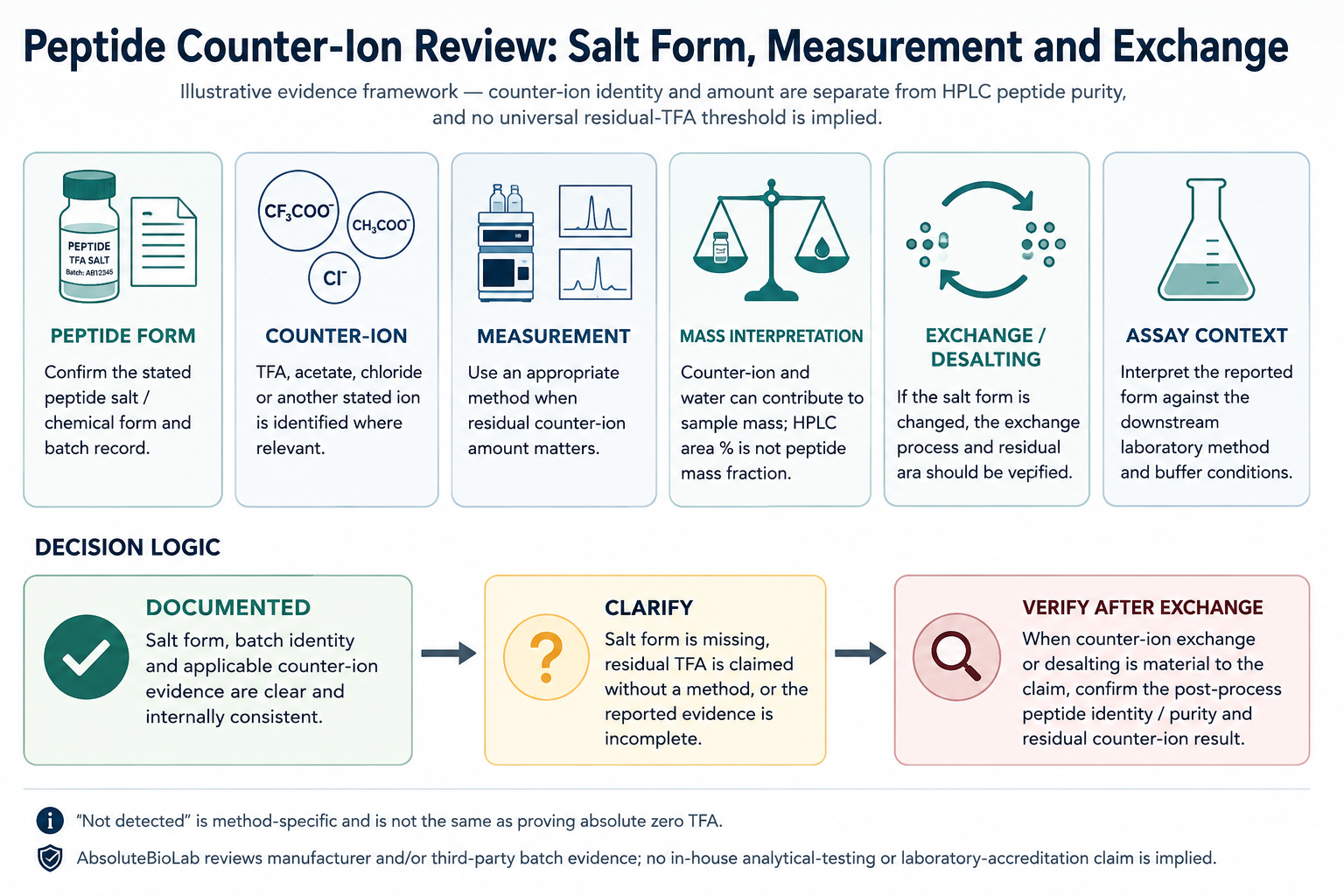
From Our Work: how Core Research reviews counter-ion evidence
Core Research reviews counter-ion information as one element of the batch evidence set when it is applicable to the exact material and stated chemical form. The analytical testing is produced by the manufacturer and/or third-party laboratories; Core Research reviews that evidence rather than claiming in-house TFA, HPLC, MS or counter-ion testing. If the salt form, counter-ion result, product/batch match or supporting documentation is meaningfully inconsistent, the batch remains on hold while clarification and/or a justified retest is requested. No laboratory accreditation claim is made unless separately verified.
This means the review does not turn a generic statement such as “desalted”, “acetate form” or “TFA-free” into a batch fact without supporting evidence. Where counter-ion amount is material to the product specification or downstream laboratory use, the evidence should identify the method and result strongly enough to interpret what was actually measured.
Why does TFA appear in synthetic peptide material?
TFA is widely used in synthetic-peptide workflows, including cleavage chemistry and reversed-phase purification. Basic sites on a peptide can be protonated, leaving an anion such as trifluoroacetate associated with the positively charged peptide as a counter-ion. The resulting dried material can therefore contain peptide, counter-ion and water rather than peptide alone.
The exact counter-ion amount is sequence- and process-dependent. It should not be inferred from peptide molecular mass, HPLC peak area or a generic manufacturing assumption. Modern work on synthetic peptides has shown that counter-ion content can be measured directly and that exchange efficiency varies with peptide sequence and exchange conditions [1-3].
Counter-ion is not the same question as HPLC purity
This distinction matters because a sample can have a high peptide HPLC area percentage while the dried material still contains a substantial non-peptide mass contribution from counter-ion and water. In one metrology study of an angiotensin II certified reference material, TFA was measured at nearly one quarter of the material by mass; that is a specific reference-material result, not a universal expectation for synthetic peptides [4].
How can residual TFA or another counter-ion be measured?
Counter-ion analysis needs a method that actually responds to the ion being reported. Published peptide work has used ion chromatography, capillary electrophoresis, 19F NMR for TFA, FT-IR in validated contexts and HPLC with detectors suitable for non-UV-active counter-ions. Different methods have different selectivity, limits of detection and quantification, and sample requirements [1-3,5].
| Analytical question | What it can tell you | What it does not establish by itself |
|---|---|---|
| HPLC peptide purity/profile | Relative chromatographic peak-area distribution under the stated method. | Counter-ion identity or amount; absolute peptide mass fraction; molecular identity. |
| Mass spectrometry | Observed mass evidence supporting peptide identity. | Counter-ion mass fraction or chromatographic purity. |
| Counter-ion assay | Amount or presence of a stated ion such as TFA, acetate or chloride under the analytical method. | Peptide-sequence identity or all other impurities. |
| Water/moisture | Water contribution where measured. | Counter-ion amount or peptide purity. |
| Method example | Useful role | Interpretation limit |
|---|---|---|
| Ion chromatography | Direct separation and quantification of anions such as TFA, acetate and chloride. | Result is method- and calibration-specific. |
| 19F NMR | Selective quantification of fluorinated TFA in suitable samples. | Does not quantify non-fluorinated counter-ions such as acetate or chloride. |
| Capillary electrophoresis | Can separate and quantify small ionic species under a validated method. | Performance depends on method conditions and detection. |
| FT-IR | Can support TFA detection/exchange studies when method performance is demonstrated. | Less specific at low levels than dedicated quantitative methods in some applications. |
| HPLC-ELSD or other suitable detector | Can quantify counter-ions in appropriately developed methods. | Ordinary peptide HPLC-UV area % should not be substituted for this measurement. |
What does “TFA-free” or “zero residual TFA” actually mean?
An absolute “zero TFA” claim is stronger than most analytical results support. A report may legitimately state that TFA was not detected or was below a validated reporting limit, but that statement belongs to the specific method, sample amount, limit of detection or quantification and batch tested. “Not detected” is not the same as proving that no TFA molecule is present.
For that reason, Core Research should publish “TFA-free”, “zero residual TFA”, a numerical residual-TFA value or a named counter-ion only where the exact batch documentation supports the claim. If the report does not identify the method or reporting limit, the safer conclusion is that the available evidence is insufficient to support an absolute zero claim.
What is peptide desalting, and is it the same as counter-ion exchange?
Desalting is a broad processing term for reducing low-molecular-weight salts or reagents from a peptide preparation. Counter-ion exchange is more specific: the peptide is deliberately converted from one salt form to another, for example from a trifluoroacetate form to chloride or acetate, and the residual original counter-ion is then assessed.
These terms should not be treated as interchangeable proof of composition. A process labelled “desalted” or “double-desalted” does not by itself establish a numerical residual-TFA result. Likewise, repeating an exchange or lyophilisation step does not guarantee absolute removal. Published studies have shown that counter-ion exchange can be highly effective but that residual TFA can remain and should be measured when the claim matters [1,6].
Should TFA always be removed from a research peptide?
No universal rule says every research peptide must be converted away from TFA. The appropriate salt form depends on the exact peptide, the analytical specification and the downstream laboratory method. Counter-ion exchange can change material composition and, in some peptide systems, physicochemical or assay behaviour; therefore the target salt form should be selected for a defined laboratory reason rather than because one counter-ion is always “better” [1,6].
Where an assay is sensitive to ionic composition, pH, buffer conditions or mass-based concentration, the counter-ion should be included in method planning. For buffer and pH considerations, use the dedicated guide to solvent selection and buffer compatibility rather than inferring compatibility from this counter-ion article alone.
How counter-ions affect peptide mass interpretation
A labelled vial amount and the mass of active peptide are not automatically the same quantity. A dried peptide salt can contain peptide, counter-ion, water and other measurable contributions. If an experiment requires an accurate mass fraction or concentration of peptide itself, the calculation should use an appropriate peptide-content or mass-balance value rather than simply multiplying the labelled mass by the HPLC area percentage.
The metrology literature illustrates the principle clearly: reference-material purity assignments can require separate measurements for related peptide impurities, counter-ion and water before a defensible peptide mass fraction is assigned [4]. That level of analysis is not a universal requirement for every RUO product; it demonstrates why HPLC area % and net peptide content are different attributes.
What should a CoA or analytical record say about counter-ions?
| Document field | Question to ask | Safe interpretation |
|---|---|---|
| Stated chemical form | Does the product say TFA salt, acetate salt, chloride salt or another defined form? | Treat the stated form as a specification claim that should match batch evidence. |
| Counter-ion method | Is the analytical technique named? | A method name makes the result more interpretable than a bare “TFA-free” label. |
| Measured result | Is a value, ND statement or reporting limit provided? | Interpret only within the method and reporting limits. |
| Batch link | Does the result clearly belong to the exact batch? | Do not transfer one batch result to another batch without evidence. |
| Post-exchange verification | If the salt form was exchanged, was the resulting form/residual original ion checked? | Exchange process wording alone is not a composition result. |
For a broader document review, see How to Read a Peptide Certificate of Analysis. For supplier-level due diligence and attribution of laboratory evidence, use the Supplier Verification and Analytical Quality System page.
A practical counter-ion review sequence
- Confirm the exact product, batch and stated peptide salt/form.
- Check whether counter-ion identity or amount is an applicable specification for that material.
- Identify the analytical method used for TFA, acetate, chloride or another counter-ion.
- Read the numerical result, “not detected” statement and any LOD/LOQ in method context.
- Keep HPLC peptide purity separate from counter-ion amount and peptide mass fraction.
- If the salt form was exchanged or the product is described as desalted, look for post-process verification rather than relying on process wording alone.
- If the evidence is missing or contradictory, hold the interpretation and request clarification or a scientifically justified retest.
Frequently asked questions
Does high HPLC purity mean there is very little TFA?
No. HPLC peptide area percentage and counter-ion content are different measurements. A peptide can show a high chromatographic purity result while still containing a material amount of TFA, acetate, chloride, water or other non-peptide mass. Counter-ion content needs its own suitable analytical method when it matters.
Is TFA always an impurity?
Not necessarily. Trifluoroacetate can be the specified counter-ion of a peptide salt rather than an accidental contaminant. Whether it is acceptable depends on the specified chemical form and downstream laboratory use. The important point is to distinguish the stated salt form from residual-process claims and to measure the ion when the specification requires it.
Does “not detected” mean zero residual TFA?
No. “Not detected” means the method did not detect TFA above its applicable detection capability in that sample. It should be interpreted with the method, limit of detection or quantification and batch context. An absolute “zero TFA” statement requires stronger evidence than an ND result alone.
Is double-desalting proof that a peptide is TFA-free?
No. A named process is not a quantitative result. If residual TFA is material to the claim, the post-process peptide should be tested with an appropriate counter-ion method. Core Research should not publish “double-desalted” or “TFA-free” as a batch fact unless the exact batch documentation supports it.
Can acetate or chloride simply replace TFA in every peptide?
No universal exchange condition is appropriate for every peptide. Exchange efficiency and material behaviour can depend on sequence, charge and method conditions. The target counter-ion and verification strategy should be selected for the exact peptide and planned laboratory use.
Does Core Research perform residual-TFA testing in-house?
No in-house counter-ion testing claim is approved for this page. The verified business workflow is that analytical data are produced by manufacturers and/or third-party laboratories, and Core Research reviews the batch-specific evidence before accepting the material.
Key takeaway
Residual TFA and other counter-ions are part of peptide salt-form and composition review, not a footnote to HPLC purity. A defensible batch record identifies the stated chemical form, measures counter-ion where it is relevant, keeps HPLC purity separate from peptide mass fraction, and verifies any counter-ion exchange or desalting claim with appropriate evidence. Core Research reviews manufacturer and/or third-party batch evidence and holds meaningful mismatches for clarification or justified retesting rather than inventing universal residual-TFA limits.
References
- Erckes V, Streuli A, Chamera Rendueles L, Krämer SD, Steuer C. Towards a Consensus for the Analysis and Exchange of TFA as a Counterion in Synthetic Peptides and Its Influence on Membrane Permeation. Pharmaceuticals. 2025;18(8):1163. PMID: 40872554.
- Mrozik W, Markowska A, Guzik Ł, Kraska B, Kamysz W. Determination of counter-ions in synthetic peptides by ion chromatography, capillary isotachophoresis and capillary electrophoresis. Journal of Peptide Science. 2012;18:192-198. DOI: 10.1002/psc.1436.
- Little MJ, Aubry N, Beaudoin M-E, Goudreau N, LaPlante SR. Quantifying trifluoroacetic acid as a counterion in drug discovery by 19F NMR and capillary electrophoresis. Journal of Pharmaceutical and Biomedical Analysis. 2007;43(4):1324-1330. PMID: 17145157.
- Melanson JE, Thibeault M-P, Stocks BB, et al. Purity assignment for peptide certified reference materials by combining qNMR and LC-MS/MS amino acid analysis results: application to angiotensin II. Analytical and Bioanalytical Chemistry. 2018;410(26):6719-6731. PMID: 30143839.
- Kaiser E, Rohrer J. Determination of residual trifluoroacetate in protein purification buffers and peptide preparations by ion chromatography. Journal of Chromatography A. 2004;1039(1-2):113-117. PMID: 15250411.
- Sikora K, Jaśkiewicz M, Neubauer D, et al. Counter-ion effect on antistaphylococcal activity and cytotoxicity of selected antimicrobial peptides. Amino Acids. 2018;50:609-619. DOI: 10.1007/s00726-017-2536-9. Used here only to support that salt form/counter-ion can alter experimental behaviour and that exchange should be verified; not for therapeutic claims.