Why Batch Numbers & Lot Traceability Matter
Why Batch Numbers & Lot Traceability Matter
RESEARCH USE ONLY
This guide concerns laboratory traceability, analytical documentation and experimental record-keeping for Research Use Only materials. It does not provide dosing, administration, reconstitution, treatment or veterinary-use guidance.
Why does a batch number matter?
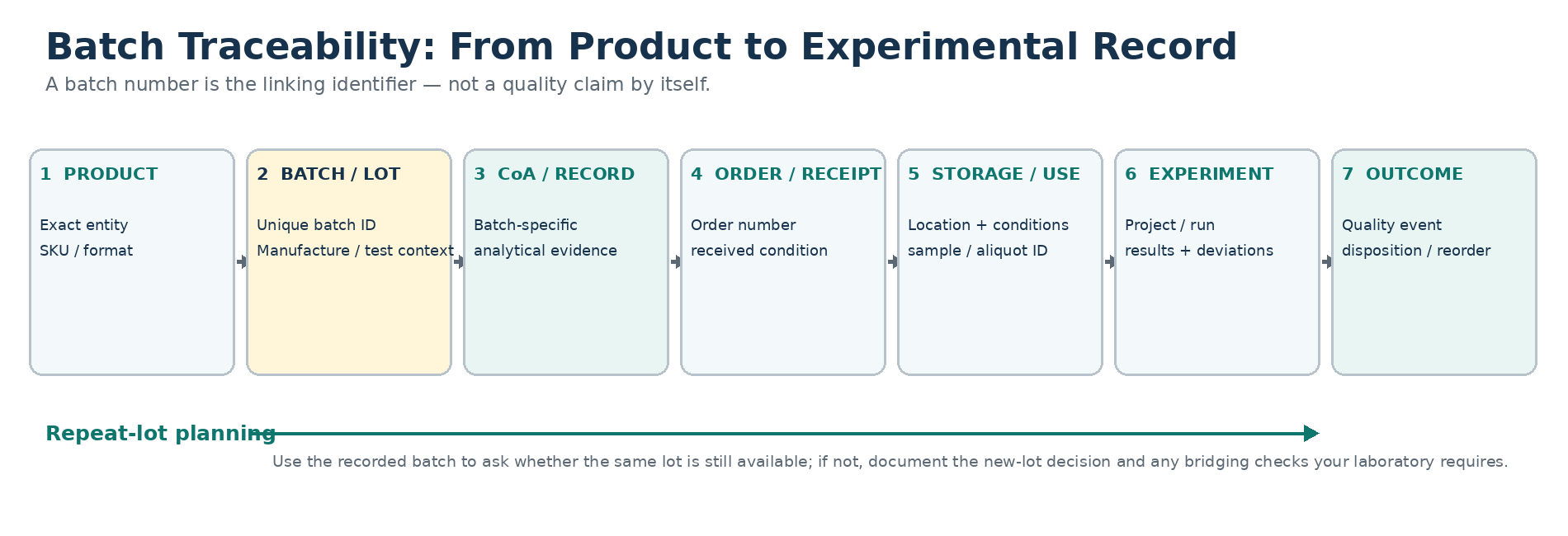
A batch or lot number is the identifier that connects a specific unit of research material to the records that describe it. For a laboratory, that connection should run from the exact product and batch to the Certificate of Analysis (CoA), the order and receiving record, the storage/handling record, and finally the experiment in which the material was used. Without that chain, a later result may be linked only to a product name rather than to the actual batch that generated the data.
Good laboratory-practice guidance illustrates why this matters. OECD guidance on test-item management states that identity information should include the batch number and other characteristics needed to define each batch, and that characterisation information should be available for each batch when multiple batches are used in a study.[1] OECD guidance for in-vitro methods similarly recommends recording batch/lot numbers, catalogue numbers, supplier details and expiry dates for critical reagents so the work can be interpreted and reconstructed.[2]
These OECD documents apply to defined GLP or good-practice settings; they are not presented here as a legal requirement for every Core Research customer. They are useful because they express a broader scientific principle: if a material can vary by batch, the experimental record should identify which batch was used.
Product name, batch number, order number: what is the difference?
| Identifier | What it identifies | Why it is not enough on its own |
|---|---|---|
| Product name / exact entity | The material being supplied — for example an exact peptide, research compound or blend. | The same named product may be supplied in more than one batch over time. |
| SKU / catalogue item | The commercial product/format or pack size. | It identifies the catalogue item, not the specific production/test batch. |
| Batch / lot number | A defined batch or lot of the material. | The number itself does not prove identity, purity or fitness; it links to the evidence for that batch. |
| Order number | The commercial transaction in which material was supplied. | One order can contain multiple products or batches. |
| CoA / analytical report ID | The analytical document or report. | It must still be matched to the correct product and batch. |
The batch-document graph a laboratory should be able to reconstruct
For a traceable research workflow, the laboratory should be able to move in both directions through the record chain: from an experimental result back to the batch that was used, and from the batch forward to the experiments that relied on it.
| Record layer | Minimum useful information | Question it lets you answer |
|---|---|---|
| Product / specification | Exact material, strength or labelled amount, physical form and SKU where applicable. | What was the laboratory intending to use? |
| Batch / lot | Batch identifier and any relevant manufacture/test dates supplied. | Which specific batch was received? |
| Analytical documentation | CoA or supporting report matched to product and batch. | What evidence was available for that batch? |
| Order / receipt | Order number, receipt date and receiving condition where recorded. | When and under what commercial/receiving event did the batch enter the laboratory? |
| Storage / handling | Storage state/location and laboratory sample or aliquot identifiers where relevant. | How was the batch managed after receipt? |
| Experiment / project | Experiment or sample identifier, date and deviations. | Which data were generated using the batch? |
| Quality event / disposition | Any concern, investigation, hold/reject decision or supplier correspondence. | Was there a later event that changes how the batch record should be interpreted? |
From Core Research’s CoA request workflow
A real business-side traceability step
Core Research’s current CoA request process uses the order details and batch number to match a request to the correct batch document. That operational step is important because a CoA for the same product name but a different batch is not the analytical record for the material a researcher actually received.
Batch-specific documents: Core Research CoA page
How to interpret the document once it is matched: How to Read a Peptide Certificate of Analysis
Why lot changes can matter to reproducibility
A new lot should not automatically be treated as scientifically identical to the previous lot simply because the catalogue name is unchanged. Lot-to-lot variation is a recognised laboratory problem for some reagents and calibrators, where different manufacturing lots can shift analytical behaviour or assay performance.[3,4] The scale and relevance of that variation depend on the material and the experiment.
The critical-reagent literature also emphasises documentation and controlled management of lot changes because changes to an important reagent can affect assay performance over time.[3] This does not mean every new peptide batch will materially change an experiment. It means that a laboratory cannot assess continuity if it did not record the batch in the first place.
For research peptides and other biochemical materials, the most relevant batch-to-batch comparisons are therefore evidence-led: exact chemical identity/form, labelled specification, batch-specific analytical documentation, physical format and any experiment-specific attributes that the laboratory has already defined as critical.
What a batch number does — and does not — prove
| Batch number can help you | Batch number cannot prove by itself |
|---|---|
| Match a received unit to its batch-specific CoA or supporting record. | That the material has the stated identity or purity without supporting analysis. |
| Link an order to the exact material used in an experiment. | That two different batches are experimentally interchangeable. |
| Investigate a later quality concern or documentation mismatch. | That the batch remained stable under every storage or transit condition. |
| Request the same lot again if the supplier still has it available. | That the same lot is still available or can be reserved. |
| Separate data generated with one batch from data generated with another. | That a change in experimental result was caused by the batch. |
When should a batch number be recorded in the laboratory?
The most useful approach is to capture the batch number at the point where losing it would make reconstruction difficult. For many laboratories that means recording it at receipt and again in the experiment or sample record.
- Receiving inspection: record product, batch/lot, quantity/format and any visible or documentation discrepancy.
- CoA review: confirm the batch number on the document matches the material received.
- Storage or subdivision: keep the parent batch linked to any internal sample or aliquot identifier.
- Experimental record: record the batch for critical research materials used in the run.
- Quality event: link the concern and supplier correspondence back to the same batch.
- Repeat procurement: use the recorded batch when asking about same-lot availability or planning a change to a new lot.
Receiving workflow: Research Product Receiving Inspection and Batch Acceptance Checklist
Long-term records: Research Batch Documentation Retention and Experimental Audit Trails
How to handle a change from one batch to another
A batch change is a decision point, not automatically a problem. The appropriate response depends on how sensitive the experiment is to reagent variation and which product attributes are critical to the method.
The broader laboratory literature supports this cautious approach: lot-to-lot changes can affect some reagent systems, but the appropriate verification method is context-specific rather than universal.[3,4]
| Scenario | Reasonable laboratory action | Important limitation |
|---|---|---|
| Same lot is required by the experimental plan | Ask whether the recorded lot is still available before the current stock is exhausted. | Same-lot availability must be confirmed; it should never be assumed. |
| New lot is acceptable without special bridging | Record the new lot and retain the corresponding CoA/documentation. | A new batch number still needs to be captured so later results can be traced. |
| New lot may affect a critical method | Define an appropriate laboratory comparison or qualification step based on the method’s own acceptance criteria. | Do not use a generic peptide-wide bridging threshold; the laboratory must define what matters for its method. |
| Results change after a lot change | Review the batch record, analytical documents, storage/handling, instrument/method changes and other confounders. | Temporal association with a new lot does not prove the lot caused the shift. |
Repeat-lot planning: Repeat-Batch Procurement and Lot-Continuity Planning
Institutional purchasing: Institutional Procurement
What to retain with a batch record
There is no single retention period that applies to every laboratory or study. Retention is determined by the organisation’s study type, sponsor/funder, quality system and applicable rules. The useful principle is to retain enough information to reconstruct which material was used and what evidence was available at the time.
- Product name / exact entity and SKU or format.
- Batch or lot number.
- Order number and receipt date.
- CoA or supporting analytical document used for acceptance.
- Any relevant receiving inspection or temperature/packaging concern.
- Storage location/state and internal sample identifiers where needed.
- Experiment, project or sample records that used the batch.
- Quality-event, hold/reject or supplier-resolution records if an issue occurred.
Common traceability failures
- Recording only the product name, with no batch number.
- Saving a CoA without checking whether its batch matches the received material.
- Using one product-level CoA file as if it represented every future batch.
- Creating internal aliquot/sample IDs that are no longer linked to the parent batch.
- Discarding the order/receipt record so the batch cannot be tied back to the supply event.
- Changing to a new lot without recording the change in the experimental record.
- Assuming a same-lot reorder is guaranteed because a previous batch number is known.
- Treating a batch number itself as proof of quality rather than as the identifier that links to evidence.
Frequently asked questions
Are ‘batch number’ and ‘lot number’ always the same thing?
They are often used similarly, but terminology can vary by supplier or quality system. The important point is to use the identifier that uniquely links the received material to its batch-specific records.
Can I use a CoA from a different batch of the same peptide?
No. A CoA is batch-specific evidence. A document for another batch can provide background about the product, but it should not be treated as the analytical record for the batch you received.
Does a new batch mean I must repeat my entire experiment?
Not automatically. The decision depends on the method and the attributes your laboratory has defined as critical. At minimum, record the new batch and review its applicable documentation.
Can Core Research guarantee the same lot for a repeat order?
Same-lot availability should be checked at the time of reorder and must not be assumed. Use the recorded batch number when asking about continuity.
Why record the batch if the product specification is unchanged?
Because the specification identifies the product, while the batch number identifies the specific material used. Without the batch, you cannot reliably connect an experiment to its batch-specific documentation or investigate a later lot change.
How long should I keep batch records?
There is no universal retention period for every research laboratory. Follow the retention requirements of your organisation, study, sponsor, funder and quality system, while keeping enough information to reconstruct the material used.
Key takeaway
The batch number is the connective tissue of research-material traceability. It links the exact product received to its CoA, order, storage/handling record, experiment and any later quality event or repeat-lot request. It does not prove quality by itself, and it does not guarantee that two lots are interchangeable. Its value is that it makes the evidence chain reconstructable.
References
- OECD. Management, Characterisation and Use of Test Items used in GLP studies. OECD Series on Principles of Good Laboratory Practice and Compliance Monitoring, No. 19. 2018. DOI: 10.1787/da9ee953-en. Used for general traceability principles; not presented as a legal requirement for all RUO research.
- OECD. Guidance Document on Good In Vitro Method Practices (GIVIMP). OECD Series on Testing and Assessment, No. 286. 2018. Reporting guidance recommends recording batch/lot numbers and related reagent details so studies can be interpreted and reconstructed.
- King LE, Farley E, Imazato M, et al. Ligand Binding Assay Critical Reagents and Their Stability: Recommendations and Best Practices from the Global Bioanalysis Consortium Harmonization Team. AAPS Journal. 2014;16(3):504–515. DOI: 10.1208/s12248-014-9583-x.
- Thompson S, Chesher D. Lot-to-Lot Variation. Clinical Biochemist Reviews. 2018;39(2):51–60. PMID: 30473592. Used as evidence that lot-to-lot variation can materially affect some laboratory reagent systems; it is not peptide-specific.
- OECD. GLP Data Integrity. OECD Series on Principles of Good Laboratory Practice and Compliance Monitoring, No. 22. 2021. DOI: 10.1787/45779212-en. Used for general data-lifecycle and record-integrity principles.