Receiving Inspection & Batch Acceptance Checklist
Receiving Inspection & Batch Acceptance Checklist
RESEARCH USE ONLY
This guide covers receiving inspection and laboratory acceptance of Research Use Only materials. It does not provide dosing, administration, reconstitution, treatment or veterinary-use guidance.
What should a laboratory check when a research product arrives?
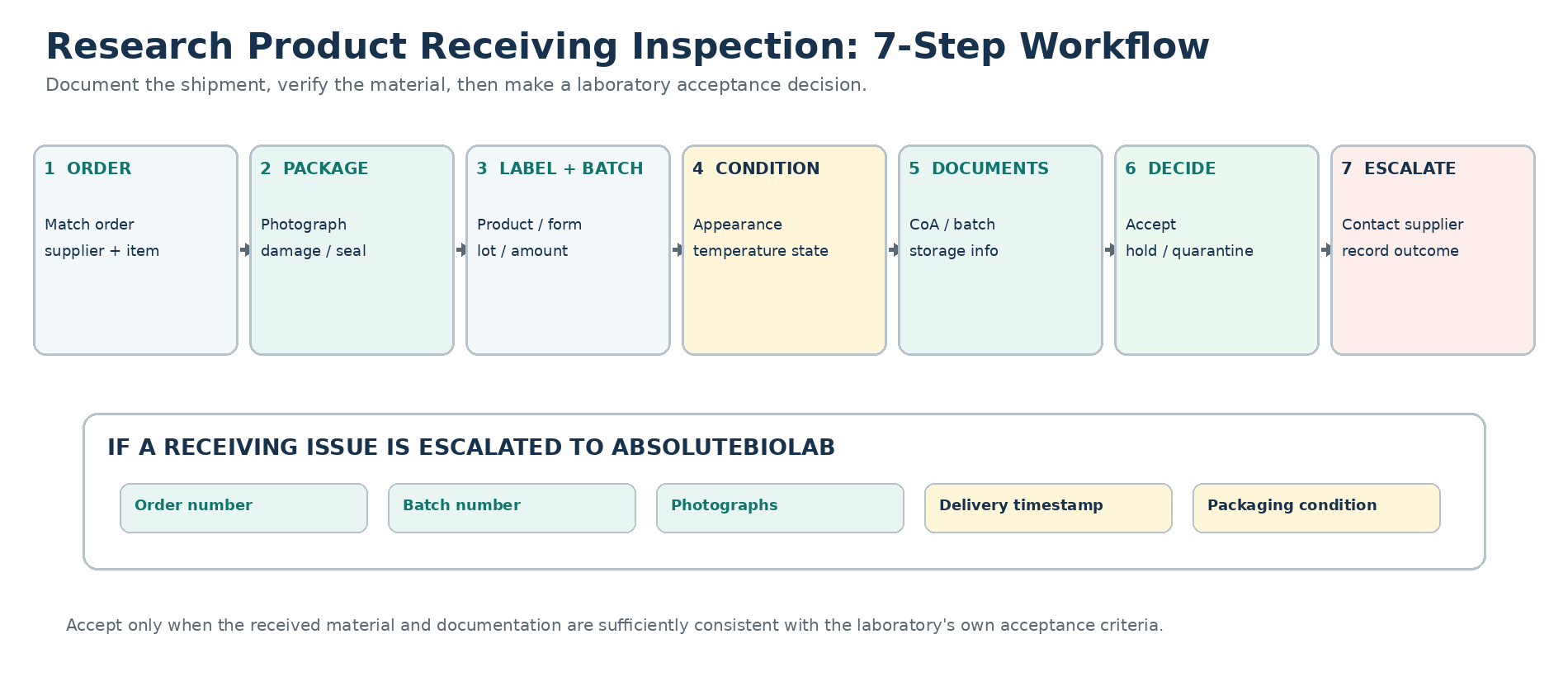
A receiving inspection should answer three questions before the material enters normal laboratory stock: (1) did the correct item arrive, (2) did it arrive in a condition consistent with the product and shipping information, and (3) is the batch-specific documentation sufficient for the laboratory’s acceptance decision?
The inspection is primarily a traceability and condition check. It is not the same as supplier-side analytical release testing, and it does not require every laboratory to repeat HPLC, mass spectrometry or other batch-release analyses on receipt. Instead, the laboratory should verify the shipment, label, batch, physical condition and documents, then decide whether to accept the material, place it on hold/quarantine under its own procedure, or contact the supplier.
Why receiving inspection matters
A product name alone is not enough to reconstruct what entered the laboratory. Good scientific records connect the received unit to its order, supplier, batch or lot, documentation, received condition and later experimental use.
OECD guidance for GLP test items covers transport, receipt, identification, labelling, handling, storage and characterisation as linked controls.[1] OECD Good In Vitro Method Practices (GIVIMP) similarly recommends recording supplier and batch/lot information for reagents, following manufacturer storage information, and documenting shipment condition where it is relevant to stability.[2] These documents govern specific GLP/regulatory contexts; they are used here for general laboratory traceability principles rather than presented as mandatory rules for every Core Research customer.
Step 1 – Match the delivery to the order
Start with the commercial record. Confirm that the supplier, order reference, product name, labelled amount or format, and quantity received are consistent with the order confirmation. If the wrong product, wrong quantity or an unexpected format has arrived, record the discrepancy before the material is incorporated into stock.
| Check | Accept when | Hold / escalate when |
|---|---|---|
| Order reference | The delivery can be matched to the correct purchase/order record. | No order can be identified or the delivery belongs to another order. |
| Product / exact entity | The label matches the exact material ordered. | Name, blend, chemical form or device format is inconsistent. |
| Quantity / labelled amount | The number of units and labelled amount/format match the order. | Units are missing, duplicated or materially different from the order. |
Step 2 – Inspect and document the packaging
Before discarding the shipping materials, record the condition in which the consignment arrived. Photograph visible damage, crushing, leakage, wet packaging, broken seals or other abnormalities. Do not infer the chemical condition of the material from appearance alone; the purpose of the photograph is to preserve receiving evidence.
European GDP guidance for medicinal products describes the receiving function as checking that the arriving consignment is correct and has not been visibly damaged in transport, and prioritising products that require special storage.[3] Core Research RUO materials are not being represented as medicinal products; the citation is used only because the receiving-control principle is relevant.
Step 3 – Verify the product label, batch and container
The batch or lot number is the key link between the physical material and its batch-specific documentation. Record it directly from the received unit. Also check that the container, seal and product format are consistent with what was ordered.
| Field to record | Why it matters |
|---|---|
| Product / exact entity | Prevents a document or batch record from being attached to the wrong material. |
| Batch / lot number | Links the received unit to the correct CoA and later experimental records. |
| Labelled amount / format | Confirms what the unit claims to contain or what format was supplied. |
| Container / closure / seal condition | Provides evidence of obvious package integrity problems. |
| Internal laboratory ID, if used | Preserves the link when the material is subsequently stored or subdivided under an internal code. |
Step 4 – Check appearance and received temperature state
Appearance is a receiving observation, not an analytical identity test. Record gross features that are inconsistent with the product record: a broken vial, leakage, an obviously disturbed closure, unexpected colour or other visible change that the laboratory considers material.
Temperature should also be treated as an observed condition rather than an automatic verdict. GIVIMP notes that shipment stability matters as well as storage and gives the example that a reagent specified to be shipped frozen should arrive frozen, with the condition documented; a data logger provides stronger evidence where one is used.[2]
If a product arrives warm, delayed or in a temperature state that conflicts with the product-specific shipping/storage information, do not apply a generic peptide-wide time/temperature threshold. Document the event and use the dedicated temperature-excursion workflow.
Temperature concern workflow: What to Do if a Research Product Arrives Warm or Delayed
Current shipping information: Core Research Shipping Policy
Step 5 – Match the batch documentation
Where a batch-specific Certificate of Analysis or supporting record is part of the laboratory’s acceptance process, confirm that the product and batch on the document match the material received. A CoA for the same product name but a different batch should not be used as the analytical record for the received batch.
At receipt, the question is usually whether the required documentation is present and correctly matched – not whether the receiving laboratory should independently repeat every test. The depth of document review should follow the laboratory’s own experimental and quality requirements.
Batch-specific documentation: Core Research CoA page
From Our Work: what to capture if a receiving issue is escalated
When a shipment-related receiving concern is escalated to Core Research, the requested evidence is: order number, batch number, photographs, delivery timestamp and packaging condition. Separately, Core Research’s own batch-review workflow checks HPLC purity, MS identity, product/batch match, appearance, labelled amount/content, water or moisture, counter-ion information, CoA/document completeness and storage/handling status. If a meaningful mismatch is identified, the batch is held while clarification and/or a retest is requested. Testing is produced by the manufacturer and/or third-party laboratories; no laboratory accreditation claim is made because none has been verified for publication.
For the receiving laboratory, the practical takeaway is to capture facts that can be matched to the supplier’s batch records. The section above does not imply that customers must reproduce Core Research’s supplier-side release review or conduct the same test panel on receipt.
Step 6 – Decide: accept, hold/quarantine, or contact the supplier
The receiving outcome should be explicit and recorded. The term ‘quarantine’ is used here in its laboratory stock-control sense: material is kept out of routine use while a discrepancy is unresolved, according to the laboratory’s own procedure.
Do not send material back simply because it is on hold. A return or replacement is a separate commercial/policy process and should follow the supplier’s instructions for the case.
Quality concern pathway: Research Product Returns, Replacement and Quality Concerns
| Outcome | Use when | Record |
|---|---|---|
| Accept | Order, product, batch, condition and required documents are sufficiently consistent with the laboratory’s acceptance criteria. | Date received/accepted, batch, relevant document reference and receiving record. |
| Hold / quarantine | A condition, label, batch, document or temperature concern is unresolved but does not require an immediate safety response. | Reason for hold, date, person/role recording it and evidence retained. |
| Contact supplier | The discrepancy requires clarification, correct documentation or a quality/shipping review. | Evidence submitted, correspondence and resulting decision. |
| Reject under laboratory procedure | The issue remains incompatible with the laboratory’s acceptance criteria after review. | Reason, evidence and final disposition; follow supplier instructions before any return. |
Step 7 – Preserve the receiving record
A receiving record is most useful when it remains linked to the later experiment. OECD data-integrity guidance treats records as part of a life cycle and emphasises controls that preserve data that affect interpretation.[4] For a laboratory, the practical objective is that a later reviewer can reconstruct which batch arrived, its received condition, what evidence was checked and what decision was made.
- Order number / purchase reference.
- Supplier and product / exact entity.
- Batch or lot number.
- Date and delivery timestamp where relevant.
- Photographs or notes on packaging/container condition where a concern exists.
- Observed temperature state or logger record, if applicable.
- CoA or supporting batch-document reference used for acceptance.
- Acceptance / hold / escalation decision and date.
- Any supplier correspondence connected to a discrepancy.
Printable receiving inspection checklist
The table below is designed to be copied into a laboratory SOP, worksheet or electronic receiving form and adapted to the laboratory’s own acceptance criteria. It is not a universal regulatory checklist.
| Done | Receiving check | Evidence / record |
|---|---|---|
| [ ] | Order reference matched | Order / PO / receipt |
| [ ] | Correct product / exact entity received | Label + order |
| [ ] | Correct number of units / labelled format | Delivery + order |
| [ ] | Outer packaging inspected | Photo if abnormal |
| [ ] | Container / closure / seal inspected | Photo / note if abnormal |
| [ ] | Batch / lot number recorded | Label |
| [ ] | Appearance checked against available product information | Receiving note |
| [ ] | Temperature state / logger checked where applicable | Observation / logger |
| [ ] | CoA / batch document matched where required | CoA / batch record |
| [ ] | Storage requirement identified before routine storage | Product / supplier info |
| [ ] | Decision recorded: ACCEPT / HOLD / CONTACT | Receiving record |
| [ ] | Any discrepancy linked to supplier correspondence | Email / ticket / case record |
Receiving-inspection mistakes to avoid
- Discarding the packaging before documenting a visible shipping problem.
- Recording the product name but not the batch or lot number.
- Using a CoA for a different batch because the product name is the same.
- Treating ‘warm to the touch’ as proof of degradation without product-specific evidence.
- Using appearance as a substitute for analytical identity or purity.
- Assuming that the receiving laboratory must repeat every supplier analytical test before acceptance.
- Moving a questionable unit into normal stock without recording the unresolved discrepancy.
- Returning material without first following the supplier’s case-specific instructions.
Frequently asked questions
Does every research product need to be quarantined when it arrives?
No. Hold or quarantine is appropriate when a discrepancy is unresolved or when the laboratory’s own procedure requires it. Material that meets the laboratory’s receiving criteria can be accepted directly.
Should I weigh the vial or repeat HPLC/MS during receiving inspection?
Not as a universal rule. Receiving inspection is primarily a condition, identity/label, batch and document check. Independent analytical testing should be driven by the laboratory’s study or quality requirements, not added automatically to every delivery.
What if the CoA batch number does not match the vial?
Do not use that CoA as evidence for the received batch. Hold the document-based acceptance decision and request the correct batch-specific record or clarification.
What if the shipment feels warm?
Record the shipment condition and use product-specific evidence. Warmth alone does not establish degradation. Follow the dedicated warm/delayed shipment workflow.
What information should I send Core Research about a delivery concern?
Send the order number, batch number, photographs, delivery timestamp and packaging condition.
When can the material move into accepted laboratory stock?
When the required order, product, batch, received-condition and documentation checks are sufficiently consistent with the laboratory’s own acceptance criteria and any material discrepancy has been resolved.
Key takeaway
Receiving inspection is the hand-off between shipping and experimental traceability. Match the delivery to the order, document the packaging, record the product and batch, assess appearance and temperature state, match the required batch documents, then record an explicit accept / hold / contact decision. The objective is not to prove every quality attribute at the receiving bench; it is to ensure that the material entering laboratory stock is identifiable, documented and consistent with the evidence required for its intended research use.
References
- OECD. Management, Characterisation and Use of Test Items used in GLP studies. OECD Series on Principles of Good Laboratory Practice and Compliance Monitoring, No. 19. 2018. DOI: 10.1787/da9ee953-en. Used for general receipt, identification, labelling, handling, storage and traceability principles; not presented as a requirement for every RUO purchase.
- OECD. Guidance Document on Good In Vitro Method Practices (GIVIMP). OECD Series on Testing and Assessment, No. 286. 2018. DOI: 10.1787/9789264304796-en. Used for general reagent batch records, manufacturer storage information and shipment-condition documentation principles.
- European Commission. Guidelines of 5 November 2013 on Good Distribution Practice of medicinal products for human use (2013/C 343/01), sections 5.4-5.5. Used only as a comparative receiving-control principle; Core Research RUO products are not represented as medicinal products.
- OECD. GLP Data Integrity. OECD Series on Principles of Good Laboratory Practice and Compliance Monitoring, No. 22. 2021. DOI: 10.1787/45779212-en. Used for general data-life-cycle and reconstructable-record principles.