Returns Replacement & Quality Concerns Guide
Returns Replacement & Quality Concerns Guide
RESEARCH USE ONLY
This guide covers post-purchase quality-event documentation for laboratory research materials. It does not provide dosing, administration, reconstitution, treatment or veterinary-use guidance.
What should you do when you have a quality concern?
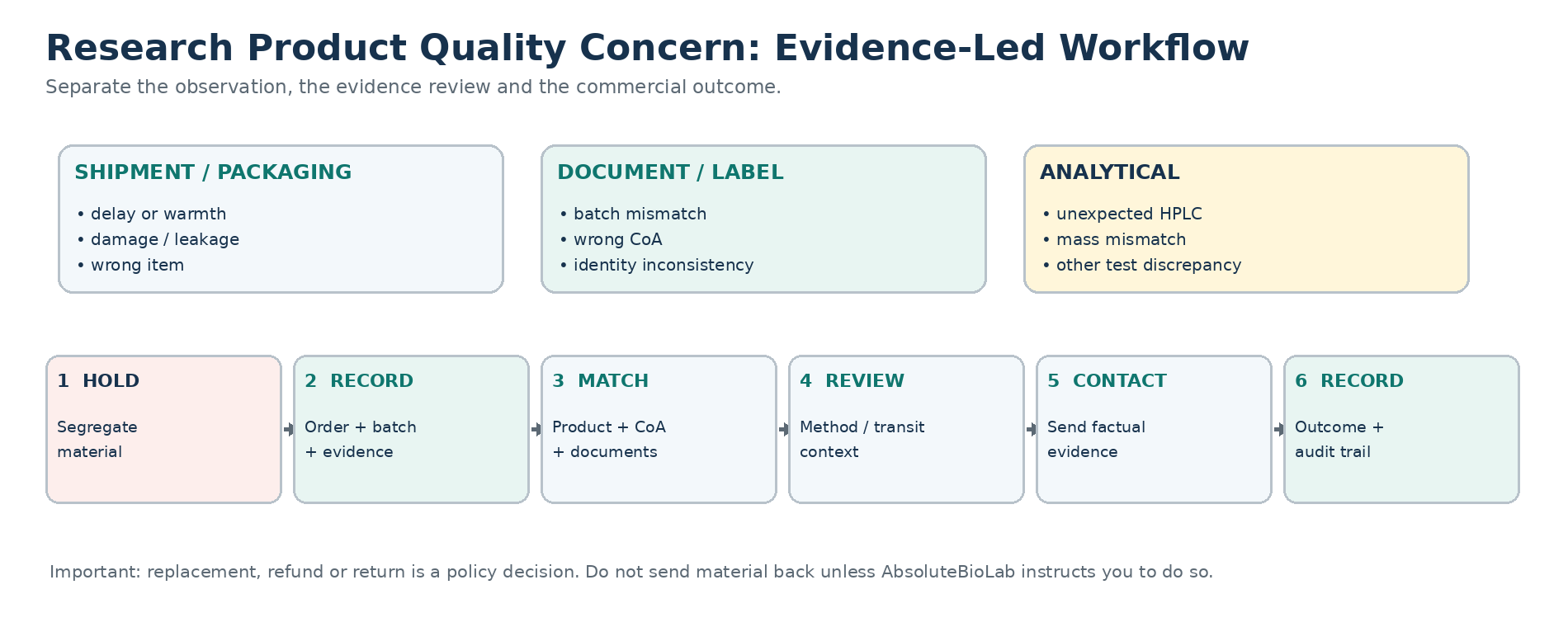
Treat the concern as a documented laboratory event rather than jumping directly to a replacement request or a conclusion that the material has failed. Keep the affected material identifiable and separate from routine stock while the issue is assessed, record what you observed, match the product and batch to the relevant order and Certificate of Analysis (CoA), and contact Core Research with factual supporting evidence.
The commercial outcome is a separate step. Core Research’s current Terms state a strict no-returns policy and direct customers to the Return Policy for the circumstances in which a replacement or other remedy may apply. Do not send research material back unless Core Research specifically instructs you to do so.
Current policy documents: Terms & Conditions · Return Policy
1. Identify what kind of concern you are reporting
Different concerns require different evidence. Classifying the observation helps the laboratory and supplier avoid treating a transit event, a document mismatch and an analytical discrepancy as the same problem.
| Concern type | Examples | Useful evidence |
|---|---|---|
| Shipment / packaging | Delay, package arrived warm, visible parcel damage, leakage, broken container, wrong item. | Order number, batch number, photographs, delivery timestamp, packaging condition, tracking information. |
| Product / label / document | Label does not match order; batch on CoA differs from received batch; product identity or format is inconsistent across records. | Order confirmation, product label, batch/lot number, CoA or report, clear photographs. |
| Analytical discrepancy | Laboratory result appears inconsistent with the batch CoA or expected identity/profile. | Batch-matched CoA, raw/processed analytical data, instrument/method information, sample-preparation context and observed result. |
| Experimental outcome only | An assay did not behave as expected, without an independent material or documentation discrepancy. | Investigate the experiment first. An unexpected research outcome alone does not establish supplier non-conformance. |
2. Put the affected material on hold and preserve the evidence
If the concern could affect whether the material should be used in further work, keep the affected unit clearly identified and separate from routine use while the evidence is reviewed. Maintain the documented storage conditions for that exact product and preserve the packaging, label and associated records. If the container is damaged or leaking, follow your laboratory’s own chemical-safety procedure.
OECD guidance for GLP test items illustrates the wider traceability principle: test materials should be received, identified, labelled, handled, stored and characterised in a way that preserves their identity and study context.[1] That guidance applies to GLP studies rather than to every RUO purchase, but the record-keeping logic is useful for any laboratory trying to reconstruct a quality event.
3. Match the concern to the exact order, product and batch
A quality concern should be tied to the specific material involved. Confirm the product name or exact entity, the order reference and the batch/lot number. Then verify that any CoA or analytical report you are using belongs to that same batch. A CoA for another batch is not the analytical record for the material being reviewed.
Batch document lookup: Core Research CoA page
How to interpret the matched document: How to Read a Peptide Certificate of Analysis
Batch traceability: Why Batch Numbers and Lot Traceability Matter
4. What to send Core Research
For a label or documentation mismatch, include clear photographs and the batch-specific document involved. For an analytical discrepancy, include the relevant data and enough method context to understand what was measured. If you do not have every analytical detail, send what is available and describe the observation factually rather than declaring the batch defective before the evidence is reviewed.
From Our Work: shipment-related quality concerns
For a shipment concern, Core Research asks for five concrete details: the order number, batch number, photographs, delivery timestamp and packaging condition. These are the supplied operational inputs for this guide. No additional response-time, replacement, testing or refund promise is implied by this list.
Submit a quality enquiry through: Contact Core Research
5. How to assess an analytical discrepancy without over-claiming
A result that differs from the CoA deserves investigation, but a single conflicting measurement does not automatically prove that either laboratory result is wrong. Analytical procedures are purpose- and method-dependent. ICH Q2(R2) sets out validation principles for analytical procedures used for identity, purity/impurities, assay and other measurements; the method has to be suitable for the analytical question being asked.[2]
For example, an HPLC purity result should be compared with appropriate chromatographic method context, while a mass-spectrometry result should be interpreted using the correct ion/adduct, charge-state and mass context. If the concern is truly an out-of-specification result relative to a defined criterion, the useful principle is to investigate the result and the measurement process before assigning a cause. FDA’s OOS guidance expresses that principle for pharmaceutical production; it is cited here as an investigation framework, not as a regulatory requirement for Core Research RUO materials.[3]
| Check | Why it matters | Do not assume |
|---|---|---|
| Correct batch | The laboratory result and supplier CoA must refer to the same material. | A product-level CoA represents every batch. |
| Method purpose | HPLC, MS and other techniques answer different analytical questions. | One technique proves every quality attribute. |
| Sample preparation | Concentration, solvent, filtration, handling and preparation can affect observed data. | Every unexpected trace originated in the supplied material. |
| Raw + processed data | Preserving both helps distinguish observation, integration/processing and interpretation. | A screenshot alone contains all necessary method context. |
| Defined criterion | A ‘failed’ result requires a criterion against which it failed. | A difference from another laboratory’s number is automatically OOS. |
6. What happens after the concern is submitted?
The page should not promise a predetermined replacement, refund, credit note, independent re-test or response time. The next step depends on the evidence, the type of concern and the current Terms and Return Policy.
Because the current Terms describe a strict no-returns policy, customers should not post research material back on their own initiative. If a physical return, disposal confirmation or another action is required, follow the instructions provided for the specific case.
| Possible next step | What it means | Policy boundary |
|---|---|---|
| Clarification / document correction | The issue can be resolved by matching the correct batch, document, label or order information. | No return or replacement is implied. |
| Additional evidence requested | More information is needed to understand the observation or analytical discrepancy. | Provide the requested factual material; avoid altering/discarding the affected unit unless instructed. |
| Shipment or quality remedy under policy | The current policy may provide a remedy for defined circumstances such as eligible transit loss or another covered issue. | Eligibility and remedy are governed by the current Return Policy/Terms, not by this guide. |
| No supplier non-conformance established | The available evidence does not demonstrate that the supplied material failed the applicable evidence/specification. | The laboratory should document its own final disposition and reasoning. |
7. Warm, delayed or damaged deliveries: use the transit workflow
A warm or delayed shipment is a specific kind of quality concern and should not be treated as automatic proof of degradation. Document the shipment condition, match the product and batch, review product-specific evidence and contact support when the event cannot be resolved from the available documentation.
Use the dedicated workflow: What to Do if a Research Product Arrives Warm or Delayed
Receiving inspection: Research Product Receiving Inspection and Batch Acceptance Checklist
Shipping information: Research Product Shipping and Delivery Information
8. Record the final outcome
The quality-event record should be complete enough for a later researcher, QA reviewer or procurement colleague to understand what happened, what evidence was reviewed and how the material was ultimately treated. OECD data-integrity guidance describes data as a life-cycle issue and emphasises risk-based controls over records that affect study interpretation.[4] Again, the OECD document governs GLP contexts; here it supports the general principle that a quality decision should be reconstructable from contemporaneous records.
- Order reference and product identity.
- Batch / lot number.
- Date the concern was observed or reported.
- Photographs or other received-condition evidence where relevant.
- CoA / analytical record used in the assessment.
- Any laboratory analytical data and method context supplied.
- Supplier correspondence and any requested follow-up.
- Final laboratory disposition: accepted, kept on hold, rejected, replaced under policy or otherwise resolved.
Long-term record management: Research Batch Documentation Retention and Experimental Audit Trails
If lot continuity matters after resolution: Repeat-Batch Procurement and Lot-Continuity Planning
What is not, by itself, evidence of a product defect?
- An experiment produced an unexpected biological or analytical outcome without an independent material discrepancy.
- A package felt warm, with no product-specific stability evidence showing that the observed transit event caused degradation.
- A different batch of the same product has a different laboratory result, without considering method and batch context.
- A vial looks different from memory but remains consistent with the documented product/batch description.
- An HPLC result differs from another laboratory’s result when the analytical methods or integration conditions are not comparable.
Any of these observations may justify a closer look. The point is that the observation and the conclusion should be kept separate until the relevant evidence has been reviewed.
Frequently asked questions
Should I send the product back as soon as I report a concern?
No. Core Research’s current Terms state a strict no-returns policy. Do not send research material back unless you are specifically instructed to do so for the case.
What should I send for a warm or delayed shipment?
Send the order number, batch number, photographs, delivery timestamp and packaging condition. These are the current business-supplied inputs for shipment-related concerns.
Does an HPLC or mass-spectrometry mismatch automatically mean the batch failed?
No. Confirm that the data refer to the same batch and review the analytical method, sample preparation and interpretation. A discrepancy should be investigated before the cause is assigned.
Will every valid quality concern receive a replacement or refund?
No automatic remedy is promised by this guide. The outcome depends on the current Return Policy, Terms, the type of concern and the evidence available.
Can an unexpected experiment result be used as proof that the product is defective?
Not by itself. Experimental outcomes can be influenced by many variables. A supplier-quality concern is stronger when it is tied to product identity, batch documentation, physical condition or appropriate analytical evidence.
What should I keep after the case is closed?
Keep the order and batch identifiers, the CoA or relevant report, submitted evidence, correspondence and the final laboratory disposition with the batch record.
Key takeaway
A quality concern should move through an evidence chain: hold the affected material, record the observation, match the exact order/product/batch, review the relevant documentation or analytical context, contact support with factual evidence and retain the final outcome. Replacement, refund or return is not automatic and must follow the current policy for the specific case.
References
- OECD. Management, Characterisation and Use of Test Items used in GLP studies. OECD Series on Principles of Good Laboratory Practice and Compliance Monitoring, No. 19. 2018. DOI: 10.1787/da9ee953-en. Used for general material-identification, receipt, handling, storage and traceability principles; not presented as a requirement for every RUO purchase.
- ICH Q2(R2). Validation of Analytical Procedures. Final guidance, March 2024. Used for the principle that analytical procedures should be suitable for their intended analytical purpose.
- U.S. Food and Drug Administration. Investigating Out-of-Specification (OOS) Test Results for Pharmaceutical Production. Final Level 2 Revised Guidance, May 2022. Used only as a general investigation framework for unexpected analytical results; not as an RUO regulatory requirement.
- OECD. GLP Data Integrity. OECD Series on Principles of Good Laboratory Practice and Compliance Monitoring, No. 22. 2021. DOI: 10.1787/45779212-en. Used for general data-lifecycle and reconstructable-record principles.