What to Do if a Product Arrives Warm or Delayed
What to Do if a Product Arrives Warm or Delayed
RESEARCH PURPOSES ONLY
This guide is for laboratory quality-event documentation only. It does not provide dosing, reconstitution, injection, administration or therapeutic guidance. All Core Research products are supplied for controlled in-vitro research use only and are not intended for human or veterinary use.
What should you do first?
Do not treat a warm package as automatic proof that the material has degraded. Record the condition in which the shipment arrived, keep the material segregated while the concern is assessed, identify the exact product and batch, and compare the event with product-specific storage, shipping and stability evidence. Temperature is one factor in peptide and protein stability, but its effect depends on the molecule, physical state, formulation, moisture, packaging and duration of exposure.[1–3]
For an Core Research shipping concern, include the order number, batch number, photographs, delivery timestamp and packaging condition when you contact the team. These details give the support process a documented starting point without requiring the laboratory to guess at product integrity.
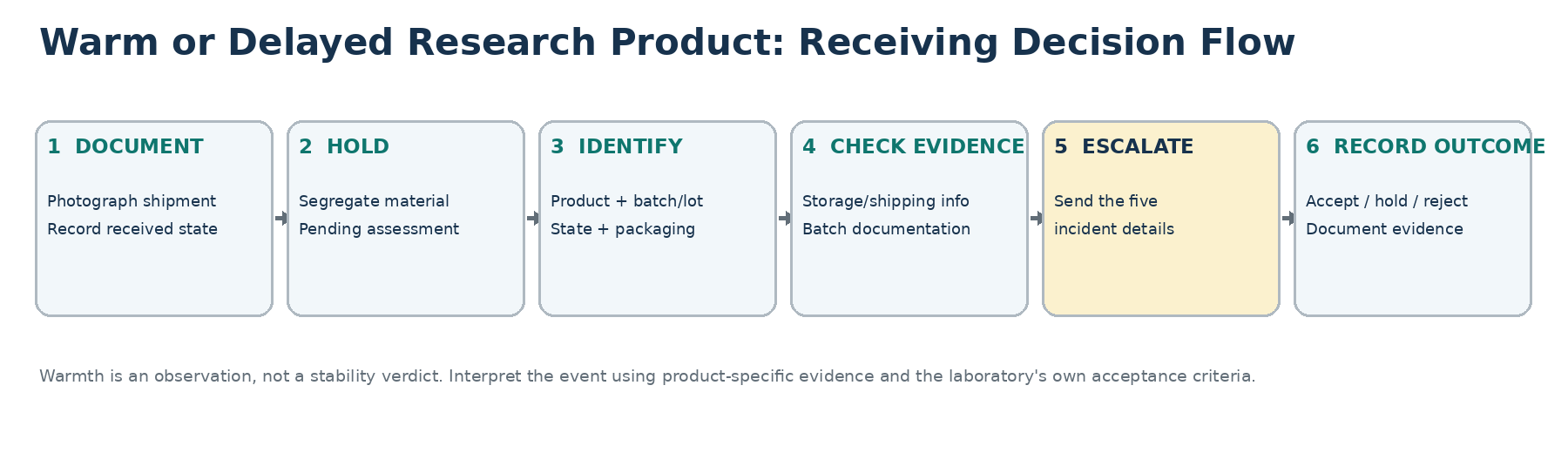
A six-step receiving workflow
1. Document the shipment before altering it
Record what was actually received before the packaging or product state changes. Photograph the outer parcel, internal packaging, vial or container, seals and any obvious damage. Record the delivery timestamp and preserve the tracking information. For Core Research support, include the order number, batch number, photographs, delivery timestamp and packaging condition.
2. Place the material on hold while the concern is assessed
A quality concern should be treated as a receiving event, not solved by assumption. Keep the affected material clearly identified and separate from routine laboratory stock while the available evidence is reviewed. Follow your laboratory’s own receiving, quarantine or deviation procedure where one exists.
3. Confirm exactly what material arrived
Check the product name, strength or labelled amount, batch/lot number, physical state and container or device format. A lyophilised powder, a solution and a pen cartridge may have different stability profiles and different evidence available. Confirming the exact material is necessary before any product-specific evidence can be applied.
4. Review the available product-specific evidence
Check the batch Certificate of Analysis, product page, any available storage or shipping information and the supplier’s published shipping policy. The question is whether the available evidence supports a decision about the material’s acceptability for the intended research use — not whether a universal rule has been met. See Analytical Release Criteria for Research Peptides for the distinction between batch-specific evidence and universal claims.
5. Decide whether to accept, hold or escalate
If the available evidence is sufficient and the material meets the laboratory’s own acceptance criteria, it may be accepted for the intended research workflow. If the evidence is insufficient, the material should remain on hold and the concern escalated to the supplier or to the laboratory’s quality process. Escalation is not a verdict — it means the laboratory does not yet have enough information to make a defensible decision. Contact the supplier earlier rather than later before incorporating the material into an experiment. Give the supplier the documented facts rather than an inferred diagnosis of degradation.
6. Record the final disposition
Document the laboratory’s final decision and the evidence used: accepted for the intended research workflow, retained on hold pending further information, rejected, returned or otherwise resolved. Link the decision to the order, product, batch and any supplier correspondence so the event can be reconstructed later.
Why ‘warm to the touch’ is not a stability verdict
Peptide stability is molecule- and condition-specific. Sequence, concentration, pH, charge, excipients, surfaces and interfaces, impurities, temperature, agitation and lyophilisation can all affect physical stability.[1] Chemical reactions can also occur in solid peptide and protein materials; temperature, moisture content, excipients and the physical state of the formulation are among the factors that influence solid-state degradation.[2]
This is why blanket rules such as ‘ambient temperature is always safe’, ‘a warm vial is unusable’, or ‘lyophilised material tolerates X days at Y degrees’ are not defensible without evidence for the exact material and formulation. Lyophilisation can reduce molecular mobility and is widely used to improve storage stability, but it does not make a peptide immune to chemical or physical change.[1,2]
Temperature-excursion frameworks in pharmaceutical quality systems similarly evaluate excursions in the context of the product’s stability, packaging, storage and shipping conditions rather than using touch temperature alone.[3] Those pharmaceutical frameworks are useful for the principle of evidence-based excursion assessment, but they are not direct storage specifications for an Core Research Research Use Only product.
What evidence should a laboratory capture?
| Evidence type | What it can show | What it cannot show alone |
|---|---|---|
| Photographs on receipt | Packaging condition, visible damage, labelling | Internal product integrity |
| Delivery timestamp and tracking | Transit duration, carrier events | Temperature history during transit |
| Temperature logger (if supplied) | Recorded temperature profile during transit | Product-specific stability under that profile |
| Batch Certificate of Analysis | Analytical results at time of testing | Post-dispatch condition or transit stability |
| HPLC chromatographic purity | Relative peak-area composition under a defined method | Identity, physical stability, aggregation, formulation integrity |
| Mass spectrometry | Molecular mass / identity evidence | Purity, physical stability, concentration |
How product state changes the assessment
The same delivery event cannot be interpreted identically across all research materials. A useful first distinction is the physical state and formulation of the received product.
| Physical state | Considerations |
|---|---|
| Lyophilised powder (vial) | Generally lower molecular mobility; stability still depends on moisture, temperature, excipients and the specific molecule. A warm vial does not automatically mean degradation, but the absence of evidence is not evidence of stability. |
| Lyophilised powder (pen cartridge) | Same considerations as vial format, plus device-specific packaging and seal integrity. |
| Solution or reconstituted material | Solutions are generally more susceptible to temperature-dependent degradation than lyophilised solids. pH, concentration, buffer composition and container surfaces are additional factors. |
What can the CoA, HPLC and mass spectrometry tell you?
Analytical documents and methods can answer important questions, but they should not be used beyond their scope. Orthogonal techniques are often needed to characterise different forms of peptide or protein instability.[4]
| Method / document | Useful for | Not sufficient alone for |
|---|---|---|
| Batch CoA | Confirming batch identity, methods applied, results at time of testing | Proving post-dispatch stability or transit conditions |
| RP-HPLC | Chromatographic purity profile under a defined method | Detecting all forms of instability (aggregation, physical change, formulation loss) |
| ESI-MS | Molecular mass / identity confirmation | Quantitative purity, physical stability, concentration |
When should the event be escalated?
- The outer or inner packaging is damaged, wet, leaking or visibly compromised.
- A vial, cartridge, seal or closure is damaged or cannot be confirmed intact.
- The product or batch received does not match the order or available documentation.
- The shipment was materially delayed and there is no product-specific evidence that lets the laboratory interpret the event.
- A temperature logger, if supplied, records an excursion outside the product’s documented conditions.
- The laboratory’s own receiving SOP requires quarantine or quality review.
- The material is intended for an experiment where an unresolved integrity question would undermine data quality or reproducibility.
Escalation does not automatically mean the product has failed. It means that the laboratory does not yet have enough evidence to make a defensible acceptance decision.
What to send Core Research
- Shipping policy: Core Research Shipping Policy
- Quality concern / replacement workflow: Research Product Returns, Replacement and Quality Concerns
- Contact: Contact Core Research
After the incident: retain the quality record
Keep the incident record with the order and batch documentation. At minimum, retain the evidence captured on receipt, the supplier correspondence, any analytical information used in the assessment and the final laboratory disposition. This makes it possible to connect a later experimental result back to the exact batch and receiving event rather than relying on memory.
Related guide: Research Batch Documentation Retention and Experimental Audit Trails
Frequently asked questions
Does a warm package mean the research product is unusable?
No. Warmth is an observation, not a product-specific stability result. The significance of the event depends on the exact material, physical state/formulation, packaging, exposure history and the stability evidence available for that product.
Should I alter or prepare the material before documenting the concern?
Document the received state first. Photograph the shipment and record the identifiers and timing before changing packaging or product condition. Then follow the laboratory’s SOP and product-specific instructions.
Can a CoA prove that the shipment remained stable in transit?
No. A CoA documents the analytical results and identifiers shown for the batch. It does not normally record the temperature history after dispatch.
Is HPLC the definitive test for a temperature excursion?
No single method is definitive for every type of stability concern. HPLC can provide a chromatographic purity/profile result under a defined method, while other questions may require identity, physical-stability or formulation-specific evidence.
What information should I send Core Research?
Send the order number, batch number, photographs, delivery timestamp and packaging condition. These details allow the shipping concern to be reviewed against the relevant order and product information.
Key takeaway
A delayed or warm shipment should be handled as a documented laboratory quality event. Capture the received condition, identify the exact product and batch, review product-specific evidence, hold the material when the evidence is insufficient, and record the final disposition. Avoid universal temperature thresholds: stability conclusions should follow the evidence for the exact material and formulation.
References
- Zapadka KL, Becher FJ, Gomes dos Santos AL, Jackson SE. Factors affecting the physical stability (aggregation) of peptide therapeutics. Interface Focus. 2017;7(6):20170030. DOI: 10.1098/rsfs.2017.0030.
- Lai MC, Topp EM. Solid-state chemical stability of proteins and peptides. Journal of Pharmaceutical Sciences. 1999;88(5):489–500. DOI: 10.1021/js980374e.
- United States Pharmacopeia. General Chapter <1079.2> Mean Kinetic Temperature in the Evaluation of Temperature Excursions During Storage and Transportation of Drug Products. USP-NF. 2025. DOI: 10.31003/USPNF_M13855_04_01.
- Reubsaet JL, Beijnen JH, Bult A, van Maanen RJ, Marchal JA, Underberg WJ. Analytical techniques used to study the degradation of proteins and peptides: physical instability. Journal of Pharmaceutical and Biomedical Analysis. 1998;17(6–7):979–984. DOI: 10.1016/S0731-7085(98)00064-8.
- ICH Q1A(R2). Stability Testing of New Drug Substances and Products. Final guidance, November 2003. Used here only as an example of evidence-based stability-study design, not as a direct RUO product specification.
See also: Research Product Receiving Inspection • Certificate of Analysis Portal