Analytical Release Criteria for Research Peptides
Analytical Release Criteria for Research Peptides
RESEARCH USE ONLY
This guide explains batch-review and analytical-documentation principles for laboratory research materials. It does not provide dosing, administration, reconstitution, treatment or veterinary-use guidance.
What are analytical release criteria?
Analytical release criteria are the evidence and decision rules used to determine whether a specific batch is acceptable for release, should remain on hold, or needs clarification or justified retesting. The key concept is not a single purity percentage. A release decision should consider the attributes that actually define the material and the quality questions relevant to that exact product.
In pharmaceutical quality guidance, a specification is defined as a list of tests, analytical procedures and acceptance criteria used to decide whether a material conforms to its intended quality standard.[1] Core Research supplies Research Use Only materials, so pharmaceutical ICH specifications are not presented here as regulatory requirements. The useful scientific principle is that release should be based on a defined, product-specific evidence set rather than a generic marketing threshold.
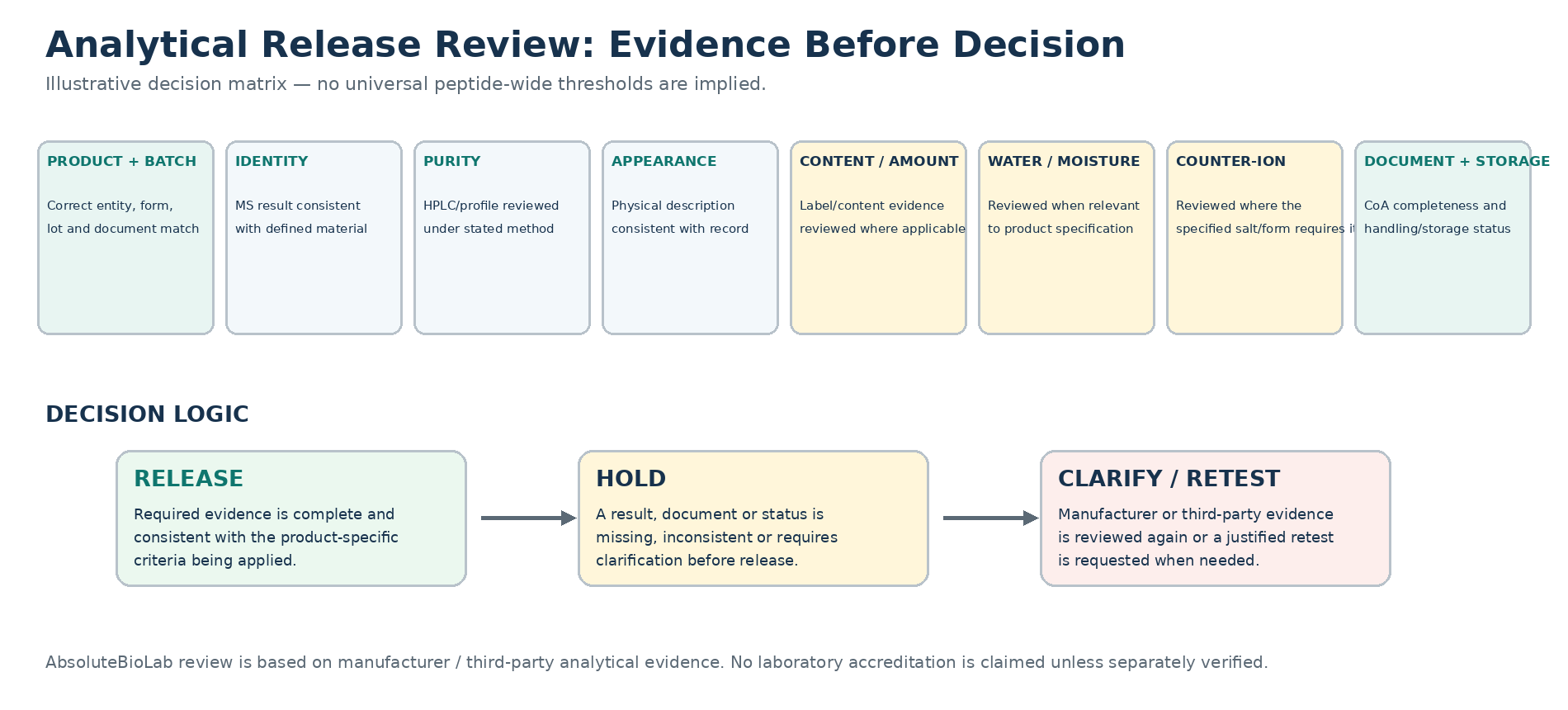
From Our Work: the Core Research batch-review workflow
Before accepting a batch for sale, Core Research reviews: HPLC purity, MS identity, the product/batch match, appearance, labelled amount/content, water or moisture, counter-ion information, CoA/document completeness and storage/handling status. If a meaningful mismatch is identified, the batch is held while clarification and/or a retest is requested. The analytical testing is produced by the manufacturer and/or third-party laboratories; this workflow describes Core Research’s review of that evidence and does not imply in-house analytical testing. No laboratory accreditation claim is made because no accreditation has been verified for publication.
These fields do not all need the same analytical method or the same numerical acceptance rule. Water/moisture and counter-ion evidence, for example, are meaningful only when they are applicable to the exact material, form and batch specification. Likewise, labelled amount/content should not be inferred from HPLC area percentage unless an appropriate quantitative method actually supports that conclusion.
The release matrix: what each evidence layer contributes
| Release attribute | What is reviewed | What it does not establish by itself |
|---|---|---|
| Product + batch match | Product/entity, stated form, batch/lot number and document linkage. | Quality of the batch without supporting analytical evidence. |
| MS identity | Observed/deconvoluted mass versus theoretical mass, charge/deconvolution context and any meaningful mismatch. | Chromatographic purity, peptide content by mass or stereochemical proof. |
| HPLC purity/profile | Batch-specific chromatographic purity/profile under the stated method. | Molecular identity by retention time alone or absolute material composition. |
| Appearance | Recorded physical description and any visible inconsistency. | Chemical identity or chromatographic purity. |
| Labelled amount / content | The stated amount and any quantitative content/assay evidence that actually applies to the product. | A quantitative result if the batch documentation does not contain an appropriate assay/content measurement. |
| Water / moisture | Applicable moisture result or status when moisture is a defined product attribute. | Universal suitability of one moisture limit for every peptide or compound. |
| Counter-ion | Counter-ion identity/content evidence when the specified chemical form requires it. | Counter-ion quantity from HPLC-UV peptide purity alone. |
| CoA / document completeness | Correct batch, methods/results, dates and other fields needed to interpret the evidence. | Accuracy of an unsupported or mismatched analytical claim. |
| Storage / handling status | Whether available batch/storage/handling information is consistent with the material being reviewed. | A universal shelf life or proof that every later transit event was acceptable. |
Identity and purity should be reviewed as separate questions
A release review should not treat one analytical technique as proof of every quality attribute. HPLC and mass spectrometry are complementary. HPLC can provide a chromatographic profile and purity result under a defined method, while MS can support molecular identity by comparing observed mass evidence with the theoretical mass of the intended material.
ICH Q6A expresses the same specificity principle in its pharmaceutical context: identification by a single chromatographic retention time is not considered sufficiently specific, while combined methods such as HPLC/MS can provide stronger identification evidence.[1] For an RUO batch review, the practical implication is simple: a high HPLC area percentage should not be treated as identity confirmation, and a correct intact mass should not be treated as a purity measurement.
Detailed purity interpretation: What Is HPLC Purity in Peptide Testing?
Detailed identity interpretation: What Is Mass Spectrometry in Peptide Identity Testing?
Why there should not be one universal release threshold
A universal rule such as ‘every research peptide must be >=98% or >=99% by HPLC’ is too blunt to describe a defensible release system. The meaningful acceptance criteria depend on the exact material, the analytical method, relevant impurity risks and the intended laboratory decision.
ICH Q6A requires specifications and criteria to be justified for the particular substance or product, and it distinguishes broadly applicable tests from tests that are specific to particular materials.[1] Modern ICH Q14 guidance similarly frames analytical procedures as science- and risk-based tools that should be suitable for the quality attribute they are intended to assess.[2]
For Core Research, that means the public-facing release guide should explain the decision architecture without inventing fixed company-wide HPLC, mass-error, water, counter-ion or content limits that have not been verified from the relevant product/batch specification.
Appearance: useful evidence, but not an identity test
Appearance is a legitimate release attribute because obvious inconsistency in physical state, colour or container condition can signal a documentation, packaging or material problem. Q6A includes description/appearance among generally relevant quality attributes in its pharmaceutical scope.[1]
However, appearance remains a qualitative observation. A white lyophilised cake, powder or clear solution does not prove that the material has the expected molecular identity or purity. If appearance is inconsistent with the batch record, the appropriate action is to hold the batch and clarify the discrepancy rather than infer the cause from appearance alone.
Labelled amount and peptide content are not the same as HPLC area %
A vial label may state a nominal amount, but quantitative peptide content is a separate analytical question from chromatographic purity. HPLC area normalisation describes the relative detector area of chromatographic peaks; it does not directly measure the mass fraction of peptide in a lyophilised material.
Peptide certified-reference-material work demonstrates why orthogonal quantitative methods may be needed when peptide mass fraction matters. Melanson and colleagues combined quantitative NMR, LC-MS/MS amino-acid analysis and mass-balance information to assign peptide purity/content, including explicit correction for TFA counter-ion.[5]
The release implication is not that every research peptide must undergo those reference-material methods. It is that a content claim should be supported by a method capable of measuring content, rather than calculated from the HPLC purity percentage.
Water or moisture: include it when it is relevant to the material
Moisture can matter to the composition and stability of some solid research materials, particularly hygroscopic materials or products for which water is a defined specification attribute. Q6A specifically identifies water content as an applicable test when a substance is hygroscopic, moisture-sensitive or a stoichiometric hydrate.[1]
That does not justify one universal moisture cut-off for every peptide or compound. The release review should compare the reported water/moisture evidence with the product-specific criterion, if one applies. If the material does not have a defined moisture requirement, the guide should not invent one.
Counter-ion review: confirm the specified chemical form
Synthetic peptides may be supplied with counter-ions such as trifluoroacetate, acetate or chloride. Counter-ion information can matter to material composition and to the interpretation of a labelled salt/form, but peptide HPLC purity does not automatically measure counter-ion content.
For a release decision, the key questions are whether the specified peptide form is clear, whether the batch evidence is consistent with that form and whether a quantitative counter-ion result is available when the product specification requires one. Do not claim ‘TFA-free’, ‘acetate form’ or a specific counter-ion percentage unless the actual batch evidence supports it.
Related guide: Residual TFA, Counter-Ions and Peptide Desalting
Document completeness is part of the release decision
A technically acceptable result is not useful if it cannot be matched to the correct material. The release file should make it possible to identify the exact product and batch, understand the analytical result being relied on and distinguish observed results from the criteria or status applied to them.
Core Research should not add an accreditation badge or claim to this page unless the accreditation, certificate scope, issuing body and laboratory identity have been independently verified. The current supplied business input explicitly confirms that no accreditation claim is approved for publication.
How to read batch documents: How to Read a Peptide Certificate of Analysis
Batch traceability: Why Batch Numbers and Lot Traceability Matter
| Document check | Release question |
|---|---|
| Product/entity and form | Does the analytical document describe the exact material being sold? |
| Batch/lot number | Does the CoA/report belong to this batch? |
| Test / method | Is the analytical attribute and method identifiable? |
| Result | Is the measured value or conclusion visible and interpretable? |
| Acceptance/status where used | Is the PASS/FAIL or acceptance decision tied to a stated criterion rather than a marketing label? |
| Test/report date | When was the evidence generated? |
| Laboratory/source attribution | Is it clear whether the result came from the manufacturer or a third-party laboratory? |
Release, hold, clarification and retest
The result of the review should be explicit. A batch should not drift into a released state simply because most fields look acceptable.
The supplied Core Research workflow is hold plus clarification/retest when a meaningful mismatch is found. FDA’s OOS guidance, although written for pharmaceutical manufacturing rather than RUO supply, provides a useful scientific caution: unexpected results should be investigated, and retesting should not be used simply to ‘test into compliance’.[4]
| Decision | When it is appropriate | What happens next |
|---|---|---|
| Release | The required product-specific evidence is present, correctly matched and consistent with the criteria being applied. | The batch can proceed to sale under the documented RUO product specification. |
| Hold | A meaningful result, document, storage status or product/batch relationship is missing, inconsistent or unresolved. | Do not release while the issue remains open. |
| Clarification | The analytical or manufacturer record may be correct but needs additional context, correction or explanation. | Request the missing or corrected evidence and re-review the full release set. |
| Retest / re-analysis | A scientifically justified repeat analysis is needed to resolve an analytical question. | Review the retest with the original result and investigation context; do not simply replace an inconvenient result with a passing one. |
| Reject / do not release | The issue cannot be resolved to the product-specific release standard. | The batch should not be represented as released/accepted. |
How to treat third-party and manufacturer testing
Core Research’s release review relies on analytical evidence produced by the manufacturer and/or third-party laboratories. This division of roles should be stated clearly: the laboratory generates the analytical data; Core Research reviews the batch-specific evidence against the applicable product/release requirements.
A third-party result is not automatically superior simply because it is external, and a manufacturer result is not automatically invalid. What matters for the review is traceability to the batch, method suitability, result interpretability and the reliability of the evidence being used. If an accreditation status is commercially important, it should be verified against the exact laboratory, standard, scope and validity period before publication.
A practical release-review checklist
- Confirm the exact product/entity, stated form and batch/lot.
- Match every analytical document to that product and batch.
- Review MS identity evidence against the theoretical mass using appropriate charge/deconvolution context.
- Review HPLC purity/profile under the stated chromatographic method; do not use it as identity proof.
- Check appearance against the batch/product record.
- Review labelled amount/content evidence using the method that actually supports the claim.
- Review water/moisture where it is an applicable product attribute.
- Review counter-ion evidence where the specified form requires it.
- Confirm CoA/report completeness, dates and laboratory/source attribution.
- Confirm the available storage/handling status is not inconsistent with the release decision.
- If a meaningful mismatch exists: HOLD, request clarification and/or a justified retest, then review the complete evidence set again.
Frequently asked questions
Does every research peptide need the same release tests?
No. Identity, purity and batch/document matching are core analytical questions, but other attributes such as water, counter-ion or quantitative content depend on the exact material and product specification.
Is a 99% HPLC result enough to release a batch?
Not by itself. HPLC area percentage addresses chromatographic purity under a defined method. Identity, batch match and any other applicable release attributes still need to be reviewed.
Does Core Research perform all of the analytical testing in-house?
No. The supplied business workflow states that analytical testing is produced by the manufacturer and/or third-party laboratories. Core Research reviews that evidence before accepting a batch.
Are the testing laboratories ISO 17025 accredited?
No accreditation claim is approved for this page because no laboratory accreditation has been verified for publication. A future accreditation claim should identify the exact laboratory, standard, scope and valid certificate.
What happens if one result does not match?
The batch is held while clarification and/or a justified retest is requested. The mismatch should be resolved in the context of the full evidence set rather than ignored.
Can a retest simply replace a failing result?
No. A retest should be scientifically justified and reviewed alongside the original result and investigation. Retesting should not be used merely to obtain a passing number.
Key takeaway
Analytical release is a multi-attribute evidence decision, not a single purity-number check. For Core Research, the review covers product/batch matching, HPLC purity, MS identity, appearance, labelled amount/content, water/moisture, counter-ion information, document completeness and storage/handling status. Testing comes from manufacturers and/or third-party laboratories. A meaningful mismatch places the batch on hold until clarification and/or justified retesting resolves the issue. No universal peptide-wide thresholds or unverified accreditation claims should replace batch-specific evidence.
References
- ICH Q6A. Specifications: Test Procedures and Acceptance Criteria for New Drug Substances and New Drug Products: Chemical Substances. FDA. Used for general specification, identification, assay, impurity, appearance and water-content concepts; not presented as a regulatory requirement for Core Research RUO materials.
- ICH Q14. Analytical Procedure Development. Final guidance, March 2024. FDA / ICH. Used for science- and risk-based analytical-procedure development and fitness-for-purpose principles.
- ICH Q2(R2). Validation of Analytical Procedures. Final guidance, March 2024. FDA / ICH. Used for general analytical-procedure validation and performance principles.
- U.S. Food and Drug Administration. Investigating Out-of-Specification (OOS) Test Results for Pharmaceutical Production – Level 2 Revision. May 2022. Used only for the general scientific principle that unexpected results require investigation and retesting should not be used to test a batch into compliance.
- Melanson JE, Thibeault M-P, Stocks BB, et al. Purity assignment for peptide certified reference materials by combining qNMR and LC-MS/MS amino acid analysis results: application to angiotensin II. Analytical and Bioanalytical Chemistry. 2018;410(26):6719-6731. PMID: 30143839. Used to illustrate orthogonal peptide-content/purity assignment and explicit counter-ion correction.