What Are Research Peptides?
What Are Research Peptides?
RESEARCH USE ONLY
This guide is for laboratory, analytical and procurement context. It does not provide human or veterinary administration, dosing, injection, treatment, diagnosis, supplementation or personal-use guidance.
What are research peptides?
Research peptides
are peptide chemical entities used as reagents or test materials in
laboratory research. Chemically, peptides are compounds built from
amino-acid residues joined through peptide bonds; “research
peptide” adds a use-context description, not a separate chemical
class. The label does not by itself establish purity, identity,
content, sterility, stability, regulatory status or suitability for a
particular experiment.
For a laboratory,
the useful question is therefore not only “what peptide name is on
the vial?” but “what exact entity, form and batch is this, what
evidence supports it, and is that evidence fit for the planned
analytical or experimental purpose?”
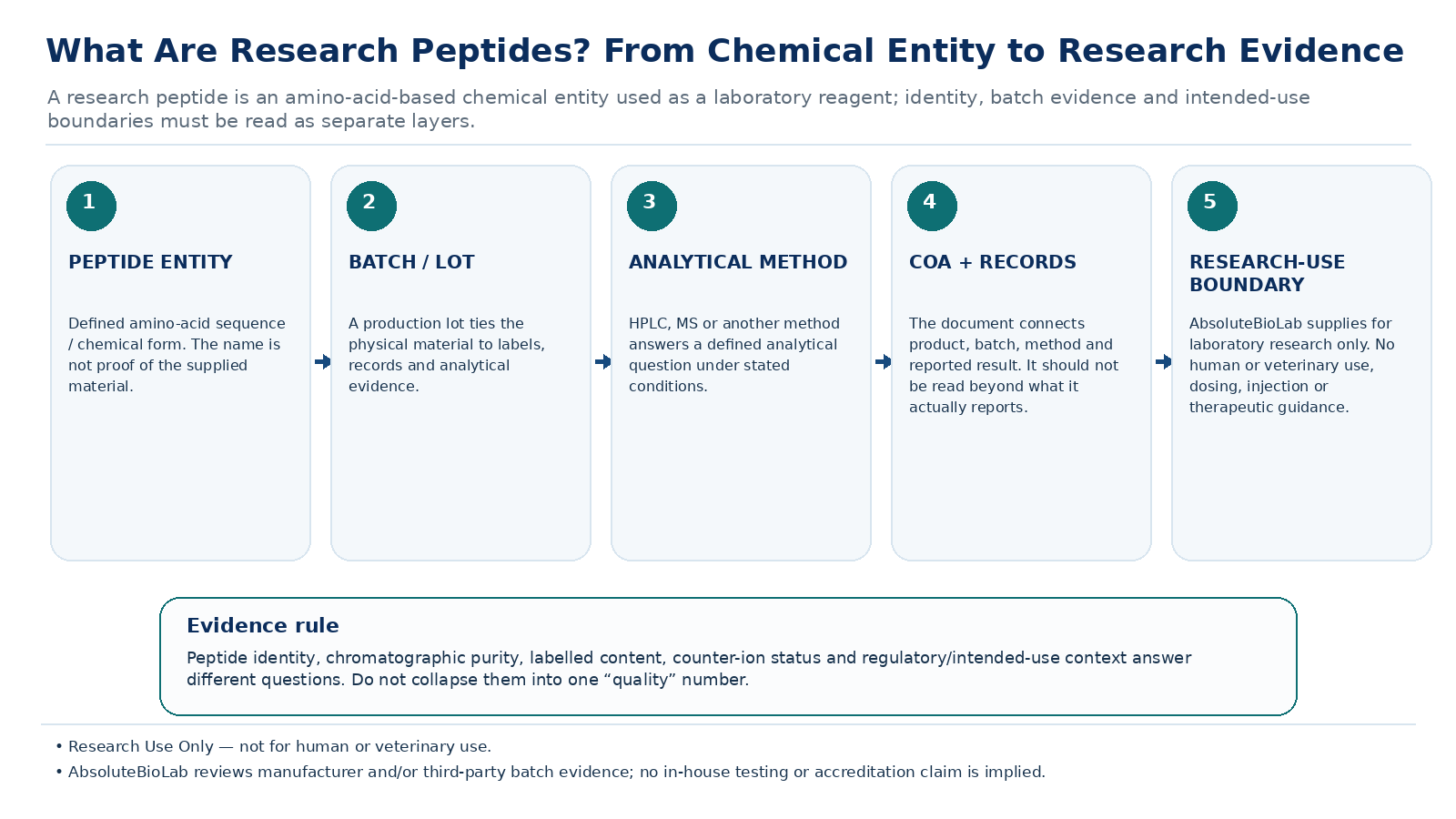
Figure
1. Research peptide evidence chain: chemical entity, batch,
analytical method, documentation and research-use boundary.
Alt
text: Five-step laboratory evidence chain from peptide entity to
batch or lot, analytical method, CoA and documentation, and the
Research Use Only boundary.
Peptide is a chemical term; “research peptide”
is a context term
IUPAC defines
peptides by their chemical structure: they are amides derived from
amino-carboxylic acid molecules joined by peptide bonds. That
structural definition says nothing about whether a particular
finished product is a medicine, a food, a clinical-trial material or
a laboratory reagent. Product context comes from how the finished
product is presented, supplied, documented and intended to be used.
This distinction
matters because the same underlying sequence can be encountered in
different forms: a free peptide, a salt form with a counter-ion, a
modified or cyclised analogue, a blend containing more than one
entity, a lyophilised solid or a prepared solution. Those are
scientific attributes. They should not be turned into human-use
recommendations on an RUO supplier site.
What information identifies a research peptide in
practice?
|
Attribute |
What |
What |
|
Name |
The |
That |
|
Chemical |
Salt, |
Total |
|
Batch |
Which |
Quality |
|
HPLC |
Chromatographic |
Molecular |
|
Mass |
Mass-to-charge |
Chromatographic |
|
Labelled |
The |
That |
|
Storage |
Conditions |
Universal |
What kinds of research-peptide format may a
laboratory encounter?
Common laboratory
formats include lyophilised solids, solutions, individual peptide
entities, peptide blends and finished cartridge or pen-format
research products. Each format changes the evidence set that matters.
A finished pen-format product, for example, adds cartridge, vehicle
and device attributes that are not described by a bulk-peptide CoA
alone. A blend adds an additional identity and composition problem
because more than one peptide is intentionally present.
Those format
questions belong to dedicated handling and comparison guides. This
page owns only the foundational definition and the decision path into
the wider evidence network.
From Our Work: why one purity number is never the
whole definition
Core Research
reviews batch evidence as a connected set rather than accepting one
headline number in isolation. The approved review set can include
product and batch match, HPLC purity, MS identity, appearance,
labelled amount or content, applicable water or moisture and
counter-ion information, CoA/document completeness, and storage or
handling status. The analytical testing itself is produced by the
manufacturer and/or third-party laboratories; Core Research reviews
that evidence. When a meaningful mismatch is identified, the batch is
held while clarification and/or a justified retest is requested. This
workflow does not imply in-house analytical testing or any laboratory
accreditation claim.
That review practice
is why Core Research treats the peptide name, batch identifier,
analytical evidence and supporting documentation as related but
distinct. A reported HPLC purity result can be useful evidence, but
it is not the definition of the peptide and it is not a substitute
for molecular-identity evidence, content information or the product’s
intended-use boundary.
How should a researcher move from definition to
due diligence?
-
Start with the research-use
boundary and what the supplier will and will not support.Open
the relevant guide -
Compare research-supply
products with medicines and other product contexts before making
regulatory assumptions.Open
the relevant guide -
For a purchase decision, use
the supplier due-diligence framework rather than relying on a
marketing purity number.Open
the relevant guide -
For batch evidence, read the
CoA and the method-specific HPLC/MS guides.Open
the relevant guide
Frequently asked questions
Are research peptides the same as medicines?
No. “Peptide”
describes a chemical class; medicine status is a separate
finished-product and regulatory question. Core Research supplies its
products for laboratory research only and does not present them for
human or veterinary treatment. See the dedicated comparison and RUO
pages for the UK boundary.
Does “research peptide” mean a specific
purity grade?
No. The phrase does
not create a universal analytical grade. Purity must be interpreted
from the stated analytical method and batch result, and purity should
not be confused with identity, labelled amount or total peptide
content.
Can a peptide be both lyophilised and a salt?
Yes. Physical format
and chemical form are different attributes. A peptide may be supplied
as a lyophilised material and also have a stated counter-ion or salt
form. The batch documentation should make the relevant form clear.
Why do batch numbers matter?
The batch or lot
number connects the physical material to batch-specific labels,
analytical evidence and records. It is a traceability key, not a
quality score by itself.
Does this guide explain how to use peptides in
people or animals?
No. The page is
restricted to laboratory definition, evidence and procurement
context. It does not provide dose, injection, administration,
treatment or veterinary-use guidance.
Key takeaway
A research peptide
is first a defined peptide chemical entity and second a
laboratory-use product context. Evaluate the entity, form, batch and
method-specific evidence separately, then apply the Research Use Only
boundary rather than treating the peptide name or one purity number
as the whole product definition.
References
[1] IUPAC Gold
Book: peptides (P04479). IUPAC. Accessed 14 August 2026. Source.
Primary terminology source for the chemical definition of peptides.
[2] IUPAC Gold
Book: amino-acid residue (A00279). IUPAC. Accessed 14 August
2026. Source.
Primary terminology source for amino-acid residues and peptide-chain
terminology.
[3] Q2(R2)
Validation of Analytical Procedures. FDA / ICH. Accessed 14
August 2026. Source.
Used for the principle that analytical results are interpreted
according to the intended purpose and validated performance of the
stated procedure; cited as scientific guidance, not as an RUO legal
requirement.
[4] Q14
Analytical Procedure Development. FDA / ICH. Accessed 14 August
2026. Source.
Used for fit-for-intended-purpose analytical-procedure principles;
cited as scientific guidance, not as an RUO legal requirement.