Research Peptides vs Medicines Supplements & Clinical Products
Research Peptides vs Medicines Supplements & Clinical Products
RESEARCH USE ONLY
This guide is for laboratory, analytical and procurement context. It does not provide human or veterinary administration, dosing, injection, treatment, diagnosis, supplementation or personal-use guidance.
What is the difference between a research peptide
and a medicine?
A peptide is a
chemical entity; “research peptide”, “authorised medicine”,
“food supplement” and “clinical-trial medicinal product”
describe different finished-product and use contexts. A molecule does
not become one of those categories simply because of its name.
Presentation, intended purpose, regulatory authorisation,
formulation, claims and the evidence route all matter.
Core Research
supplies research products under a laboratory-only boundary and does
not present them for human or veterinary treatment. That supplier
position is different from the regulated status of an authorised
medicine or a medicinal product used in a clinical trial.
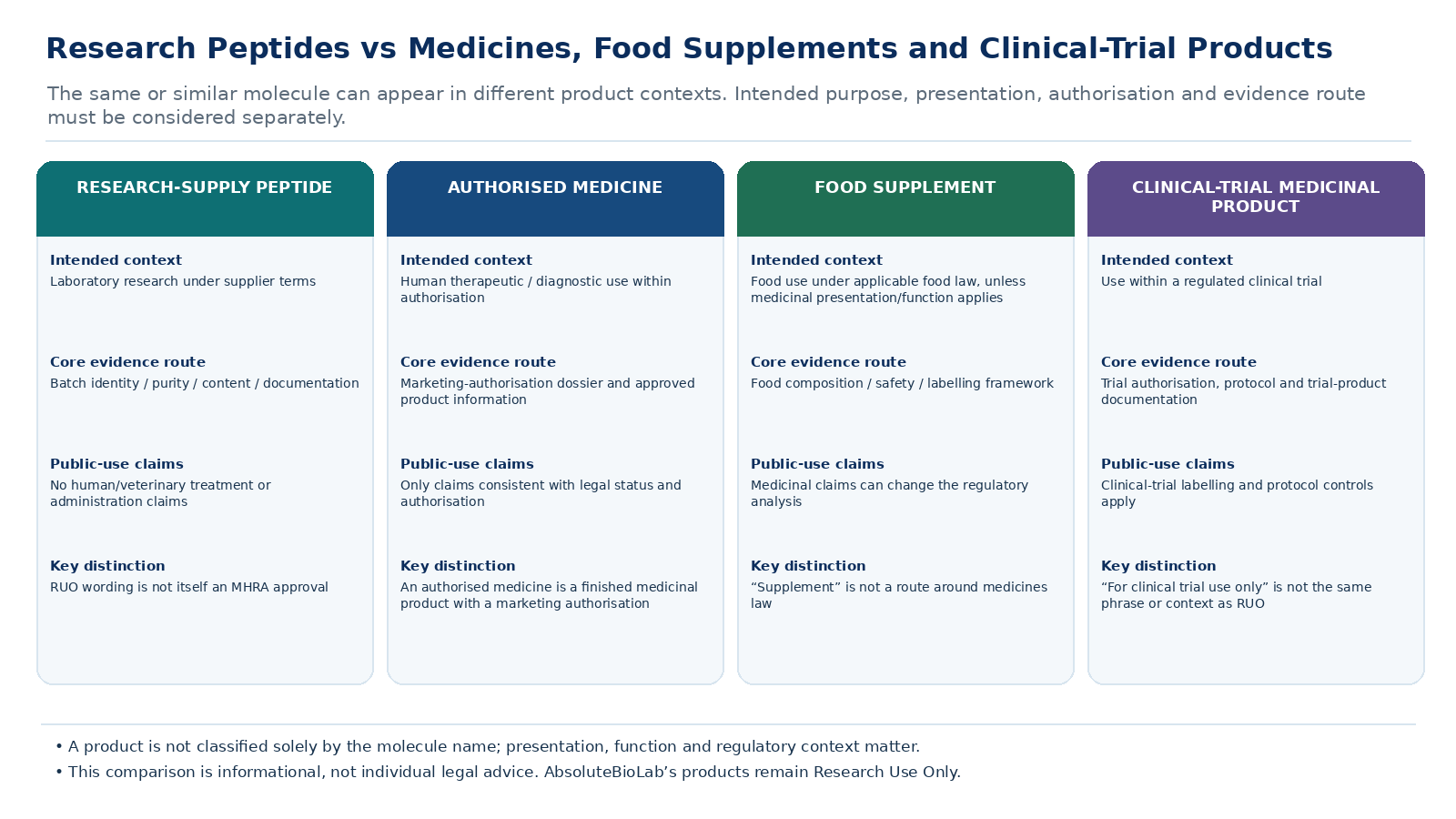
Figure
1. Research-supply peptide, authorised medicine, food supplement and
clinical-trial product comparison.
Alt
text: Four-column comparison of intended context, evidence or
authorisation route, public-use claims and key distinctions between
research-supply peptides, authorised medicines, food supplements and
clinical-trial medicinal products.
Quick comparison
|
Feature |
Research-supply |
Authorised |
Food |
Clinical-trial |
|
Intended |
Laboratory |
Human |
Food |
Use |
|
Core |
Batch/product |
Marketing-authorisation |
Composition, |
Trial |
|
What |
Defines |
Reflects |
Describes |
Connects |
|
What |
RUO |
Authorisation |
A |
“For |
Why chemical identity and product status must be
kept separate
The same chemical
substance can be an ingredient in more than one product context. UK
medicines rules focus on the finished product and its
presentation/function. Current MHRA guidance specifically considers
claims, promotional context, composition, pharmacological properties,
intended purpose, manner of use and similar authorised products when
assessing borderline status. This is why scientific discussion of a
peptide’s biological literature must not be turned into therapeutic
promotion on a research-supply page.
What does an authorised medicine add?
An authorised
medicinal product has a marketing authorisation for the relevant UK
product context. Approved product information, including the Summary
of Product Characteristics and patient information where applicable,
describes the authorised product and its conditions of use. That
regulatory package is fundamentally different from a supplier CoA for
an RUO batch. A CoA is batch evidence; it is not a marketing
authorisation.
What about food supplements?
MHRA guidance
recognises an interface between medicines and foods, including food
supplements. A product presented as a food supplement is not
automatically a medicine, but medicinal claims or a medicinal
function can alter the regulatory analysis. For this reason,
“supplement” should not be used as a casual synonym for a
research peptide, and research-supply content should not encourage
ingestion or supplementation.
What about products used in clinical trials?
A clinical-trial
medicinal product sits inside a regulated trial context with its own
approvals, protocol and labelling rules. MHRA guidance also
recognises non-investigational medicinal products and non-medicinal
products used in clinical trials. The phrase “for clinical trial
use only” has a specific trial-labelling context and should not be
substituted for a supplier’s RUO wording.
From Our Work: evidence review and intended use
are different controls
Core Research also
applies a strict research-use boundary to its catalogue and
laboratory guides: products are supplied for laboratory research, not
for human or veterinary use, and the site should not provide dose,
injection, administration, therapeutic or personal-use guidance. This
is an operating and supply-policy boundary; it is not presented as an
MHRA determination that every product carrying an RUO label falls
outside medicines law in every possible context.
Core Research
reviews batch evidence as a connected set rather than accepting one
headline number in isolation. The approved review set can include
product and batch match, HPLC purity, MS identity, appearance,
labelled amount or content, applicable water or moisture and
counter-ion information, CoA/document completeness, and storage or
handling status. The analytical testing itself is produced by the
manufacturer and/or third-party laboratories; Core Research reviews
that evidence. When a meaningful mismatch is identified, the batch is
held while clarification and/or a justified retest is requested. This
workflow does not imply in-house analytical testing or any laboratory
accreditation claim.
This separation
prevents two common errors: treating a research-only disclaimer as if
it proved batch quality, and treating a high analytical purity result
as if it granted a clinical product status. Neither inference is
valid.
How should the two existing Core Research URLs
be consolidated?
Frequently asked questions
Can a research peptide have the same molecule as
a medicine?
It can share an
active chemical entity with a medicinal product, but finished-product
status is not determined by the molecule name alone. Authorisation,
formulation, presentation, intended use and the applicable regulatory
framework are separate questions.
Is a Certificate of Analysis the same as a
medicine licence?
No. A CoA is
batch-level analytical or quality documentation. A medicine marketing
authorisation is a regulatory authorisation for a finished medicinal
product and its authorised use.
Are research peptides food supplements?
Not on the
Core Research site. They are supplied as research products, not for
ingestion or supplementation. More generally, medicine-versus-food
status is a product-specific regulatory question and medicinal claims
can change the analysis.
Is a clinical-trial peptide automatically the
same as an RUO peptide?
No. Clinical-trial
products are controlled within a regulated trial framework, with
trial-specific documentation and labelling. A commercial
research-only supplier label is not the same status.
Does this comparison give legal advice about a
particular product?
No. It provides a
structured distinction using current MHRA sources. Product-specific
classification questions should be addressed through current
regulatory guidance and appropriate professional advice.
Key takeaway
Separate the
molecule from the finished-product context. Core Research research
peptides are supplied under an RUO laboratory boundary; medicines,
food supplements and clinical-trial products follow different
evidence, authorisation and presentation routes.
References
[1] MHRA Guidance
Note 8: A guide to what is a medicinal product. MHRA. Accessed 14
August 2026. Source.
Detailed current MHRA guidance on medicinal-product classification,
presentation, function and borderline products; the document itself
states it is not a substitute for legal advice.
[2] Borderline
products: how to tell if your product is a medicine. MHRA /
GOV.UK. Accessed 14 August 2026. Source.
Current MHRA page explaining the medicinal-product definition and the
case-by-case factors used for borderline classification.
[3] Human
Medicines Regulations 2012, regulation 2. UK legislation.
Accessed 14 August 2026. Source.
Primary legal source for the UK definition of a medicinal product.
[4] Clinical
trials for medicines: labelling. MHRA / GOV.UK. Accessed 14
August 2026. Source.
Current MHRA clinical-trial labelling guidance, used to distinguish
regulated clinical-trial product context from a general research-only
supplier label.
[5] Find product
information about medicines. MHRA / GOV.UK. Accessed 14 August
2026. Source.
Explains the MHRA medicine-information service and authorised product
information such as SPCs and PILs.