Peptide Chromatogram Red Flags
Peptide Chromatogram Red Flags
RESEARCH USE ONLY
This guide explains analytical-document review principles for laboratory research materials. It does not provide dosing, administration, injection, reconstitution, treatment, human-use or veterinary-use guidance.
What are chromatogram red flags?
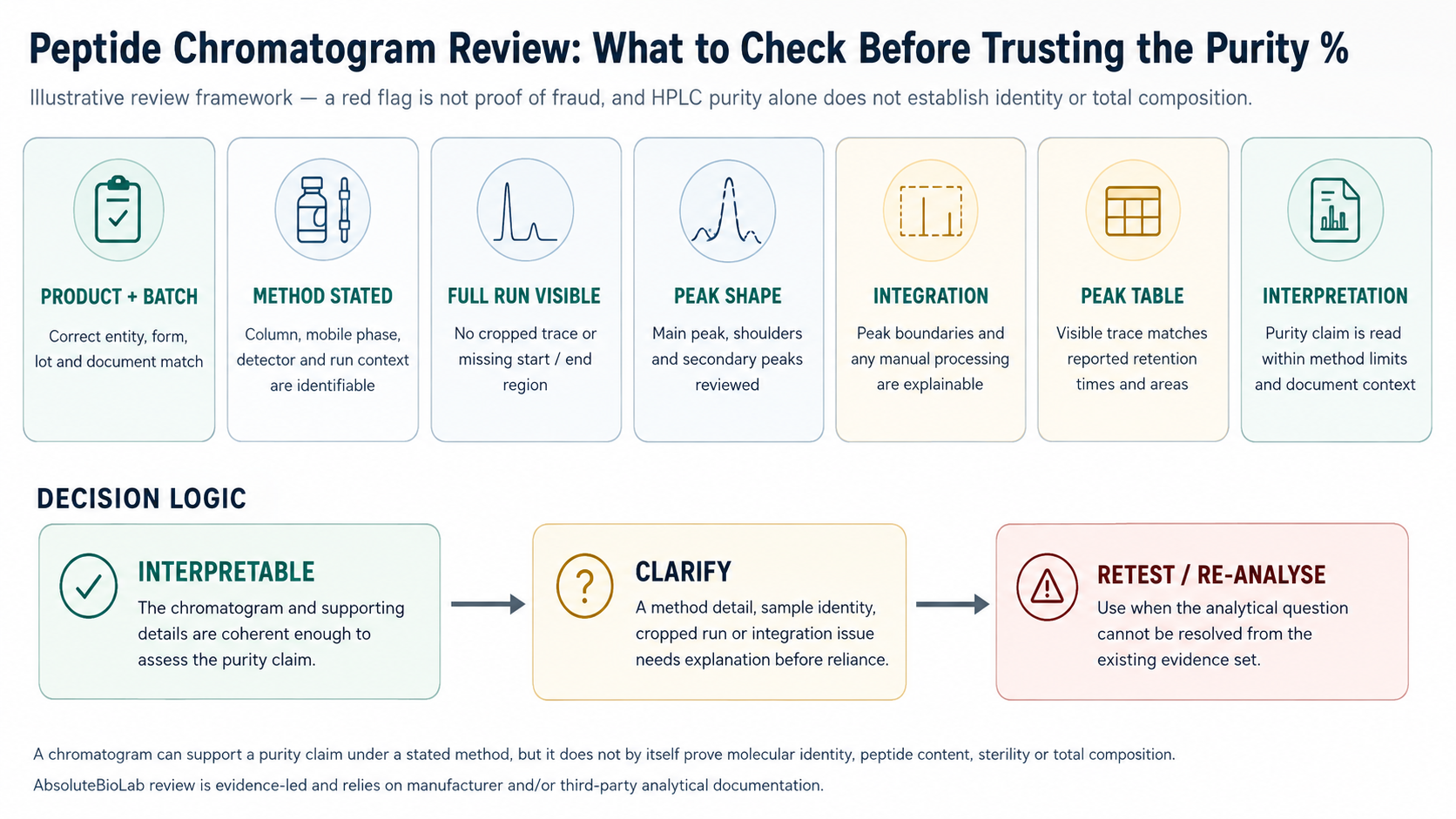
Chromatogram red flags are features that make an HPLC purity result harder to interpret or verify, such as an unknown sample identity, missing method context, a truncated display, unexplained manual integration or poorly resolved peak features. They are reasons to clarify the analytical record, not automatic proof that a batch failed, a laboratory manipulated data or a supplier committed fraud.
A chromatogram is one output from an analytical procedure. Its meaning depends on the sample being tested, the procedure used, the detector response, the processing and integration approach, and whether the separation is suitable for the analytical question. ICH Q2(R2) and Q14 frame analytical results around fitness for purpose, specificity/selectivity, procedure parameters and suitable performance checks.[1][2]
Detailed HPLC background: What Is HPLC Purity in Peptide Testing?
A chromatogram is not the complete analytical record
A customer-facing chromatogram can be useful evidence without containing every piece of electronic raw data. The important distinction is between what the visible report can support and what may exist in the underlying laboratory system. In FDA-regulated pharmaceutical testing, FDA notes that a printed chromatogram generally does not contain the injection sequence, instrument method, integration method or audit trail that form part of the complete electronic analytical record.[3]
Core Research should not present those pharmaceutical CGMP record-retention rules as regulatory requirements for its RUO materials. The narrower and useful review principle is that a static chromatogram may not show enough context to resolve every question. Where the visible trace and report are internally consistent, that may be sufficient for the public evidence layer. Where something materially affects interpretation, clarification from the manufacturer and/or testing laboratory is appropriate.
| Visible item | Why it matters | What not to infer |
|---|---|---|
| Product / sample / batch link | Shows whether the chromatogram can be connected to the material and lot being represented. | A technically plausible trace with no batch linkage does not verify a specific batch. |
| Method context | Column, mobile-phase programme, detector conditions and other procedure details help explain retention and separation. | A clean-looking trace is not method-independent proof of purity. |
| Full displayed run | Shows the chromatographic window supplied for review and whether potentially relevant regions are visible. | A cropped display is not by itself proof that peaks were deliberately hidden. |
| Integration / peak table | Shows how detector response was assigned to the main and secondary peaks. | A high area percentage does not identify every component or measure total peptide content. |
| System / suitability context | Helps show whether the procedure was performing as intended for the analytical question. | Absence from a customer PDF does not prove the laboratory failed to perform suitable checks. |
From Our Work: how chromatograms fit into the Core Research batch review
Core Research reviews chromatographic purity/profile as one part of a wider batch evidence set. The review does not treat an HPLC percentage as a substitute for product and batch matching, mass-spectrometry identity evidence or the other applicable release attributes. Analytical testing is produced by the manufacturer and/or third-party laboratories; Core Research reviews the supplied evidence and does not claim that the HPLC testing is performed in-house.
For the chromatogram layer, the practical review question is whether the HPLC result is interpretable for the exact product and batch under the stated analytical context. A meaningful inconsistency between the chromatogram, the reported result, the sample identity or the accompanying document is not silently converted into an accepted batch. The batch remains on hold while clarification and/or a scientifically justified retest is requested, then the complete evidence set is reviewed again.
This workflow is a document-and-evidence review, not a claim that Core Research can diagnose the cause of every unusual peak shape from a PDF. No laboratory accreditation is claimed on this page unless a separate, current verification supports the exact laboratory, standard and scope.
The main chromatogram review flags
The following features should trigger a proportionate question. Their evidential weight depends on the analytical procedure and the surrounding documentation; none is fraud proof by itself.
| Review flag | Why it deserves clarification | Proportionate follow-up |
|---|---|---|
| Unknown sample or batch ID | The trace cannot be confidently connected to the exact material being represented. | Request the report/sample identifier and batch linkage. |
| Missing method context | Retention and resolution depend on the analytical procedure; the same retention time is not universal across methods. | Ask for enough method information to understand how the result was generated. |
| Unlabelled axes or unclear units | The chromatogram is less interpretable when time and detector response cannot be read clearly. | Request a complete exported report or clearer copy. |
| Truncated or tightly cropped run | The supplied display may not show the full chromatographic window relevant to the interpretation. | Ask whether the complete run can be supplied or whether the crop is only a presentation choice. |
| Shoulder or poorly resolved feature beside the main peak | A shoulder can reflect incomplete separation, co-elution, peak-shape effects or other method/sample factors. | Ask how the method resolves relevant components and whether the feature affects the reported result. |
| Visible peak not reflected in the peak table | The relationship between the trace and reported integration is unclear. | Request the peak table and explanation of the processing. |
| Manual integration with no explanation | Manual integration can be legitimate, but unexplained changes to peak boundaries can affect quantitative results. | Request the integration rationale or laboratory clarification where material to the result. |
| Baseline disturbance or unusual scaling | Noise, drift, overload, solvent effects or scaling choices can affect how small features appear. | Review the method/report context; do not assign a chemical identity from appearance alone. |
Why retention time is not identity proof
Retention time is method-dependent. It can support an identification strategy when appropriately compared under the same analytical procedure, but a retention-time match alone should not be promoted into proof of molecular identity. ICH Q2(R2) treats specificity/selectivity as a core performance characteristic because the procedure must distinguish the analyte from relevant interfering components for its intended purpose.[1]
For the separate identity question, see What Is Mass Spectrometry in Peptide Identity Testing?
What does a shoulder peak mean?
A shoulder next to the dominant peak is a reason to examine separation, not a diagnosis. It can be consistent with incomplete resolution of another component, but peak shape can also be influenced by sample loading, the column, mobile phase, detector response and other procedure conditions. The visible shape alone does not identify the second component or establish contamination.
The defensible question is whether the analytical procedure has adequate specificity/selectivity for the impurity or purity question being asked. Q14 also emphasises understanding procedure parameters and performance rather than treating a chromatogram as independent of its method.[2]
Manual integration: clarification, not automatic rejection
Chromatography software applies integration rules to determine peak boundaries and areas. Manual integration is not automatically invalid. There are cases where an analyst may need to correct an inappropriate automated boundary or deal with a complex chromatographic feature. The review concern is uncontrolled or unexplained integration that materially changes the result.
FDA warning letters in pharmaceutical CGMP settings provide concrete examples of why integration controls matter. In the 2023 Intas Pharmaceuticals letter, FDA criticised manual integration events that produced passing results without adequate procedural controls or justification.[5] That enforcement record applies to a regulated pharmaceutical manufacturer and is not a legal standard imposed on Core Research RUO supply. It is used here only to illustrate the analytical-review principle: if manual integration materially affects a reported purity result, there should be a defensible explanation.
A cropped chromatogram is not automatically a falsified chromatogram
Reports are often exported or formatted for readability. A cropped figure may simply be a presentation choice. The issue is whether the crop prevents the reviewer from seeing information needed to evaluate the claim. If the displayed range ends immediately around the principal peak, omits a region referenced in the peak table or otherwise makes the calculation difficult to reconstruct, ask for a complete export or clarification.
The FDA records-and-reports Q&A is useful for understanding the distinction between a static chromatogram and the underlying electronic analytical record: a printout generally does not contain the injection sequence, instrument method, integration method or audit trail.[3] The practical implication for a research-supply evidence review is modest: do not assume a customer PDF is the whole data system, and do not assume absence from the PDF means the information never existed.
Why HPLC area % is narrower than “total purity”
An HPLC area-percentage result describes the relative detector response assigned to chromatographic peaks under a defined procedure. It does not, by itself, establish molecular identity, absolute peptide content by mass, counter-ion content, water/moisture, sterility, endotoxin or the absence of every non-detected component. Those are separate analytical questions and may require different evidence.
This is why a 99% HPLC result can be a useful batch attribute without becoming a universal statement that “99% of everything in the vial has been identified”. The claim should remain coupled to the method and attribute actually measured.
| Question | Can the HPLC chromatogram answer it alone? | Better evidence / next layer |
|---|---|---|
| Does the chromatogram show a dominant integrated peak under this method? | Potentially yes, if the trace and peak table are interpretable. | HPLC report + method context. |
| Is the material the intended peptide? | No, not from retention time alone. | MS and/or other suitable identity evidence. |
| What is the absolute peptide content by mass? | Not from area % alone. | Appropriate quantitative content/assay evidence where required. |
| What counter-ion is present, and how much? | Not from peptide HPLC-UV purity alone. | Counter-ion-specific evidence where applicable. |
| Does the result belong to this batch? | Only if sample/batch linkage is present. | CoA, report identifiers and batch traceability. |
| Is the supplier trustworthy overall? | No single chromatogram can establish this. | Wider supplier due-diligence and quality-system review. |
A practical chromatogram review sequence
- Confirm the exact product, form, sample ID and batch/lot linkage before interpreting the trace.
- Identify the analytical attribute being claimed and the method context supplied with the result.
- Review the displayed chromatographic window, axes, baseline and the relationship between visible features and the peak table.
- Check whether the main peak and any secondary features appear to be integrated consistently with the reported result.
- If a shoulder, unresolved feature or manual integration materially affects interpretation, request clarification rather than naming the cause from appearance alone.
- Keep purity separate from identity and from quantitative content, moisture and counter-ion questions.
- If a meaningful inconsistency remains unresolved, keep the batch on hold while clarification and/or a justified retest is reviewed in the context of the full evidence set.
Document-level context: How to Read a Peptide Certificate of Analysis
Supplier-level context: How to Verify a Research Peptide Supplier and Supplier Verification and Analytical Quality System
Frequently asked questions
Is a shoulder peak proof that a peptide is contaminated?
No. A shoulder can justify further review because it may reflect incomplete resolution or another chromatographic effect, but the visible trace alone cannot identify the cause. Review the method, separation and supporting evidence before drawing a chemical conclusion.
Is manual HPLC integration always a red flag?
No. Manual integration can be scientifically justified. The concern is an unexplained or uncontrolled change that materially affects the reported result. Where it matters to the purity claim, ask for the rationale or laboratory clarification.
Does a 99% HPLC result prove the peptide is the correct molecule?
No. HPLC purity and molecular identity are separate analytical questions. A high area percentage can describe the chromatographic profile under a method, while suitable MS or other identity evidence is needed for the identity question.
Should a chromatogram be rejected if the full HPLC method is not printed on the page?
Not automatically. A customer-facing report may be a summary. The question is whether enough analytical context is available to interpret the result and whether the manufacturer or testing laboratory can clarify material method details when needed.
Does a cropped chromatogram prove peaks were hidden?
No. Cropping may be a presentation choice. It becomes a review issue when the displayed range prevents the reviewer from evaluating information relevant to the reported result. In that case, request the complete export or an explanation.
What should Core Research do if the chromatogram and reported purity do not reconcile?
The approved batch-review workflow is to keep a meaningful mismatch on hold while clarification and/or a scientifically justified retest is requested. The new evidence is then reviewed with the rest of the batch record rather than simply replacing an inconvenient result.
Key takeaway
A peptide chromatogram is useful when it is traceable to the correct sample and batch, interpretable under the analytical procedure and consistent with the accompanying report. Missing context, cropped displays, unexplained integration or poorly resolved features are reasons to clarify the evidence, not automatic fraud findings. HPLC purity should remain a method-specific purity claim rather than being stretched into identity, absolute content or whole-vial composition.
References
- ICH Q2(R2). Validation of Analytical Procedures. Final guidance, March 2024. FDA / ICH. Used for specificity/selectivity, validation and fitness-for-purpose principles.
- ICH Q14. Analytical Procedure Development. Final guidance, March 2024. FDA / ICH. Used for science- and risk-based procedure development, parameters and performance understanding.
- U.S. Food and Drug Administration. Questions and Answers on Current Good Manufacturing Practice Requirements — Records and Reports. Used for the distinction between printed chromatograms and the complete electronic analytical record in regulated drug testing.
- MHRA. Guidance on GxP data integrity. Used for general data-integrity concepts; not presented as an accreditation or regulatory-status claim for Core Research.
- U.S. Food and Drug Administration. Intas Pharmaceuticals Limited Warning Letter 652067, 28 July 2023. Used for an illustrative regulated-pharmaceutical example of uncontrolled manual chromatographic integration; not as a legal standard for RUO supply.