Research Batch Documentation Retention & Audit Trails
Research Batch Documentation Retention & Audit Trails
RESEARCH USE ONLY
This guide is for controlled laboratory and research use. It does not provide dosing, injection, administration, treatment, human-use or veterinary-use instructions.
What should a research batch documentation record contain?
A research batch documentation record should make it possible to reconstruct which material was purchased, which batch was received, which analytical evidence belonged to it, how it was stored and handled, and which experiment or sample used it. The batch or lot identifier is the join key. A retention period, however, should come from the laboratory’s own policy, study obligations, contracts and applicable rules rather than a universal number published by a supplier.
This is a record-management page, not a claim that every Core Research customer operates under GLP, GMP or another regulated quality system. OECD and MHRA documents are used below for transferable principles such as traceability, metadata, controlled changes and reconstructability; they are not presented as legal requirements for every RUO laboratory.[1][2][3]
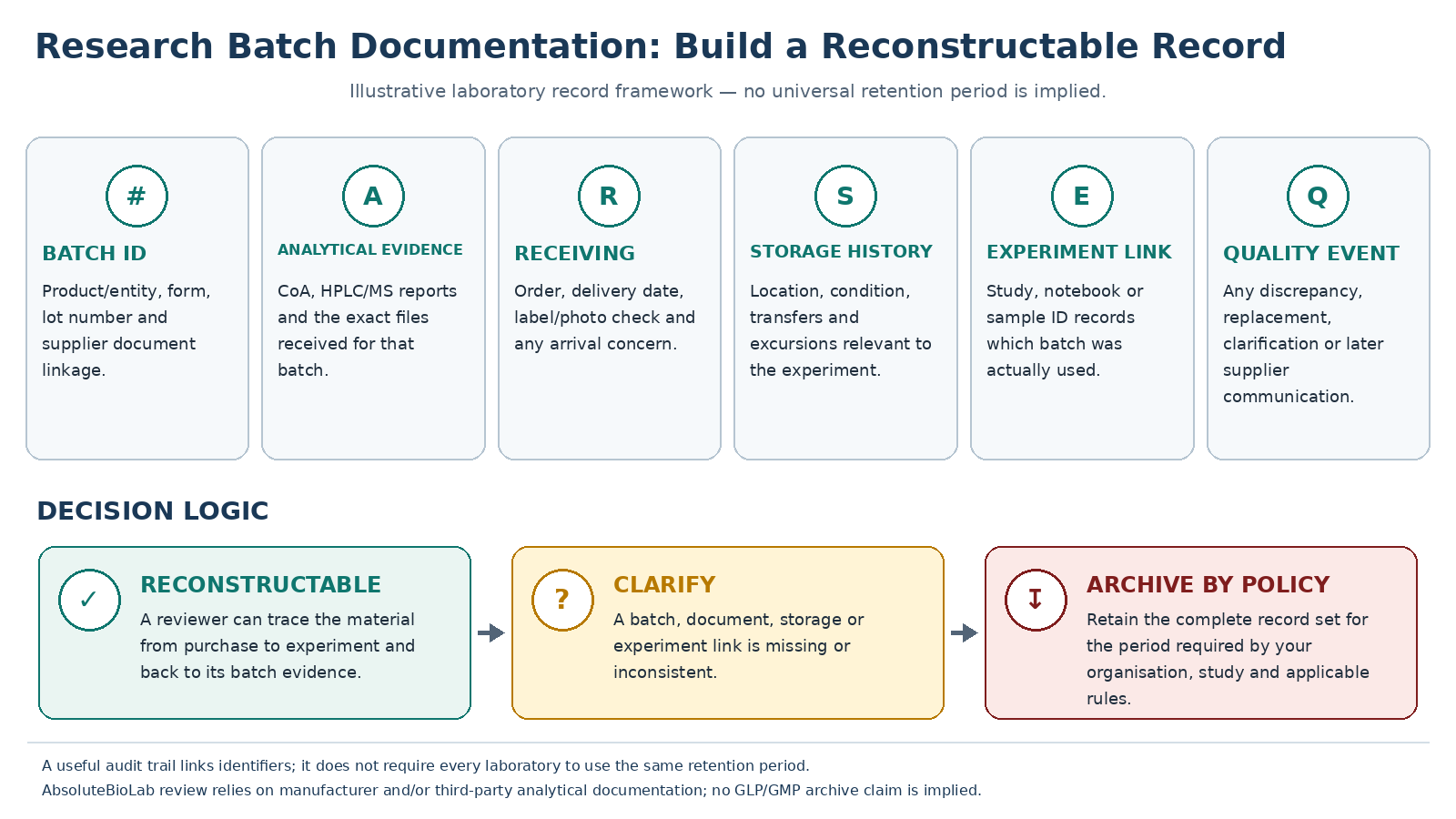
Illustrative framework only. Not an SOP, real batch record, validation report, accredited laboratory document or product-specific acceptance specification.
From Our Work: keep batch identity at the centre of the evidence set
Core Research’s approved batch-review workflow checks the product/batch match alongside HPLC purity, MS identity, appearance, labelled amount/content, applicable water/moisture and counter-ion information, CoA/document completeness and storage/handling status. The analytical data are generated by the manufacturer and/or third-party laboratories; Core Research reviews that evidence and does not claim in-house analytical testing or laboratory accreditation.
That review logic is useful after purchase as well. If the batch identifier disappears from the customer-side record, later analytical files, storage notes and experiment results become harder to connect. A practical audit trail therefore keeps the supplier document set and the experiment record linked by the same product and lot identifiers, while leaving the laboratory free to choose its own archive system and retention period.
Which records are worth linking to the batch?
OECD GLP guidance for regulated studies emphasises identification, receipt, storage, handling, characterisation and archiving of test items, while its archive guidance emphasises retrievability and preservation of contextual metadata.[1][2] The transferable principle for ordinary research is simple: keep enough context that a later reviewer can understand what happened without reconstructing the history from memory.
| Record element | Why retain it | Minimum linking detail |
|---|---|---|
| Order / procurement record | Shows what was ordered, from whom and when. | Product name, order/reference number, quantity, date and supplier. |
| Product label and batch identity | Connects the physical material to its paperwork. | Exact product/entity, stated form, batch/lot and any expiry/retest field if supplied. |
| CoA and analytical reports | Preserves the evidence actually relied on for identity/purity or other applicable attributes. | Exact file/report, batch match, test date, method/result and source laboratory/manufacturer. |
| Receiving record | Documents condition on arrival and any discrepancy. | Delivery date, packaging/label check, photographs where relevant, temperature or damage concern. |
| Storage / handling log | Shows whether the recorded material remained under the intended conditions. | Location, condition, transfers, excursions and material-state changes relevant to the study. |
| Experiment / sample record | Links the purchased lot to actual use. | Notebook, study, sample or run identifier plus batch/lot used. |
| Quality event / supplier correspondence | Preserves later clarification, replacement or investigation context. | Date, issue, evidence supplied, decision and replacement/new lot if applicable. |
How should the batch be linked to an experiment?
Use a stable identifier rather than a free-text description alone. The experiment record should point to the supplier’s batch/lot number and, where the laboratory uses internal inventory IDs, maintain a one-to-one mapping between the internal ID and supplier lot. That link should survive file renaming, instrument exports and staff turnover.
How long should research batch records be retained?
There is no defensible peptide-wide retention period. OECD archive guidance explicitly recognises that organisations need to evaluate applicable regulatory requirements alongside their business and study needs.[2] A university project, GLP study, contract research programme and internal exploratory assay can therefore have different retention obligations.
A sensible policy states the trigger for the retention clock, the minimum period for each record class, who can authorise disposal, how electronic formats remain readable, and how a legal, contractual or scientific hold overrides routine disposal. If no external period applies, the laboratory should still retain records long enough to support reproducibility, quality-event investigation and interpretation of the study outputs.
What makes a digital audit trail useful?
A useful digital audit trail preserves attribution, chronology and the relationship between original data and later processing. MHRA and FDA data-integrity guidance, written for regulated environments, emphasise reliable and accurate records, metadata, traceable processing and visibility of changes.[3][4] For ordinary RUO research, those principles translate into practical controls rather than a claim of formal GxP compliance.
- Use read-only or versioned storage for final CoAs and analytical reports rather than silently overwriting files.
- Keep original filenames or a documented naming convention that includes the batch/lot identifier.
- Record who added or changed a laboratory-created note when the change affects interpretation.
- Do not replace an inconvenient result with a later file without retaining the original and the reason for the update.
- Back up records so that the audit trail does not depend on one workstation or one staff member.
What should happen when a quality event occurs?
Freeze the relevant evidence set before the investigation changes anything. Preserve the original product/batch identifiers, receiving evidence, analytical files, storage history and experiment links, then add the new correspondence or replacement information as a later event. If a replacement or new lot is supplied, give it its own batch record and explicitly connect it to the original event rather than overwriting the old material record.
For the upstream quality-event workflow, see Research Product Receiving Inspection and Batch Acceptance and Research Product Returns, Replacement and Quality Concerns. For the batch identity principles themselves, see Why Batch Numbers and Lot Traceability Matter.
Use the Batch CoA Portal for available batch documentation. For repeat procurement planning, see Repeat-Batch Procurement and Lot-Continuity Planning.
A practical research-batch record template
| Field | Example of what to record | Rule |
|---|---|---|
| Material identity | Product/entity + stated form | Use the supplier’s exact identity; do not substitute a nickname. |
| Supplier batch / lot | Exact lot printed on label and CoA | Primary join key across records. |
| Supplier / order reference | Order ID and date | Connects procurement to the physical batch. |
| Analytical evidence | CoA/report filenames + issuing source | Retain the exact evidence relied on. |
| Receiving status | Date, packaging/label check, photos if relevant | Record discrepancies before material is altered. |
| Storage history | Condition, location, transfers, excursions | Use the product-specific requirement rather than a generic assumption. |
| Experiment links | Notebook/study/run/sample IDs | Record the lot in every experiment where lot continuity matters. |
| Quality events | Issue, date, decision, replacement/new lot | Append history; do not erase the original event. |
| Disposition / archive status | Active, closed, archived, disposal authorised | Follow the organisation’s policy and any applicable obligations. |
Weak records versus stronger records
| Weak record | Stronger record | Why the stronger version helps |
|---|---|---|
| “BPC peptide used.” | “Material inventory ID RP-014; supplier lot AB12345; CoA file linked.” | Distinguishes one physical batch from another. |
| “Stored frozen.” | “Storage location + condition + transfer dates + excursion note if applicable.” | Makes storage history reviewable rather than assumed. |
| “HPLC attached.” | “Report filename, batch, test date, issuing source and result linked.” | Keeps the analytical result tied to the correct material. |
| “Repeat experiment.” | “Repeat experiment ID plus the exact lot used in each run.” | Makes later lot-change interpretation possible. |
Frequently asked questions
Do all laboratories need to keep peptide records for the same number of years?
No. Retention periods depend on the organisation, study, contracts and any applicable regulatory or funder requirements. This guide deliberately does not publish a universal number.
Is a CoA enough for an experimental audit trail?
No. A CoA describes analytical information for a batch, but an experimental audit trail also needs the receiving, storage and experiment links that show which physical lot was actually used.
Should I keep old records after a replacement batch arrives?
Yes where they remain relevant to the study or quality event. Keep the original batch record and link the replacement/new lot rather than overwriting the history.
Does this page mean Core Research operates a GLP archive?
No. OECD GLP documents are used only for transferable recordkeeping principles. No GLP, GMP, ISO 17025, UKAS or other laboratory-accreditation claim is made for Core Research.
What is the most important field in the record set?
The supplier batch/lot identifier is the key link because it connects the physical material to its analytical documents, receiving record and experiment history.
When should records be locked or made read-only?
When a document becomes part of the evidence relied on for a study or quality decision, preserving the original and controlling later revisions improves reconstructability. The exact system depends on the laboratory’s policy.
Key takeaway
A research-material audit trail is a connected record, not a folder of unrelated PDFs. Keep the batch identifier visible from procurement through analytical evidence, receiving, storage, experimental use and quality events. Set retention periods through the laboratory’s own policy and obligations; do not import a universal number from a supplier article.
References
- OECD. OECD Principles on Good Laboratory Practice. OECD Series on Principles of GLP and Compliance Monitoring No. 1 (1998). Used for test-item identification, records and study reconstructability principles.
- OECD. Establishment and Control of Archives that Operate in Compliance with the Principles of GLP. No. 15 (2007). Used for archive/retrieval and retention-policy principles; not presented as a universal RUO retention mandate.
- MHRA. Guidance on GxP data integrity (2018; page updated 2021). Used for metadata, audit-trail and data-governance principles; not presented as proof that ordinary RUO users are subject to GxP.
- U.S. FDA. Data Integrity and Compliance With Drug CGMP: Questions and Answers (2018). Used only for transferable principles concerning reliable records and traceable data processing.
- OECD. Guidance Document on Good In Vitro Method Practices (GIVIMP), section on storage and retention of records and materials (2018). Used for record retrievability and controlled storage concepts.