Cold-Chain & Temperature-Stable Shipping
Cold-Chain & Temperature-Stable Shipping
RESEARCH USE ONLY
This guide is for controlled laboratory and research use. It does not provide dosing, injection, administration, treatment, human-use or veterinary-use instructions.
What is the difference between cold-chain and temperature-stable shipping?
Cold-chain shipping means the product is transported within a defined, controlled temperature range using a qualified transport system. Insulated packaging is not automatically a cold chain, and a research product may instead be shipped under a temperature-stable or ambient-transit approach when product-specific evidence supports the defined route and duration. The transport class should therefore be chosen from the exact product state and stability evidence, not from the word “peptide” alone.
WHO transport guidance, written for time- and temperature-sensitive medical products, is useful for defining concepts such as qualified packaging, monitoring and route control, but it is not presented here as a regulatory requirement for Core Research RUO products.[1][2]
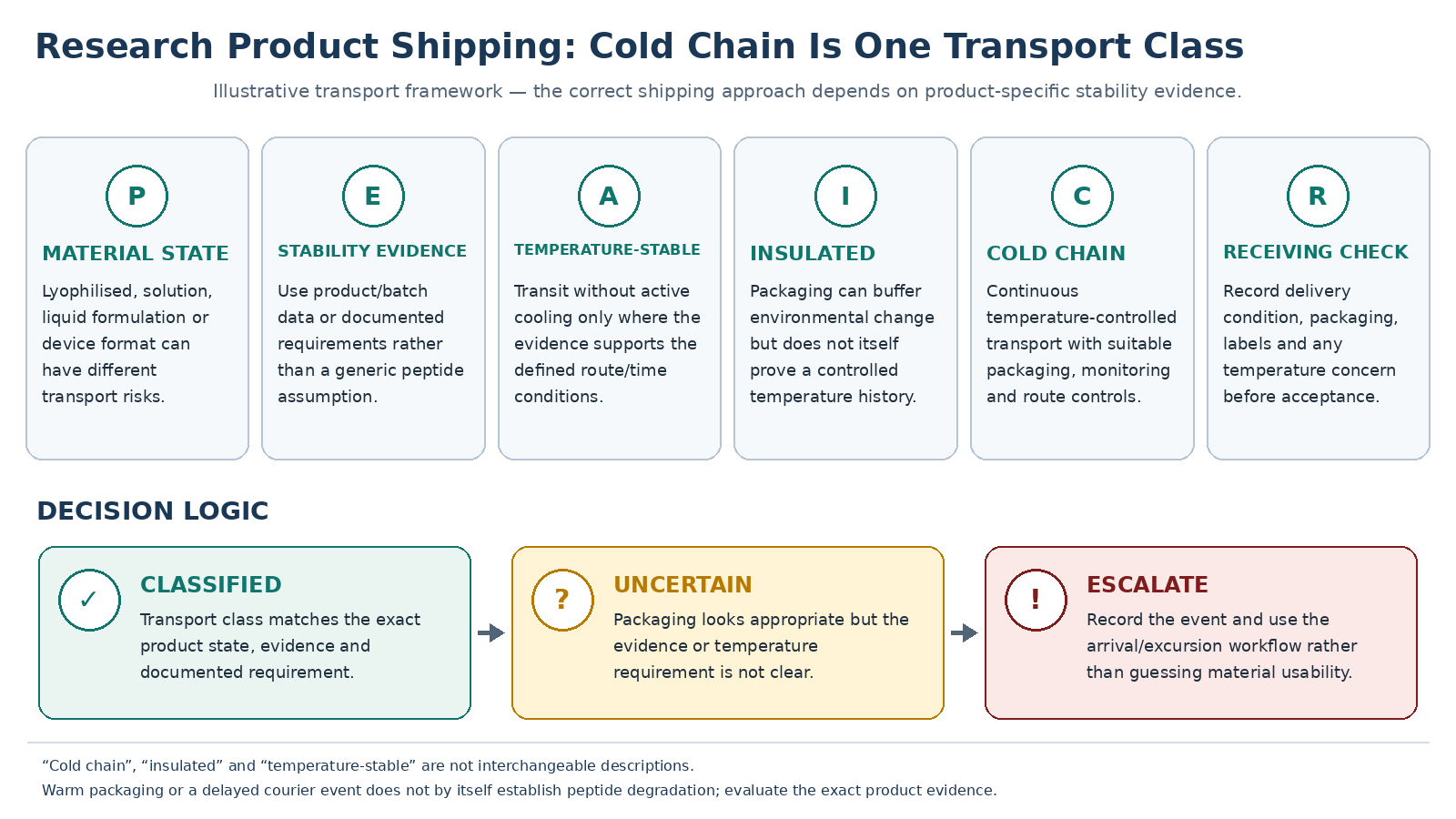
Illustrative framework only. Not an SOP, real batch record, validation report, accredited laboratory document or product-specific acceptance specification.
From Our Work: transport evidence belongs to the exact product record
Core Research’s approved batch-review workflow includes storage/handling status as one part of the evidence reviewed before a batch is accepted. The current site audit also identified conflicting generic 24-hour/48-hour and blanket temperature claims that must not be carried forward. The rebuilt shipping framework therefore uses product-specific evidence rather than one universal courier or cold-chain rule.
This means the shipping description should say what is actually being controlled. “Tracked UK delivery”, “insulated packaging”, “temperature-stable transit” and “continuous cold chain” are different claims. Each should be used only when the product, packaging and operational evidence support it.
How should research-product shipping classes be distinguished?
| Transport description | What it means | Evidence needed before using the label |
|---|---|---|
| Temperature-stable / ambient transit | No active refrigeration is relied on during the defined transport period. | Product-specific stability or handling evidence supporting the stated route/time conditions. |
| Insulated packaging | Packaging reduces the effect of the external environment but may not actively control a narrow temperature range. | Packaging design/qualification and a clear statement of what it is intended to achieve. |
| Chilled / coolant-assisted transit | Coolant or controlled packaging is used to keep the shipment cooler than ambient during transport. | Product requirement plus packaging performance appropriate to the route; avoid calling it a continuous cold chain unless that is true. |
| Continuous cold chain | Defined temperature range is controlled through storage, packing, transport and hand-off, with suitable monitoring/qualification. | Documented temperature requirement, qualified system, route controls and monitoring appropriate to the claim. |
What determines the correct transport approach?
- Exact material and formulation: the same peptide name can exist as a lyophilised solid, solution or finished research format with different transport requirements.
- Documented stability requirement: use the product/batch record or applicable manufacturer/third-party evidence, not a generic stability table.
- Transit duration and route: a packaging system that is suitable for one route is not automatically suitable for a longer or more variable route.
- Packaging function: distinguish insulation, active cooling, passive coolant systems and true continuous temperature control.
- Monitoring need: where temperature history is material to acceptance, the evidence should be capable of supporting the claimed transport condition.
- Receiving process: the customer should be able to document packaging condition, label/batch match and any temperature concern before the material is altered.
ICH Q1A(R2), although written for pharmaceutical stability studies, supports the underlying scientific principle that a stability claim is tied to defined conditions and data.[3] OECD test-item guidance similarly treats transport, receipt and storage as material-specific controls.[4]
Why does insulated packaging not automatically prove cold-chain compliance?
Insulation changes the rate of heat transfer; it does not, by itself, prove that the contents remained within a defined temperature band for the full route. WHO technical supplements distinguish shipping-container qualification, temperature monitoring and route profiling as separate control problems.[2] A supplier should therefore describe an insulated pack for what it is unless the full cold-chain claim is genuinely supported.
The same caution applies to gel packs or other coolants. Their presence can be appropriate, but a photograph of a coolant pack does not establish the material’s entire temperature history or prove that a specific product remained within specification.
What should be checked when a shipment arrives?
| Receiving check | Record | What it can answer |
|---|---|---|
| Product + batch match | Label, batch/lot and order reference | Confirms the shipment corresponds to the expected material and document set. |
| Packaging condition | Damage, seal, insulation/coolant condition, photographs if relevant | Shows whether the package arrived physically intact; does not alone prove internal product stability. |
| Temperature evidence | Logger/readout or documented observation where available | Supports evaluation of the actual transit condition when temperature matters. |
| Delivery timing | Dispatch/delivery timestamps and delay events | Helps define the potential excursion duration; timing alone does not determine degradation. |
| Product-specific requirement | Batch/product storage or transit instruction | Provides the criterion against which the receiving evidence is interpreted. |
Does a warm or delayed shipment mean the material has degraded?
No. Touch temperature or courier delay is an observation, not an analytical conclusion. Whether a transit event is meaningful depends on the exact molecule, formulation, packaging, duration and supporting stability evidence. Some peptides degrade differently in solution and solid states, and temperature effects are molecule-specific rather than peptide-wide.[3][5]
If the shipment raises a concern, preserve the evidence and use the dedicated What to Do if a Research Product Arrives Warm or Delayed workflow. Do not reframe a generic shipping article as a universal “safe for X days at Y °C” table.
How should shipping claims be written on product pages?
- Use “tracked delivery” only for the actual courier/service offered.
- Use “insulated packaging” when insulation is the verified control; do not upgrade the wording to “cold chain” without a controlled temperature system.
- Use “temperature-stable transit” only where the product/formulation evidence supports the defined transit conditions.
- State any product-specific storage condition separately from the shipping method.
- Where a product needs a defined cold chain, state the required range and monitoring system only when those details are verified for that exact product and route.
- Link arrival/excursion concerns to the service workflow rather than adding universal stability claims to every product page.
For the current service terms, see the Shipping Policy. For evidence-bound storage decisions, use Peptide Storage Temperatures: Laboratory Decision Guide. For receipt checks, use Research Product Receiving Inspection and Batch Acceptance Checklist.
Frequently asked questions
Is every research peptide shipped by cold chain?
No. The correct transport class depends on the exact product state and evidence. Some materials may use evidence-supported temperature-stable or insulated transit, while others may require tighter temperature control.
Are insulated packaging and cold chain the same thing?
No. Insulation reduces environmental heat transfer but does not automatically prove a defined temperature range was maintained throughout the route.
Does a gel pack prove the shipment stayed cold?
No. A coolant pack is one packaging component. If temperature history matters to acceptance, the relevant evidence should support the actual transport condition.
What should I record if delivery is delayed?
Keep delivery timing, packaging/label photographs where useful, batch identity and any available temperature evidence, then compare the event with the exact product requirement.
Can a product be “temperature stable” but still need refrigerated storage after arrival?
Yes in principle. Transit evidence and long-term storage requirements answer different questions. Follow the exact product documentation for both.
Where do I report a temperature concern?
Use the receiving/quality concern route with the batch number, order reference, delivery details and photographs or temperature evidence where available.
Key takeaway
Cold chain is a specific transport control, not a synonym for every padded or chilled parcel. Choose the shipping class from the exact product state, documented stability requirement, packaging performance and route. On receipt, record what actually happened and escalate uncertainty rather than guessing from package temperature alone.
References
- World Health Organization. TRS 961, Annex 9: Model guidance for the storage and transport of time- and temperature-sensitive pharmaceutical products (2011). Used for transport-system, monitoring and qualification concepts; not presented as an RUO regulatory requirement.
- World Health Organization. TRS 992, Annex 5: Technical supplements to the model guidance for storage and transport of time- and temperature-sensitive pharmaceutical products (2015). Used for shipping-container qualification, route and monitoring concepts.
- ICH Q1A(R2). Stability Testing of New Drug Substances and Products. FDA/ICH, 2003. Used for the principle that stability conclusions depend on defined conditions and evidence.
- OECD. Management, Characterisation and Use of Test Items used in GLP studies. No. 19 (2018). Used for transport, receipt, identification and storage-control principles.
- Spontaneous chemical degradation of substance P in the solid phase and in solution. PMID 7681812. Used only to illustrate that peptide stability can differ by physical state and conditions.