Peptide Storage Temperatures: Decision Guide
Peptide Storage Temperatures: Decision Guide
RESEARCH USE ONLY
This guide is for controlled laboratory and research use. It does not provide dosing, injection, administration, treatment, human-use or veterinary-use instructions.
What temperature should research peptides be stored at?
There is no single storage temperature that is correct for every research peptide, formulation or physical state. The defensible starting point is the exact product and batch documentation: identify whether the material is lyophilised, already in solution or supplied in another finished format, then follow the documented temperature, light, moisture and freeze-thaw requirements for that material.
Stability is condition-specific. Official stability frameworks evaluate temperature together with humidity, container/closure, physical state and time, while primary peptide studies show that temperature, pH and solid-versus-solution state can materially change degradation behaviour.[1][3][4] These sources are used for scientific principles, not as product-specific storage instructions for Core Research materials.
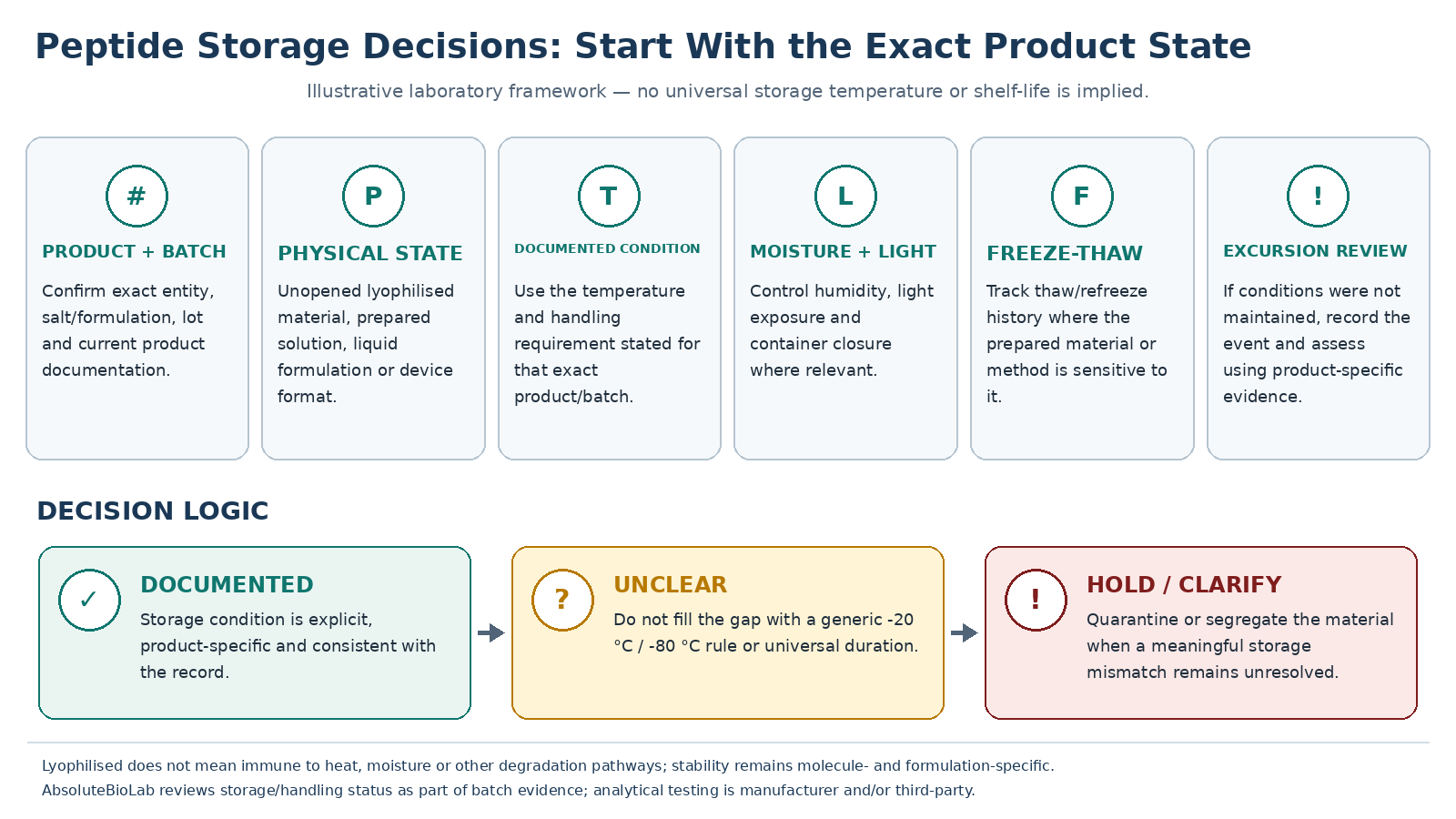
Illustrative framework only. Not an SOP, real batch record, validation report, accredited laboratory document or product-specific acceptance specification.
From Our Work: storage status is one part of the batch evidence
Core Research’s approved batch-review workflow includes storage/handling status alongside product/batch matching, HPLC purity, MS identity, appearance, labelled amount/content, applicable moisture/counter-ion evidence and document completeness. If a meaningful mismatch is unresolved, the batch is held for clarification and/or justified retesting. Analytical testing is produced by the manufacturer and/or third-party laboratories.
That is why this page does not publish a house rule such as “all peptides go at -20 °C” or a universal number of days after preparation. A storage statement should be traceable to the exact product/formulation or to evidence that genuinely applies to it. If the available record does not support the claim, the correct action is clarification, not a confident generic temperature.
How should storage be chosen by physical state?
| Material state | Decision basis | What not to assume |
|---|---|---|
| Unopened lyophilised material | Exact product specification, container closure, moisture/light sensitivity and documented temperature. | Lyophilised means “heat-proof”, “room-temperature stable indefinitely” or one frozen temperature fits every peptide. |
| Prepared aqueous solution | Peptide-specific solution stability, solvent/buffer, concentration, container, temperature and freeze-thaw history. | Solid-state storage data automatically applies after reconstitution. |
| Other liquid formulation | The supplied formulation and its documented storage conditions, including excipients/pH where relevant. | Generic peptide rules override the finished formulation instructions. |
| Pen/cartridge or other finished research format | Finished-format documentation and device/formulation-specific handling. | Bulk-vial storage evidence automatically proves finished-format stability. |
Why does physical state change the storage question?
A peptide can degrade through different pathways in solid and aqueous environments. Studies of substance P found spontaneous degradation in both lyophilised and solution states, while model-peptide work on asparagine deamidation shows that solid-state reactions remain influenced by formulation and environmental conditions.[3][4] The practical lesson is not a universal shelf life; it is that dry-state stability must be demonstrated rather than presumed.
In solution, pH, buffer, ionic environment, concentration and temperature can strongly influence degradation kinetics for individual peptides. A study of a cyclic somatostatin analogue, for example, found degradation behaviour dependent on pH, temperature, buffer and ionic strength.[5] That is exactly why product-specific handling evidence belongs on the exact compound or formulation record.
What other controls matter besides temperature?
| Control | Why it can matter | Record to keep |
|---|---|---|
| Moisture / humidity | Water can influence solid-state mobility, hydrolysis or the integrity of a lyophilised material. | Container/closure status, desiccant instructions and any humidity-sensitive storage requirement. |
| Light | Some peptide residues or formulation components can be light-sensitive. | Any protect-from-light instruction and actual storage condition where relevant. |
| Container / surface | Prepared peptides can adsorb to glass or plastics depending on the molecule, concentration and medium. | Container type and any validated low-adsorption practice used by the laboratory. |
| Freeze-thaw history | Repeated cycling can affect some peptide/protein analytes, while others tolerate multiple cycles; the effect is analyte-specific. | Aliquot plan, thaw events and any study-specific limit supported by evidence. |
| Time after preparation | Solution stability is not the same as unopened solid-state stability. | Preparation date/time, solvent/buffer, concentration and documented usable window if one is supported. |
How should a laboratory handle a storage deviation?
- Record the exact product, batch, physical state and documented storage requirement before moving or altering the material.
- Capture the deviation: observed condition, approximate duration if known, packaging/container status and any evidence such as logger data or receiving photographs.
- Do not infer degradation from touch temperature, a delayed courier event or a generic stability table. Route transit events to the dedicated arrival/excursion guide.
- Check the exact product/batch evidence and any manufacturer or third-party stability information that genuinely applies to the formulation.
- If a meaningful mismatch remains unresolved, segregate or hold the material and request clarification. A retest, where justified, should answer the specific analytical question rather than simply produce a more convenient result.
For transit-specific concerns, use Cold-Chain and Temperature-Stable Shipping for Research Products and What to Do if a Research Product Arrives Warm or Delayed. For repeated thawing and sample management, use Aliquoting and Freeze-Thaw Control for Research Peptides.
Why this guide avoids universal storage durations
ICH Q1A(R2), although written for pharmaceutical stability programmes, illustrates the core scientific principle: storage claims are established by data generated under defined conditions.[1] The OECD test-item guidance likewise treats storage as a controlled attribute tied to the nature of the material.[2] Neither document supports taking one peptide’s stability result and publishing it as a peptide-wide rule.
A source that says one peptide remained within specification for a defined period at a defined temperature is evidence for that peptide and experiment. It is not evidence that every synthetic peptide, every salt form, every lyophilised cake or every prepared solution behaves the same way.
Frequently asked questions
Should all lyophilised research peptides be stored at -20 °C?
No. Follow the exact product and batch documentation. This guide deliberately avoids a universal frozen-storage temperature because stability depends on the molecule, formulation, container, moisture and supporting evidence.
Is lyophilised peptide stable at room temperature?
That cannot be answered safely as a peptide-wide rule. Lyophilisation can improve stability for some materials, but dry-state degradation can still occur and must be assessed using material-specific evidence.
Should prepared peptide solutions be stored the same way as unopened powder?
Not necessarily. Reconstitution changes the physical environment, and solution stability can depend on solvent/buffer, pH, concentration, container and temperature.
How many freeze-thaw cycles are acceptable?
There is no universal number. Published studies show analyte-specific behaviour, so the laboratory should define an aliquot/freeze-thaw policy that is appropriate to the exact material and method.
Does a cold shipment prove the product stayed within specification?
No. Packaging and temperature are only part of the evidence. The product state, route, duration, logger data where available and product-specific stability information determine what can be concluded.
What should I do if I cannot find a storage condition for the batch?
Do not fill the gap with a generic internet rule. Hold the decision, check the product documentation and contact the supplier for the exact requirement or supporting evidence.
Key takeaway
Storage decisions begin with the exact material, physical state and batch evidence. Temperature is only one variable, and neither lyophilisation nor freezing creates a universal stability guarantee. Record the condition actually used, manage freeze-thaw deliberately, and escalate any unresolved storage mismatch instead of guessing.
References
- ICH Q1A(R2). Stability Testing of New Drug Substances and Products. FDA/ICH, November 2003. Used for the principle that stability claims require data under defined storage conditions; not presented as an RUO regulatory requirement.
- OECD. Management, Characterisation and Use of Test Items used in GLP studies. No. 19 (2018). Used for identification, storage, handling and transport-control principles.
- Spontaneous chemical degradation of substance P in the solid phase and in solution. PMID 7681812. Used as primary evidence that a peptide can degrade in both lyophilised and aqueous states; not used to set a storage limit for other peptides.
- Effects of sucrose and mannitol on asparagine deamidation rates of model peptides in solution and in the solid state. PMID 15986465. Used as primary evidence that solid-state peptide degradation remains condition/formulation dependent.
- Stability of Octastatin, a somatostatin analog cyclic octapeptide, in aqueous solution. PMID 9552470. Used as primary evidence that solution degradation can depend on pH, temperature, buffer and ionic strength.