Repeat-Batch Procurement & Lot-Continuity Planning
Repeat-Batch Procurement & Lot-Continuity Planning
RESEARCH USE ONLY
This guide is for controlled laboratory and research use. It does not provide dosing, injection, administration, treatment, human-use or veterinary-use instructions.
What is repeat-batch procurement and lot-continuity planning?
Repeat-batch procurement is the process of planning a later order so that a research programme can either continue with the same supplier lot or make a controlled transition to a new lot. Same-lot supply should be confirmed, not assumed. When a lot changes, the laboratory should compare the new batch evidence and decide whether its own assay or study needs a bridging check before results are combined.
Lot continuity matters because research materials and reagents can show between-lot differences, and those differences can affect measurement systems in ways that are not visible from the product name alone. Published lot-comparison studies in laboratory reagents demonstrate the broader reproducibility problem, although their numerical findings must not be transplanted to research peptides.[4][5]
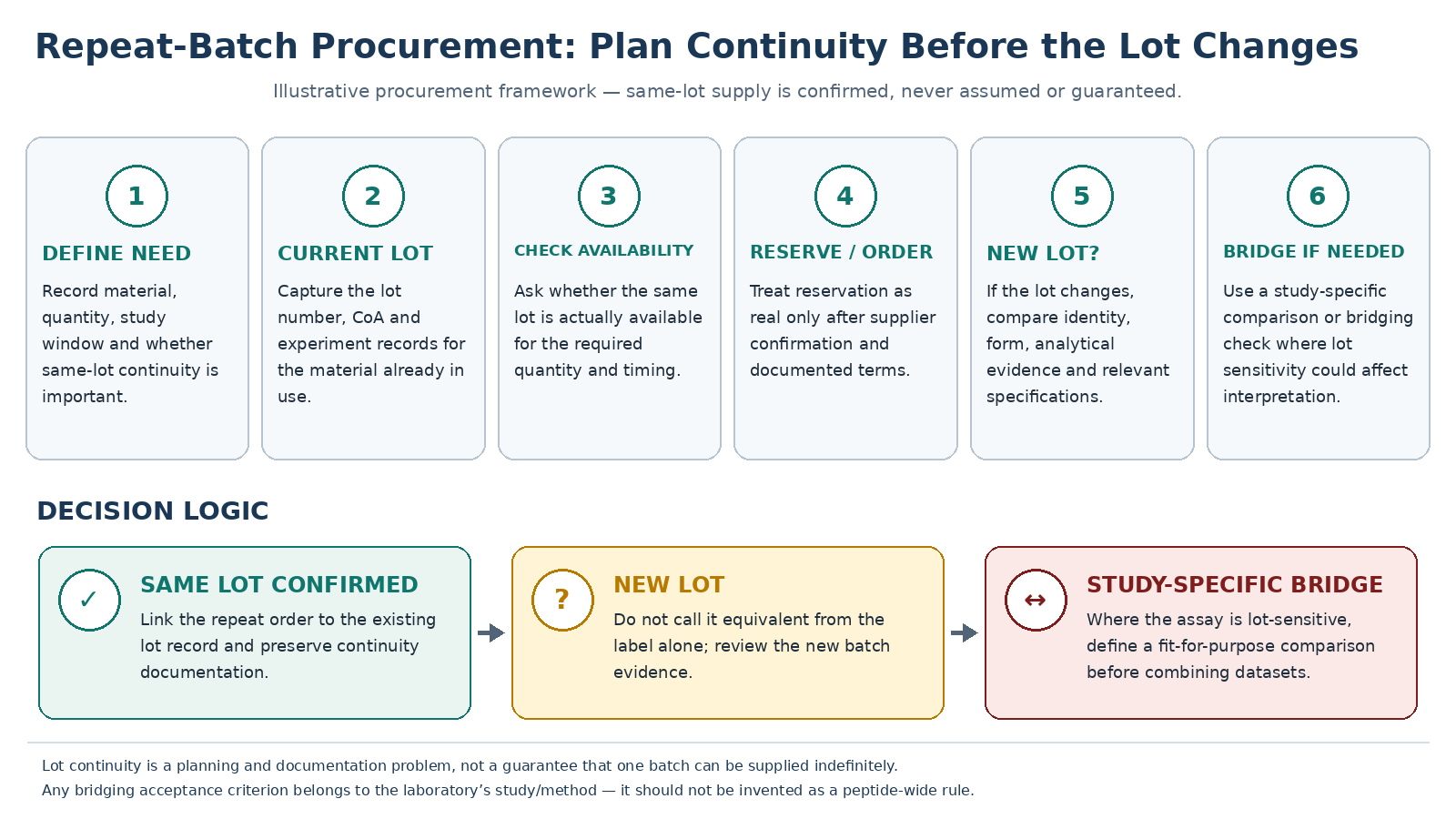
Illustrative framework only. Not an SOP, real batch record, validation report, accredited laboratory document or product-specific acceptance specification.
From Our Work: confirm the lot before the study depends on it
The unified Core Research map specifies that repeat-batch planning begins with contact, availability confirmation, reservation where possible and document comparison, with an explicit caveat that the same lot is not guaranteed without confirmation. This page therefore does not promise indefinite lot availability or imply that a reservation exists before it is confirmed.
That rule prevents a common planning error: designing the next phase of an experiment around the assumption that the current lot will still be available later. If lot continuity matters, identify the requirement early, record the current lot and quantity, and ask for availability before the remaining stock becomes critical.
When should you prefer the same lot, a new lot, or a bridging check?
| Scenario | Best planning approach | What to document |
|---|---|---|
| Same lot is available and continuity matters | Confirm quantity and timing before relying on it; reserve only when the supplier confirms the arrangement. | Current lot, requested quantity, confirmation, order reference and the same analytical document set. |
| Same lot is unavailable | Treat the replacement as a new batch and review its evidence rather than calling it equivalent from the label alone. | New lot, CoA/analytical reports, product form/specification and comparison notes. |
| Assay is sensitive to material changes | Define a study-specific bridge using the laboratory’s own method and acceptance logic. | Bridge design, samples/controls, results, decision and whether datasets may be pooled. |
| Exploratory work with low continuity risk | A document comparison may be sufficient if the laboratory determines no formal bridge is needed. | Reason for the decision and the new lot identity. |
What should be checked before placing a repeat order?
- Define the continuity requirement: exact same lot, same product/specification, or simply uninterrupted supply. Do not use “same product” as a substitute for “same lot”.
- Record the current lot and remaining usable inventory. Link the lot to the experiments already completed so the study history is explicit.
- Estimate the quantity and date range realistically. Include planned repeats, controls and contingency stock rather than requesting a reservation with no study horizon.
- Confirm current lot availability with the supplier. If the same lot cannot be confirmed, move immediately to new-lot planning rather than assuming later availability.
- Compare the document set for any new lot: product identity/form, batch number, CoA, HPLC/MS or other applicable evidence, storage/handling requirements and any changed specification field.
- Decide whether the laboratory’s method needs a bridging comparison before the new lot is used in a continuing dataset. This decision belongs to the study/method, not to a universal supplier threshold.
- Record the transition. Update the experimental audit trail so every run can be traced to the lot actually used.
Why can lot changes matter even when the product name is unchanged?
A product name defines the intended material, but individual lots are separate manufactured and tested units. OECD GLP test-item guidance therefore emphasises identification, batch/lot information, characterisation, receipt and storage as part of test-item control.[1] In other laboratory domains, prospective and retrospective studies have shown measurable lot-to-lot differences in commercial reagents.[4][5]
Those studies do not establish how much variation to expect from a specific research peptide. Their relevance is narrower: they demonstrate why an experiment that is sensitive to reagent properties should not assume that a new lot is analytically interchangeable without checking the attributes that matter to that method.
How should a new lot be compared with the previous lot?
ICH Q2(R2) and Q14, although written for pharmaceutical analytical procedures rather than RUO procurement, provide useful science-based concepts: analytical procedures need performance characteristics suited to their intended purpose, and changes should be evaluated using appropriate, justified studies rather than arbitrary rules.[2][3]
| Comparison layer | Question | Limit |
|---|---|---|
| Identity and stated form | Is the material the same intended entity and chemical/formulation form? | Label identity alone does not establish all analytical attributes. |
| Batch analytical evidence | Do the HPLC/MS and other applicable results support the new lot under the stated methods? | Do not impose a universal HPLC or mass-error threshold not defined for the product/study. |
| Physical / handling attributes | Have relevant storage, moisture, counter-ion, formulation or handling fields changed? | Only compare attributes that are actually applicable and documented. |
| Study-facing performance | Does the laboratory’s assay produce materially different behaviour with the new lot? | A supplier cannot define one bridging test that fits every downstream method. |
| Documentation | Can every historical and new experiment be traced to the correct lot? | A scientifically acceptable transition still fails reproducibility if lot identity is lost. |
What does a study-specific bridging check look like?
A bridging check is not a standard peptide test panel. It is a comparison designed around the laboratory endpoint that could be affected by the lot change. The design might use common controls, retained samples, side-by-side assay runs or another method-appropriate comparison. The sample number, acceptance rule and statistical treatment belong to the study method and should be specified before the result is known.
Clinical-laboratory lot-comparison studies illustrate why underpowered checks can miss meaningful reagent changes, but their sample counts and cut-offs are not transferable to peptide research.[4] The safe conclusion is methodological: if lot sensitivity matters, define the comparison prospectively and keep the decision with the study record.
How should lot continuity be handled in procurement records?
- Record the supplier lot in the purchase request or internal inventory record when same-lot continuity is required.
- Do not write “same lot guaranteed” unless the supplier has explicitly confirmed the quantity and terms.
- Keep the confirmation with the order record so a later researcher can distinguish planned continuity from an assumption.
- When a new lot arrives, preserve both the previous and new CoA/document set and record the transition date.
- Link any bridging evidence to both lots and to the experiments that use them.
- If continuity cannot be achieved, document the decision to pause, redesign, bridge or continue with the new lot.
For institutional planning, use Institutional Procurement Enquiries. For batch documentation, use the Batch CoA Portal, Why Batch Numbers and Lot Traceability Matter and Research Batch Documentation Retention and Experimental Audit Trails. For repeat-account and bulk-reorder support, use Research Account and Bulk Reorder Support.
Frequently asked questions
Can Core Research guarantee the same lot for every future order?
No. Same-lot continuity depends on real inventory and must be confirmed for the requested quantity and timing. This guide does not turn a continuity request into an automatic reservation or guarantee.
Is a new lot automatically equivalent if the CoA looks similar?
No. The new batch should be reviewed against the attributes relevant to the product and study. Whether a study-specific bridge is needed depends on the downstream method.
Do all experiments need formal bridging when the lot changes?
No. Bridging should be proportionate to the risk that a lot change could alter the endpoint. Exploratory work and highly quantitative longitudinal studies may justify different approaches.
Can HPLC purity alone be used to compare two lots?
No. HPLC is one analytical attribute under a stated method. Identity, form, other applicable batch attributes and study-facing performance may also matter.
When should I ask about repeat-lot availability?
As early as practical when the current lot is important to a planned study series. Waiting until the remaining inventory is nearly exhausted reduces the available continuity options.
Where should lot-change decisions be recorded?
Keep them with the procurement and experimental audit trail so each run remains traceable to the lot actually used and any bridge can be interpreted later.
Key takeaway
Lot continuity is managed, not assumed. Confirm same-lot availability before a study depends on it; when the lot changes, compare the new batch evidence and use a study-specific bridging check only where the downstream method needs one. Keep every transition tied to the experimental record.
References
- OECD. Management, Characterisation and Use of Test Items used in GLP studies. OECD Series No. 19 (2018). Used for batch/lot identification, receipt, characterisation and storage principles.
- ICH Q2(R2). Validation of Analytical Procedures. Final guidance, March 2024. Used for fit-for-purpose analytical comparison principles; not presented as an RUO procurement regulation.
- ICH Q14. Analytical Procedure Development. Final guidance, March 2024. Used for science- and risk-based analytical evaluation concepts.
- Algeciras-Schimnich A, Bruns DE, Boyd JC, et al. Failure of current laboratory protocols to detect lot-to-lot reagent differences: findings and possible solutions. Clinical Chemistry. 2013;59(8):1187-1194. PMID 23592508. Used only as evidence that lot effects can matter in laboratory measurement systems; not as a peptide-specific acceptance rule.
- Gandhi MJ, Carrick DM, Jenkins S, et al. Lot-to-lot variability in HLA antibody screening using a multiplexed bead-based assay. Transfusion. 2013;53(9):1940-1947. PMID 23305156. Used as a second laboratory-reagent example of between-lot variation; not peptide-specific.