Solvent Selection Buffer Compatibility & pH
Solvent Selection Buffer Compatibility & pH
RESEARCH USE ONLY
This guide is for controlled laboratory and research use. It does not provide dosing, injection, administration, treatment, human-use or veterinary-use instructions.
How should a laboratory choose a peptide solvent, buffer and pH?
Choose solution conditions from the exact peptide or peptide salt, the target in-vitro concentration and the analytical or experimental method. There is no peptide-wide solvent, buffer or pH that is automatically correct. Primary studies show that pH, buffer species, buffer concentration and ionic strength can alter peptide solubility, aggregation and degradation in molecule-specific ways.[1–5]
The decision therefore starts with what the method needs to measure, not with a generic “reconstitution recipe.” A condition is useful only if it dissolves the material, preserves the attribute of interest and remains compatible with the downstream method.
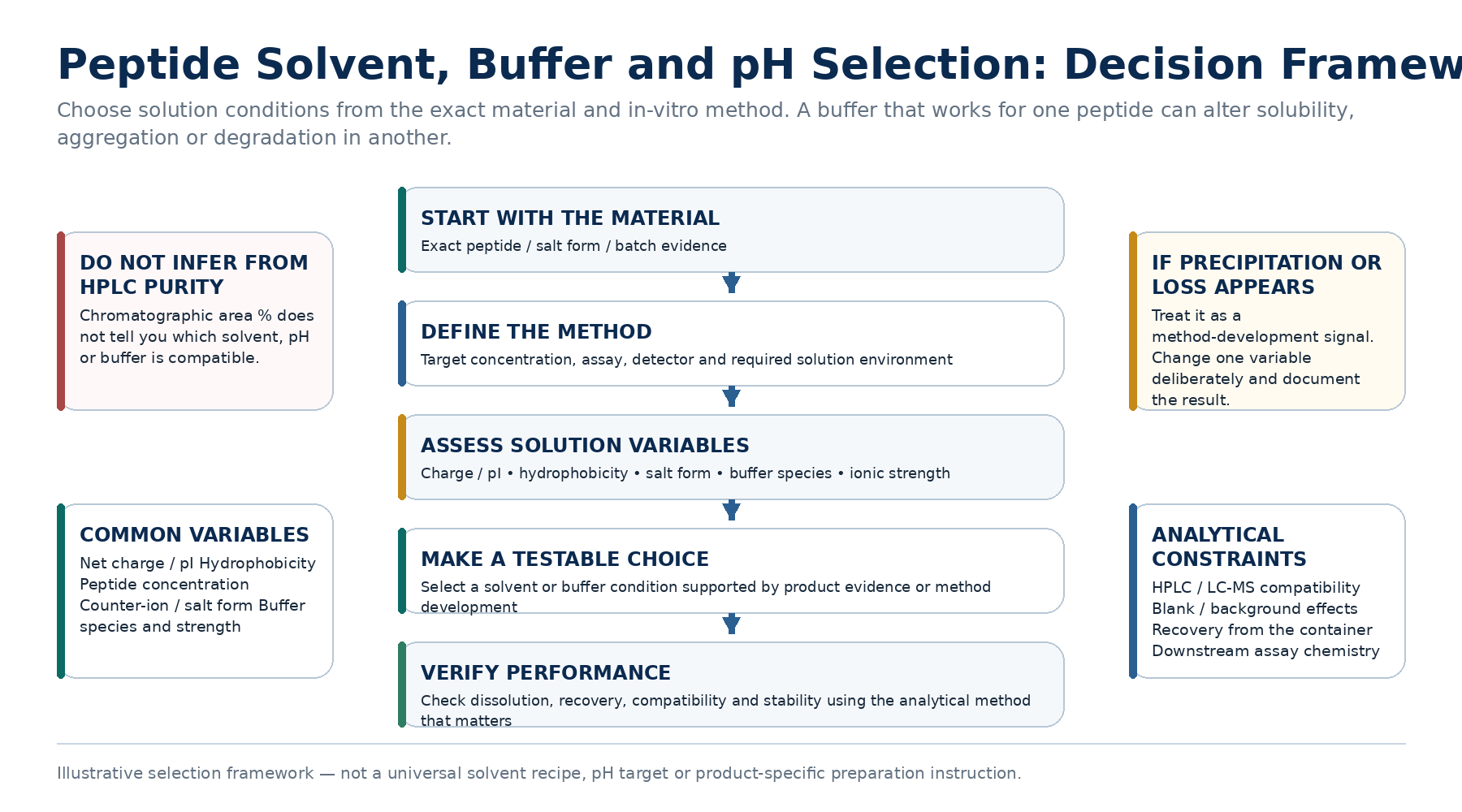
Illustrative technical framework only; not an Core Research batch record, analytical result, validated method or product-specific SOP.
Verified Experience Input
Core Research’s approved batch-review workflow separates analytical release evidence from downstream handling decisions. HPLC purity and MS identity are reviewed as evidence about the supplied batch, but neither method establishes which solvent, buffer, pH or ionic strength a laboratory should use for a later in-vitro experiment. Storage/handling status and document completeness are reviewed separately, and meaningful unresolved mismatches are held for clarification and/or justified retesting. This is why Core Research does not treat a single solvent or ‘physiological pH’ recipe as a peptide-wide rule.
From Our Work: analytical evidence does not choose the solvent
Core Research reviews HPLC purity and MS identity as separate components of the supplied batch evidence. Those results answer analytical questions about the material under the stated methods. They do not establish what will happen when a laboratory later changes solvent, pH, buffer, ionic strength or concentration. Treating the CoA as if it were also a universal solution-preparation protocol would mix two different evidence domains.
The practical rule is to preserve that separation. Confirm the exact material and any supplier/manufacturer handling information, define the downstream in-vitro method, then select and verify solution conditions that are appropriate to that method. If the available documentation conflicts with the physical behaviour of the material, stop and clarify the discrepancy rather than forcing the solution with an arbitrary pH or stronger cosolvent.
This approach also avoids a common semantic error in peptide content: “physiological pH” is not automatically the most stable pH, and “water-soluble” does not mean that every concentration, salt form or buffer environment will remain clear or analytically unchanged.
Which variables should be considered before selecting a solvent or buffer?
| Variable | Why it can matter | What to verify |
|---|---|---|
| Peptide sequence / ionisable groups | Net charge changes with pH and can alter solubility and self-association. | Sequence/form, approximate charge behaviour and any product-specific compatibility evidence. |
| Hydrophobicity | Hydrophobic side chains can limit aqueous solubility or promote self-association. | Whether the target concentration is achievable under method-compatible conditions. |
| Salt / counter-ion form | TFA, acetate, chloride or another form can influence gross mass, local chemistry and reported form. | The stated chemical form and any counter-ion evidence; do not infer from HPLC area %. |
| Concentration | A peptide can behave differently at low and high concentration. | Target in-vitro concentration and whether recovery/aggregation changes across the working range. |
| pH | Affects ionisation and can change chemical degradation or aggregation rates. | Use material-specific evidence or method development rather than a universal target. |
| Buffer species / strength | Buffers are not inert labels; species and concentration can alter degradation or interactions. | Compatibility with the peptide and downstream assay. |
| Ionic strength / additives | Electrostatic screening can change solubility and aggregation. | Whether added salts or excipients improve or worsen the actual endpoint. |
| Analytical method | Some solvents, salts and non-volatile buffers interfere with LC-MS or other readouts. | Method blank, recovery, chromatography and detector compatibility. |
Why can pH change peptide stability?
Ionisable side chains and terminal groups change protonation state with pH. That can alter solubility, electrostatic repulsion and the rates of acid- or base-catalysed reactions. A cyclic somatostatin analogue showed a clear pH-rate profile in aqueous solution, with maximum stability in a specific acidic region rather than at neutral pH.[2] Another somatostatin analogue showed degradation that varied with pH, buffer species, buffer concentration and temperature.[1] These are examples of molecule-specific behaviour, not recommended pH targets for unrelated peptides.
Why does buffer species matter, not just the pH number?
Two solutions at the same nominal pH can behave differently because the buffer species and its concentration can participate in catalysis, change ionic strength or interact with the peptide. In the Octastatin study, acetate, glutamate, citrate and phosphate buffers produced different degradation behaviour at comparable pH conditions.[1] Therefore a documented pH without the buffer identity and concentration is incomplete method information.
How can ionic strength affect solubility or aggregation?
Electrostatic interactions are one of several forces that govern peptide self-association. Primary studies on different peptide systems have shown that pH and ionic strength can substantially alter aggregation kinetics and morphology.[3–4] Solubility studies on amelogenin variants likewise found strong dependence on primary structure, pH and ionic strength.[5] The direction of the effect is not universal, so “add salt” or “lower ionic strength” should not be published as a peptide-wide control.
When is an organic cosolvent appropriate?
Some poorly water-soluble peptides require an organic cosolvent during method development, but the choice must be compatible with the peptide, target concentration, analytical method and downstream assay. A cosolvent can change conformation, aggregation state, chromatographic behaviour or assay biology. This guide therefore does not prescribe DMSO, acetonitrile, ethanol or any other solvent as a universal first choice.
What should a laboratory do if the peptide precipitates or recovery falls?
- Confirm the exact product, salt/counter-ion form, batch and target concentration before changing conditions.
- Record the current solvent/buffer, pH, ionic strength, container and time at temperature.
- Determine whether the problem is incomplete dissolution, aggregation, surface adsorption or chemical change; these mechanisms require different evidence.
- Change one method variable deliberately where practical, rather than making several undocumented adjustments at once.
- Re-check analytical compatibility after any change; a visually clear solution can still be unsuitable for the measurement.
- If the source documentation conflicts with observed behaviour, retain the discrepancy in the record and seek clarification.
Use the Peptide Aggregation, Surface Adsorption and Oxidation Controls guide to separate loss mechanisms, and the Molecular Mass, Molarity and Dilution Calculations guide to keep concentration arithmetic explicit. The Laboratory Reconstitution and Handling Hub provides the broader controlled in-vitro workflow.
Frequently asked questions
Is water always the correct solvent for a research peptide?
No. Some peptides are readily soluble in aqueous media and others are not. The correct condition depends on the exact material, concentration and method.
Should peptide solutions always be adjusted to pH 7.4?
No. Neutral or “physiological” pH is not a universal stability target. Published peptide studies show molecule-specific pH-rate behaviour.
Does a buffer guarantee better stability than water?
No. Buffer species and concentration can either improve or worsen stability depending on the peptide and reaction pathway.
Can HPLC purity predict solubility?
No. HPLC area purity under a stated chromatographic method does not establish solution compatibility at a new pH, solvent or concentration.
Should I add surfactant or salt if recovery is low?
Not as a generic rule. First determine whether the loss is aggregation, adsorption, incomplete dissolution or chemical degradation, then evaluate a method-specific control.
Does this page give a reconstitution recipe?
No. It is a decision framework for controlled in-vitro method development and does not provide product-specific administration or dosing instructions.
Key takeaway
Peptide solution conditions are part of the analytical or experimental method. Start with the exact material and intended endpoint, treat pH, buffer species, ionic strength, concentration and container as interacting variables, and verify performance rather than assuming a universal solvent recipe.
References
- Stability of Octastatin, a somatostatin analog cyclic octapeptide, in aqueous solution. Primary study, PMID 9552470. Used for buffer-species, pH, buffer-concentration, ionic-strength and temperature effects on peptide degradation.
- Kinetics and mechanism of degradation of a cyclic hexapeptide (somatostatin analogue) in aqueous solution. Primary study, PMID 1360156. Used for the molecule-specific pH-rate profile and temperature dependence.
- Effect of electrostatics on aggregation of prion protein Sup35 peptide. Primary study, PMID 22466073. Used for pH- and ionic-strength-dependent peptide aggregation kinetics.
- Aqueous gel formation of a synthetic peptide derived from the beta-sheet domain of platelet factor-4. Primary study, PMID 12425659. Used for temperature, pH and ionic-strength effects on peptide self-association.
- Quantitative analysis of amelogenin solubility. Primary study, PMID 9649167. Used for sequence-, pH- and ionic-strength-dependent peptide/polypeptide solubility.