Peptide Molarity & Dilution Calculations
Peptide Molarity & Dilution Calculations
RESEARCH USE ONLY
This guide is for controlled laboratory and research use. It does not provide dosing, injection, administration, treatment, human-use or veterinary-use instructions.
How are molecular mass, molarity and dilution calculated for peptide research?
Peptide concentration calculations use the same amount-of-substance and volume relationships as other chemical laboratory work. The core equations are n = m/M for amount of substance, c = n/V for amount concentration, mass concentration = m/V, and C1V1 = C2V2 for a dilution in which the amount of the same solute is conserved. The calculation is only as valid as the mass basis, molar mass and final volume entered.[1–4]
For peptides, the main trap is not arithmetic but definition. A vial label, gross lyophilised mass, peptide-base equivalent, salt form, residual water and counter-ion contribution are not automatically the same thing. HPLC area purity should not be converted directly into peptide mass unless an appropriate quantitative method supports that interpretation.
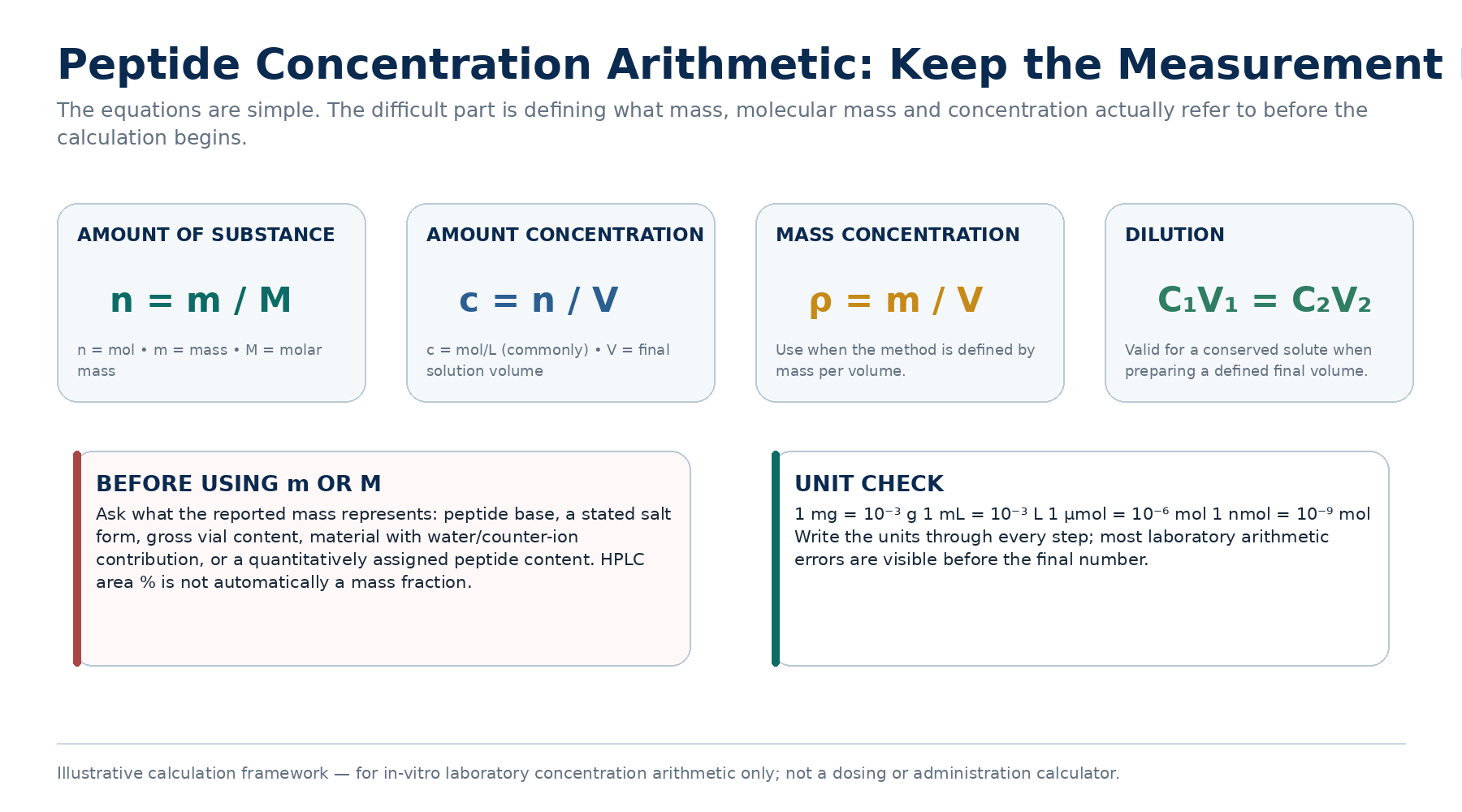
Illustrative technical framework only; not an Core Research batch record, analytical result, validated method or product-specific SOP.
Verified Experience Input
Core Research’s approved batch-review workflow keeps labelled amount/content separate from HPLC area purity. A chromatographic area percentage is not treated as an absolute peptide mass fraction unless an appropriate quantitative method establishes that basis. Counter-ion information and water/moisture may also be relevant to how gross material mass relates to peptide base content. For concentration calculations, this means the arithmetic should identify the exact mass basis being used rather than silently converting a purity percentage into peptide mass.
From Our Work: keep “purity” separate from “amount”
Core Research’s approved evidence-review workflow checks labelled amount/content separately from HPLC purity. That separation is important because an HPLC-UV area percentage is a relative chromatographic signal under a stated method; it is not automatically a gravimetric peptide mass fraction. The same workflow reviews counter-ion information and water/moisture where applicable because those components can contribute to the physical mass of a peptide material.
The practical calculation rule is therefore to name the basis. If a method uses the nominal labelled amount, call the result nominal. If a CoA or quantitative assay provides peptide-base content or another assigned amount, state that basis explicitly. If molecular mass refers to the free peptide while the weighed material is a salt or hydrate, check whether the calculation should use the stated chemical form or a documented peptide-equivalent value.
This prevents a mathematically neat answer from becoming a chemically misleading one. The units can be correct while the material basis is wrong.
The four equations used most often
| Purpose | Equation | Use |
|---|---|---|
| Amount of substance | n = m / M | Convert a known mass m to moles n using molar mass M. |
| Amount concentration | c = n / V | Convert amount of substance to molar concentration using final solution volume V. |
| Mass concentration | ρ = m / V | Express mass per volume, for example mg/mL, when the method is defined on a mass basis. |
| Dilution | C1V1 = C2V2 | Calculate the stock volume required to prepare a lower concentration of the same solute to a defined final volume. |
What is molecular mass versus molar mass?
Relative molecular mass is dimensionless, while molar mass is mass divided by amount of substance. In practical peptide calculations, molar mass is commonly expressed in g/mol. The SI base unit of amount of substance is the mole; one mole contains exactly 6.02214076 × 10²³ specified entities.[1–3]
Always confirm what chemical entity the molar mass describes. A peptide free base, TFA salt, acetate salt, hydrate or other form can have a different formula mass. For mixtures or incompletely defined salt/water content, a nominal peptide molecular mass may not convert the gross sample mass into an exact mole amount.
Worked example 1: mass concentration
For an in-vitro laboratory stock, suppose 2.0 mg of material is made up to a final volume of 4.0 mL. Mass concentration = 2.0 mg / 4.0 mL = 0.50 mg/mL. This result says nothing about peptide molarity unless the molecular mass and the material basis are also defined.
Worked example 2: molarity from a defined peptide mass
Suppose an analytically assigned peptide mass is 2.00 mg, the stated molar mass of the relevant chemical entity is 2000 g/mol, and the final solution volume is 1.00 mL. Convert 2.00 mg to 0.00200 g. Amount n = 0.00200 g / 2000 g/mol = 1.00 × 10⁻⁶ mol = 1.00 µmol. Final volume 1.00 mL = 0.00100 L, so c = 1.00 µmol / 0.00100 L = 1.00 × 10⁻³ mol/L = 1.00 mM.
If the 2.00 mg were only a gross material mass and the sample contained counter-ion, water or other non-peptide mass not accounted for in the molar-mass basis, the calculated 1.00 mM would be nominal rather than an exact peptide-base concentration.
Worked example 3: a laboratory dilution
To prepare 10.0 mL of a 20 µM working solution from a 100 µM stock of the same solute, V1 = (C2 × V2) / C1 = (20 µM × 10.0 mL) / 100 µM = 2.0 mL. Transfer 2.0 mL of the stock and make up to a final volume of 10.0 mL with the method-compatible diluent. The equation assumes the same solute basis before and after dilution and uses final volume, not “add 8 mL” as a universal rule when volume additivity is uncertain.
How should purity, counter-ion and water be handled in calculations?
| Reported item | Can it be used directly as peptide mass? | Reason |
|---|---|---|
| HPLC area % | Usually no | Area % is a chromatographic response ratio under a stated method and is not automatically absolute mass fraction. |
| Labelled vial amount | As a nominal basis if that is the stated use | The label may not define peptide-base assay, counter-ion contribution or water content. |
| Quantitative peptide content / assay | Yes, if the method and basis are appropriate | Use the reported quantitative basis and units exactly. |
| Counter-ion quantity | Not as peptide mass | Counter-ion can contribute to gross mass; use the stated peptide-equivalent or chemical-form basis. |
| Water / moisture | Not as peptide mass | Water may contribute to measured material mass and must be handled according to the quantitative method. |
For counter-ion and desalting interpretation, use Residual TFA, Counter-Ions and Peptide Desalting. For solution-condition selection, use Solvent Selection, Buffer Compatibility and pH for Peptide Research. The Laboratory Reconstitution and Handling Hub owns the broader in-vitro preparation workflow.
Unit checks that prevent common errors
- 1 mg = 10-3 g.
- 1 µg = 10-6 g.
- 1 mL = 10-3 L.
- 1 µmol = 10-6 mol; 1 nmol = 10-9 mol.
- 1 mM = 10-3 mol/L; 1 µM = 10-6 mol/L; 1 nM = 10-9 mol/L.
- Carry the units through every algebraic step and round only after the final calculation.
Frequently asked questions
Can I multiply the vial mass by HPLC purity % to get peptide mass?
Not automatically. HPLC area % is not necessarily an absolute mass fraction. Use a quantitative content/assay result when the peptide mass basis must be established.
Should I use the free-peptide molecular mass or the salt-form molecular mass?
Use the chemical entity and mass basis relevant to the measurement. If the weighed material includes a defined salt or other contribution, document how the reported content relates to the molar-mass basis.
What is the difference between mg/mL and mM?
mg/mL is a mass concentration. mM is amount concentration. Converting between them requires the relevant molar mass and a correctly defined mass basis.
Does C1V1 = C2V2 always apply?
It applies to a dilution where the amount of the same solute is conserved and V2 is the defined final volume. It should not be used to hide reactions, losses or an undefined material basis.
Can this page calculate syringe units or doses?
No. The page is limited to in-vitro laboratory concentration arithmetic and explicitly excludes dosing, syringe-unit, administration or schedule outputs.
How many significant figures should I report?
Do not report more precision than the least precise input or the method supports. Keep raw calculations in the record and round the reported value appropriately.
Key takeaway
Peptide concentration arithmetic is only defensible when the chemical entity, mass basis, molar mass, final volume and units are explicit. Keep HPLC area purity, quantitative content, counter-ion and water as separate evidence unless a validated method legitimately connects them.
References
- The International System of Units (SI), 9th edition, updated 2026. BIPM SI Brochure. Authoritative SI reference for the mole, amount of substance and unit conventions. Accessed 14 August 2026.
- SI Units – Amount of Substance. NIST. Used for the exact mole definition and amount-of-substance unit. Accessed 14 August 2026.
- NIST Guide to the SI, Chapter 8. NIST. Used for molar mass as mass divided by amount of substance and SI quantity notation. Accessed 14 August 2026.
- IUPAC Gold Book: amount concentration. IUPAC Compendium of Chemical Terminology. Used for amount concentration as amount of a constituent divided by mixture volume and common mol/L usage.
- IUPAC Gold Book: molarity. IUPAC Compendium of Chemical Terminology. Used to note that molarity is a term for amount concentration.