Peptide Aggregation Adsorption & Oxidation Controls
Peptide Aggregation Adsorption & Oxidation Controls
RESEARCH USE ONLY
This guide is for controlled laboratory and research use. It does not provide dosing, injection, administration, treatment, human-use or veterinary-use instructions.
What are peptide aggregation, surface adsorption and oxidation?
Aggregation is peptide-to-peptide association; surface adsorption is peptide loss to a container or other interface; oxidation is a chemical modification of susceptible residues or the peptide backbone environment. All three can reduce apparent recovery or alter analytical results, but they are different mechanisms. A falling HPLC peak, visible particles or low assay response should therefore be treated as an investigation signal, not as a one-step diagnosis.[1–5]
The practical objective is to preserve the distinction between physical loss and chemical change. The same symptom can have multiple causes, and a control that helps one mechanism can be irrelevant or harmful to another.
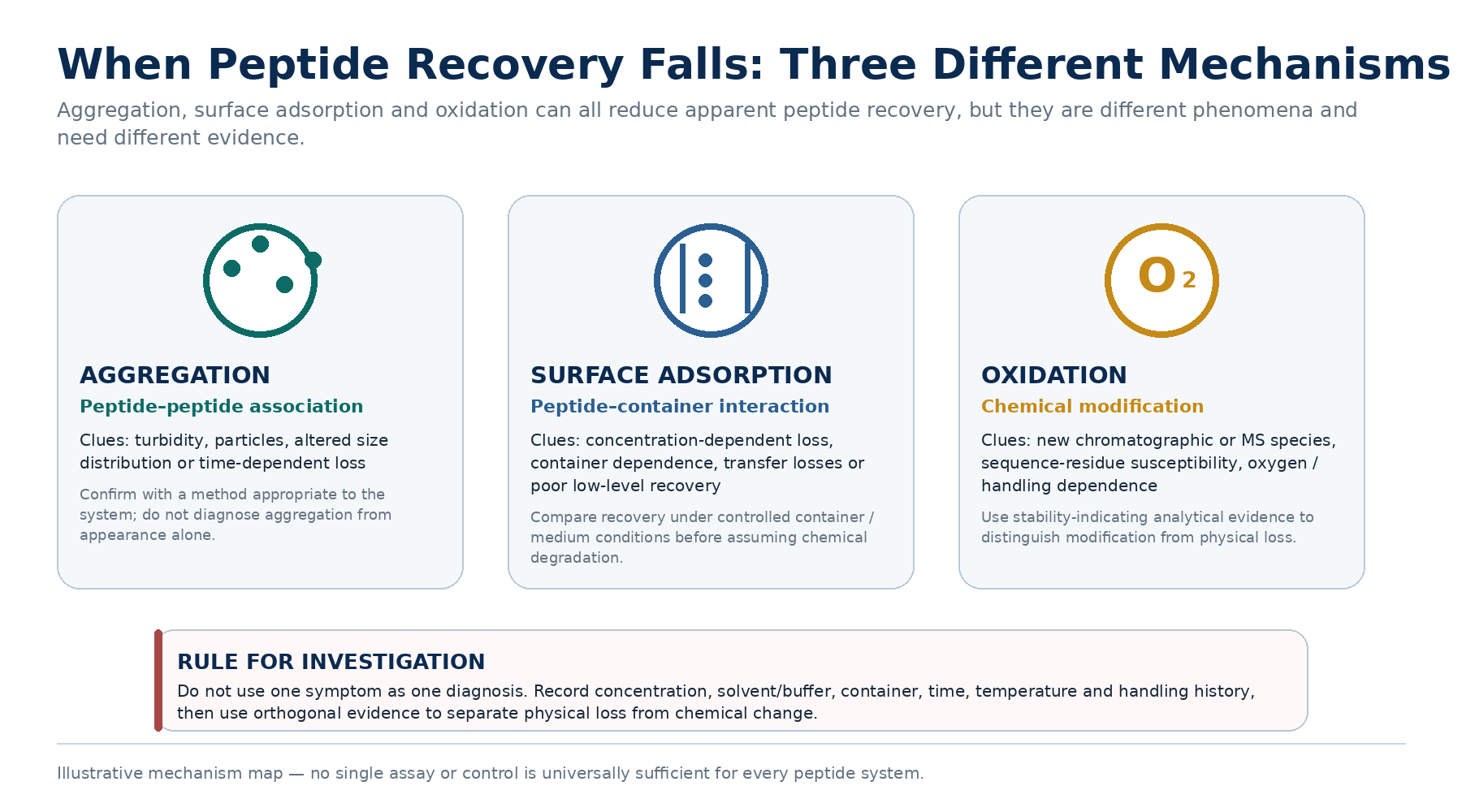
Illustrative technical framework only; not an Core Research batch record, analytical result, validated method or product-specific SOP.
Verified Experience Input
Core Research’s approved batch-review process deliberately keeps appearance, chromatographic purity and molecular identity as separate attributes. An unexpected appearance can justify clarification, but it is not automatically labelled aggregation, oxidation or contamination; HPLC purity is not identity, and MS identity is not a complete physical-stability assessment. When a meaningful inconsistency cannot be reconciled from the manufacturer and/or third-party evidence, the batch is held while clarification and/or justified retesting is requested. The same separation of questions is useful in laboratory troubleshooting: first establish what changed, then identify the mechanism.
From Our Work: appearance is a clue, not a mechanism
Core Research’s batch-review workflow treats appearance as one evidence attribute. If a material looks inconsistent with the expected presentation, that can justify holding the batch and asking for clarification. But the review does not relabel an appearance change as “aggregation” or “oxidation” without appropriate evidence. HPLC and MS are also read within their own scopes: a chromatographic profile is not the same as molecular identity, and an identity result is not a complete physical-stability assessment.
That discipline transfers directly to laboratory troubleshooting. If recovery falls after a preparation step, first record what changed: concentration, solvent/buffer, pH, container, transfer count, temperature, mixing and time. Then select evidence that can distinguish adsorption from aggregation or chemical modification. This is more reproducible than immediately adding surfactant, changing the tube, increasing mixing or adjusting pH without knowing which problem is being addressed.
Where the evidence remains internally inconsistent, the right action is clarification or a targeted retest that answers the unresolved question, not a generic repeat of the same measurement.
How does surface adsorption cause peptide loss?
Peptides can bind to glass, polypropylene, polyethylene and other materials through combinations of electrostatic and hydrophobic interactions. The magnitude is strongly peptide- and condition-dependent. In a primary Cetrorelix study, low-concentration HPLC response was poor because peptide adsorbed to vial surfaces; recovery changed with solvent, pH and vial material, and even varied between glass-vial suppliers.[1]
A separate analytical study developed an LC-MS-compatible antiadsorption diluent because adsorption to common consumables caused substantial low-concentration peptide loss and unreliable results.[2] These findings support a method-development principle: container choice and transfer history can be part of the measurement system, especially at low concentration.
What is peptide aggregation?
Aggregation occurs when peptide molecules self-associate into oligomers, particles, fibrils or other assemblies. The driving forces can include hydrophobic interactions, hydrogen bonding and electrostatics. pH, ionic strength, temperature, concentration, agitation and interfaces can change the kinetics, but the direction and magnitude are peptide-specific.[3]
An aggregation control should therefore be justified by the actual system. A lower concentration, different pH, changed ionic strength, different surface or reduced agitation may help one peptide and do little for another. This page does not prescribe a universal low-binding tube, surfactant, agitation limit or buffer.
What is peptide oxidation?
Oxidation is a chemical modification rather than a simple loss to a surface. Methionine, tryptophan, cysteine and other susceptible residues can be modified under oxidative conditions, depending on the sequence and environment. Sample handling itself can introduce ex-vivo oxidation before mass-spectrometric analysis; primary work has shown that methionine-, S-alkyl-cysteine- and tryptophan-containing peptides can acquire handling-related oxidative modifications.[4]
Because oxidation creates new chemical species, a stability-indicating chromatographic or mass-spectrometric method is usually more informative than appearance alone. “Clear solution” does not prove absence of oxidation, and “new peak” does not automatically establish oxidation without identification.
How can a laboratory separate the three mechanisms?
| Observation | Possible mechanisms | Useful next question |
|---|---|---|
| Lower-than-expected recovery at low concentration | Surface adsorption; incomplete dissolution; aggregation; analytical interference. | Does recovery change with container, transfer count, concentration or medium under controlled comparison? |
| Visible haze or particles | Aggregation; precipitation; contamination; excipient/solvent incompatibility. | Does an orthogonal physical or analytical method support self-association, and does the batch/method record explain the change? |
| New HPLC or LC-MS species | Oxidation or other chemical degradation; process impurity; analytical artefact. | Can the new species be reproduced, separated and identified under a stability-indicating method? |
| Loss after repeated transfers | Surface adsorption; hold-up volume; handling error. | Is mass balance improved by changing container/transfer conditions in a controlled recovery study? |
| Time-dependent loss | Any of the above. | Does the pattern track temperature, oxygen exposure, interface, pH, concentration or time? |
What controls are defensible?
- Use a container material and working concentration demonstrated to give acceptable recovery for the actual method.
- Minimise unnecessary transfers and expose the sample only to the handling steps the method needs.
- Define pH, buffer and ionic strength from peptide- and method-specific evidence.
- Control avoidable oxidative exposure where the sequence/method shows susceptibility; do not add antioxidants by default.
- Use appropriate orthogonal methods when one result cannot distinguish physical from chemical change.
- Document all changes to container, buffer, concentration, mixing and storage so a later result can be traced to its sample history.
For solution-condition selection, use Solvent Selection, Buffer Compatibility and pH for Peptide Research. For sample-history control, use Aliquoting and Freeze-Thaw Control for Research Peptides. For the broader preparation workflow, use the Laboratory Reconstitution and Handling Hub. For chromatographic interpretation, use HPLC Purity in Peptide Testing.
Frequently asked questions
Does low recovery prove the peptide degraded?
No. Low recovery can also result from adsorption, incomplete dissolution, transfer losses, aggregation or analytical interference.
Are low-binding tubes always required?
No. Container effects are peptide- and method-specific. Use controlled recovery evidence rather than one tube rule for every peptide.
Can visible particles prove aggregation?
No. Visible particles are an observation that requires investigation; contamination, precipitation or other material can also be present.
Does HPLC detect oxidation?
A stability-indicating HPLC method may separate oxidised species, but a new peak is not automatically identified as oxidation. Orthogonal identification may be required.
Should antioxidants or surfactants be added routinely?
No. Additives can change the analytical or experimental system. Use them only when their need and compatibility are established for the method.
Can vigorous mixing prevent adsorption?
Not as a universal rule. More mixing can increase interfacial stress or aggregation in some systems, so the response should be mechanism-specific.
Key takeaway
Aggregation, adsorption and oxidation can all change apparent peptide recovery, but they are not interchangeable explanations. Record the sample history, identify which evidence is missing, and use mechanism-specific controls instead of applying generic fixes.
References
- Adsorption of the decapeptide Cetrorelix depends both on the composition of dissolution medium and the type of solid surface. Primary study, PMID 14757490. Used for concentration-, medium- and surface-dependent peptide adsorption and HPLC recovery.
- LC-MS Compatible Antiadsorption Diluent for Peptide Analysis. Primary analytical study, PMID 31874035. Used for consumable-surface adsorption as a source of low-concentration peptide loss.
- Effect of electrostatics on aggregation of prion protein Sup35 peptide. Primary study, PMID 22466073. Used for pH- and ionic-strength-dependent aggregation kinetics and morphology.
- The origin and control of ex vivo oxidative peptide modifications prior to mass spectrometry analysis. Primary study, PMID 18306178. Used for handling-related oxidation of susceptible peptide residues before MS analysis.
- Near-Wall Aggregation of Amyloidogenic Aβ 1-40 Peptide: Direct Observation by the FRET. Primary study, PMID 34946672. Used narrowly to demonstrate that solid-liquid interfaces can contribute to peptide adsorption and aggregation behaviour.