Lyophilised Peptides: Why Freeze-Dried Formats
Lyophilised Peptides: Why Freeze-Dried Formats
RESEARCH USE ONLY
This guide is for controlled laboratory and research use. It does not provide dosing, injection, administration, treatment, human-use or veterinary-use instructions.
What is a lyophilised research peptide?
A lyophilised research peptide is a peptide-containing material that has been freeze-dried: the formulation is frozen, ice is removed mainly by sublimation during primary drying, and additional bound water is reduced during secondary drying. The result is a dry solid or “cake” intended to reduce the amount of water available for degradation and to make storage and handling more practical. Lyophilisation can improve stability for a specific peptide formulation, but the format itself is not a universal stability guarantee.[1–4]
The most important distinction is between format and evidence. “Lyophilised” describes how the material was processed; it does not by itself establish molecular identity, HPLC purity, peptide content, residual moisture, counter-ion content, sterility, a storage temperature or a shelf life. Those are separate attributes that require their own batch or method evidence.
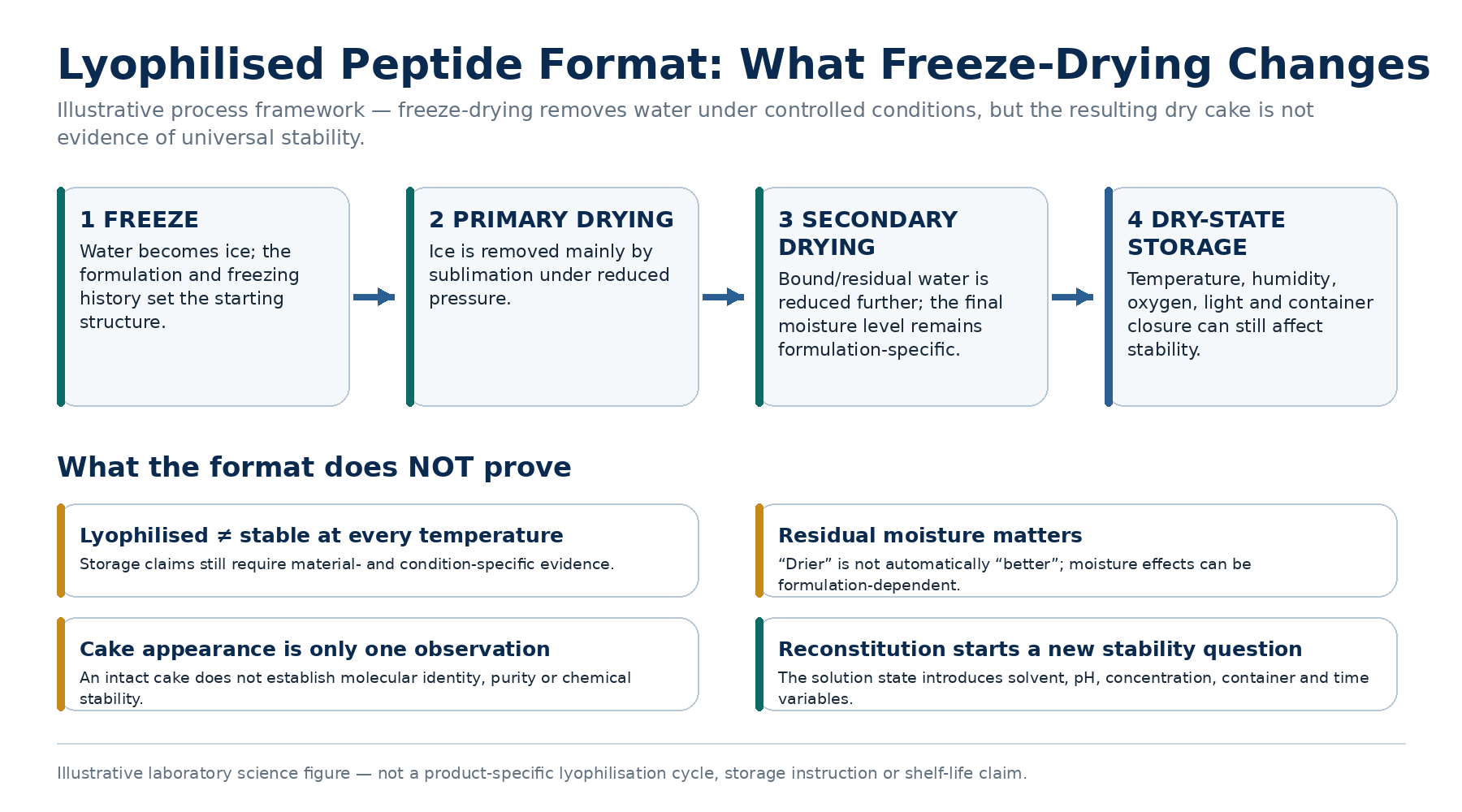
Illustrative technical framework only; not an Core Research batch record, analytical result, validated method or product-specific SOP.
Verified Experience Input
Core Research’s approved batch-review workflow treats physical appearance and storage/handling status as separate evidence attributes alongside product/batch matching, HPLC purity, MS identity, labelled amount/content, applicable water/moisture and counter-ion information, and document completeness. A lyophilised cake or a visually intact vial is not treated as proof of molecular identity, chromatographic purity or universal stability. If a meaningful mismatch remains unresolved, the batch is held for clarification and/or justified retesting. Analytical testing is produced by the manufacturer and/or third-party laboratories.
From Our Work: why a dry cake is not a release decision
In Core Research’s batch review, the physical form and appearance are read alongside the analytical and documentary record rather than used as a shortcut for it. A lyophilised cake may be the expected presentation, but a visually normal cake does not replace the product/batch match, HPLC profile, MS identity, labelled amount/content or applicable moisture and counter-ion information. Conversely, an unusual cake appearance is a review prompt, not proof of a particular degradation mechanism.
This separation matters because freeze-dried materials can still change in the solid state. Primary studies have reported peptide degradation in lyophilised material and have shown that humidity, residual water and solid-state mobility can alter chemical stability.[2–4] Therefore a batch decision should ask two different questions: “Is this the correct material with coherent analytical evidence?” and “Has the material been stored and handled under conditions supported for this exact product or formulation?”
Where a meaningful mismatch remains unresolved, the approved workflow is to hold the batch while clarification and/or a justified retest is requested. That is more defensible than assuming that “freeze-dried” automatically means intact or stable.
Why are peptides freeze-dried?
| Reason | What freeze-drying can change | Important limitation |
|---|---|---|
| Reduce liquid water | Removing bulk water can reduce hydrolytic opportunity and molecular mobility. | Dry-state reactions can still occur; the effect depends on formulation and residual moisture. |
| Improve handling and transport | A dry format can be easier to package and may be more tolerant of some handling conditions than an aqueous solution. | No universal room-temperature or transit-stability claim follows from the format alone. |
| Create a defined solid presentation | The cake can make batch appearance, container integrity and reconstitution behaviour observable. | Appearance does not establish identity, purity or peptide content. |
| Separate storage from solution preparation | The material can remain dry until the experiment requires a solution. | Once reconstituted, solvent, pH, concentration, container and time create a new stability question. |
What happens during freeze-drying?
Freezing
The formulation is cooled until ice forms and the solute-rich phase becomes increasingly concentrated. The freezing history can influence ice structure and the physical state of the remaining solids. This is one reason a production lyophilisation cycle is formulation-specific rather than a generic peptide recipe.
Primary drying
Under reduced pressure, ice is removed mainly by sublimation. Product temperature and chamber conditions must remain compatible with the physical properties of the frozen formulation. A collapsed or visibly altered cake can be a useful process observation, but a visually intact cake is still not an analytical identity or purity result.
Secondary drying
After most ice has been removed, secondary drying reduces additional sorbed or bound water. Residual moisture is not a trivial number: studies of freeze-dried polypeptide and protein systems show that water content can influence molecular mobility, degradation and aggregation, and that “the drier the better” is not a universal rule.[3–5]
Why does residual moisture matter?
Water can act both as a reactant and as a plasticiser that changes molecular mobility in a solid matrix. In a model asparagine-containing hexapeptide, increasing moisture accelerated deamidation in a lyophilised polymer matrix.[4] Work on freeze-dried human growth hormone likewise found that residual water and oxygen affected chemical decomposition and aggregation in a formulation-dependent way.[5] These studies support a general principle, not a product-specific threshold: moisture should be interpreted in the context of the exact formulation and stability data.
Does lyophilisation make every peptide more stable?
No. Lyophilisation is a formulation strategy, not a guarantee. Substance P, for example, has been shown to degrade in both lyophilised and aqueous states, with the salt form changing the observed stability pattern.[2] A separate tripeptide study found that lyophilisation, grinding, melting and high relative humidity altered chemical stability and crystallinity.[3] The correct conclusion is that solid-state stability is peptide- and formulation-specific.
How should a lyophilised peptide be assessed on receipt?
| Check | What it can tell you | What it cannot prove |
|---|---|---|
| Product and batch match | Whether the vial and documents refer to the intended material. | Molecular identity without analytical evidence. |
| Container and closure | Whether obvious damage, leakage or closure failure is present. | That storage conditions were continuously maintained. |
| Cake / powder appearance | Whether the presentation matches the expected physical description. | Purity, peptide content, counter-ion level or chemical stability. |
| CoA / analytical evidence | What the stated HPLC, MS and other batch methods actually measured. | Attributes outside those methods. |
| Storage record | Whether handling aligns with the documented condition. | A shelf life beyond the supporting evidence. |
For temperature selection, use the Peptide Storage Temperatures: Laboratory Decision Guide. For solution preparation, route to the Laboratory Reconstitution and Handling Hub and the Solvent Selection, Buffer Compatibility and pH guide.
What changes after reconstitution?
Reconstitution changes the physical environment. The material is now exposed to solvent or buffer, a defined pH and ionic strength, a particular concentration, a container surface and a time-at-temperature history. Solid-state storage evidence therefore should not be copied into the solution state unless the evidence explicitly covers that condition.
If the experiment will use multiple working portions, plan the sample history with Aliquoting and Freeze-Thaw Control for Research Peptides.
Frequently asked questions
Does lyophilised mean a peptide is stable at room temperature?
No. “Lyophilised” describes the physical format. Room-temperature stability requires evidence for the exact peptide, formulation, container and time period.
Does an intact freeze-dried cake prove the peptide is pure?
No. Appearance is a physical observation. HPLC purity, molecular identity and peptide content are separate analytical questions.
Is lower residual moisture always better?
No universal rule applies. Residual water can affect stability, but overly simple “drier is better” assumptions are not supported across all freeze-dried systems.
Can unopened lyophilised storage instructions be used after reconstitution?
Not automatically. Solution-state stability depends on additional variables such as solvent or buffer, pH, concentration, container and freeze-thaw history.
Is lyophilisation the same as sterilisation?
No. Freeze-drying is a dehydration process. Sterility is a separate attribute and should only be claimed where the product documentation explicitly supports it.
Does this guide give a freeze-drying cycle for peptides?
No. Production lyophilisation cycles are formulation- and equipment-specific. This guide explains the scientific format and evidence boundaries only.
Key takeaway
Lyophilisation can reduce water-driven instability and create a practical dry format, but it does not collapse all quality questions into one label. Treat the dry presentation, residual moisture, analytical identity/purity, storage condition and post-reconstitution stability as separate evidence attributes.
References
- ICH Q1A(R2): Stability Testing of New Drug Substances and Products. FDA-hosted ICH guidance. Used only for the principle that storage and shelf-life claims require condition-specific stability data; it is not presented as an RUO regulatory requirement. Accessed 14 August 2026.
- Spontaneous chemical degradation of substance P in the solid phase and in solution. Primary peptide stability study, PMID 7681812. Used to show that a peptide can degrade in both lyophilised and solution states and that salt form can change stability behaviour.
- Some physicochemical properties of FK906: glass transition and relaxation. Primary tripeptide study, PMID 7757458. Used for effects of lyophilisation, humidity and solid-state physical properties on stability.
- Chemical stability of peptides in polymers. 2. Discriminating between solvent and plasticizing effects of water on peptide deamidation. Primary model-peptide study, PMID 10514359. Used for the effect of water/plasticisation on deamidation in lyophilised matrices.
- Formulation and stability of freeze-dried proteins: effects of moisture and oxygen on human growth hormone. Primary polypeptide/protein study, PMID 1592171. Used narrowly for the principle that residual moisture and oxygen can influence dry-state degradation in a formulation-dependent way.