How to Verify a Pre-Filled Research Peptide Pen
How to Verify a Pre-Filled Research Peptide Pen
RESEARCH USE ONLY
This guide concerns controlled laboratory handling, evidence review and device evaluation. It does not provide human or veterinary administration, dosing, injection, treatment or personal-use instructions.
How should a pre-filled research peptide pen be verified?
Verify a pre-filled research peptide pen as a finished evidence set, not as a bulk peptide plus a device shell. First match the exact product and batch across the label and analytical records. Then separate the peptide evidence from the finished-format attributes: cartridge or container, stated vehicle or formulation information, nominal content, storage, packaging/closure condition and device specifications. If a meaningful mismatch cannot be resolved, the correct outcome is clarification or a hold — not an assumption.
A high HPLC area percentage or a matching MS result can support the analytical question each method was designed to answer, but neither result automatically establishes the contents or performance of the finished cartridge. Finished-format claims need evidence at the level where the claim is made.
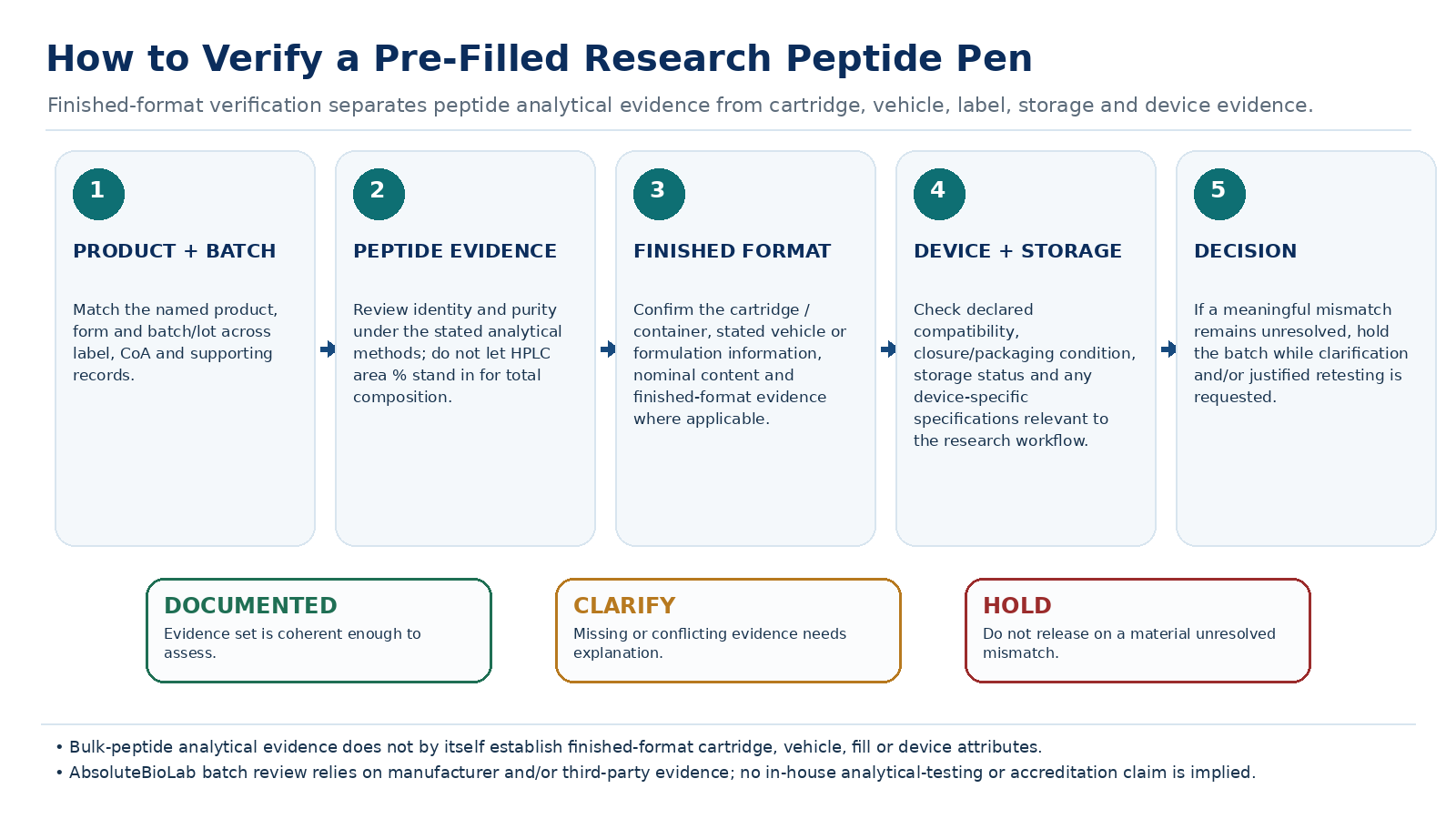
From Our Work: the batch decision is based on an evidence set
Core Research reviews batch evidence as a connected set rather than accepting one headline number in isolation. The approved review set can include product and batch match, HPLC purity, MS identity, appearance, labelled amount or content, applicable water or moisture and counter-ion information, document completeness, and storage or handling status. The analytical testing itself is produced by the manufacturer and/or third-party laboratories; Core Research reviews that evidence. When a meaningful mismatch is identified, the batch is held while clarification and/or a justified retest is requested. This workflow does not imply in-house analytical testing or any laboratory accreditation claim.
For a pen-format product, that same evidence discipline prevents a common shortcut: treating a bulk analytical result as if it also described the cartridge and device. The page therefore separates what the peptide test supports from what must be documented about the finished format.
What should be matched across the records?
| Check | What to look for | Why it matters |
|---|---|---|
| Product + batch identity | Same product/form and batch or lot across label, CoA and supporting documents | Prevents analytical evidence from being attached to the wrong finished item. |
| Peptide analytical evidence | HPLC/MS or other stated tests, method identification and results | Supports the tested material attributes only within the stated method. |
| Finished-format / cartridge | Cartridge or container identity, nominal content/fill, vehicle information where relevant | Separates bulk material evidence from the attributes of the filled format. |
| Label / expiry / storage | Labelled amount/content, storage conditions and applicable dating information | Connects the physical item to its documented state and handling requirements. |
| Device specification | Declared compatible device, cartridge/needle interface and any claimed graduation characteristics | Avoids assuming that physical fit equals documented compatibility or measured performance. |
| Packaging / closure | Condition of the packaging, cartridge/closure and any documented sterile status where applicable | A packaging observation can reveal damage, but appearance alone cannot prove sterility or closure performance. |
Why must HPLC and MS be kept separate from finished-format checks?
ICH Q2(R2) and Q14 emphasise that analytical procedures are interpreted according to their intended purpose and validated performance. In practical terms, an HPLC purity result is not a universal description of everything in the cartridge, and an MS identity result does not establish fill volume, vehicle, closure integrity or dispensing repeatability. Those are different measurands or product attributes and require different evidence.
What does “finished-format evidence” mean?
Finished-format evidence is any record that actually describes the product in the state being supplied — for example, a batch record that identifies the cartridge/finished item, a declared vehicle or formulation record, a nominal content or fill statement, container or closure information, and device-related verification where a device claim is material. ISO 11608-3 is written for medical needle-based systems, not RUO products, but its separation of container and integrated-fluid-path verification illustrates the engineering point: the container system is its own object of verification.
What are red flags that require clarification?
- The label batch does not match the analytical report.
- The report identifies bulk material but nothing links it to the finished cartridge or fill.
- The stated vehicle, carrier or nominal content is missing where it is material to the product description.
- A device precision/repeatability claim is stated with no method, reference or measurement record.
- A sterility claim is present but there is no applicable documentation supporting the claim.
- Storage instructions conflict between the label, product page and batch documentation.
- A document has been cropped, altered, or stripped of identifiers needed to connect it to the item.
What should happen when evidence is incomplete?
Treat an incomplete or conflicting evidence set as a clarification problem. Do not fill the gap with a generic assumption based on another product, another format or a headline purity number. If the missing point is material to acceptance, hold the batch while the relevant manufacturer or testing party provides clarification and/or an appropriate retest. The re-review should use the complete evidence set, not only the replacement document.
Frequently asked questions
Is a bulk-peptide CoA enough to verify a pre-filled pen?
No. It can support the tested bulk-material attributes, but a finished pen also has cartridge, fill/nominal content, possible vehicle, closure, label, storage and device attributes that may require separate evidence.
Does 99% HPLC purity prove what is in the cartridge?
No. HPLC area purity under a stated method does not by itself establish molecular identity, absolute peptide content, vehicle composition, fill volume, sterility or device performance.
Does an intact package prove sterility?
No. An intact sterile barrier is relevant when a product is actually documented and labelled as sterile, but packaging appearance alone does not prove initial sterility or validate a sterility claim.
What if the pen and CoA have different batch numbers?
That is a material traceability mismatch. The evidence should not be treated as belonging to the finished item until the relationship is resolved and documented.
Can Core Research’s review be described as in-house laboratory testing?
No. The approved workflow is evidence review. Analytical testing is produced by the manufacturer and/or third-party laboratories unless a separately verified fact says otherwise.
Key takeaway
Verify a pre-filled peptide pen at the finished-format level. Match the exact product and batch, separate peptide analytical evidence from cartridge/device attributes, and treat unresolved mismatches as a hold-and-clarify problem rather than inferring the missing evidence.
See the Peptide Pens catalogue, CoA portal, supplier verification, vials versus pen formats, cartridge capacity and repeatability, and reusable-device workflow.